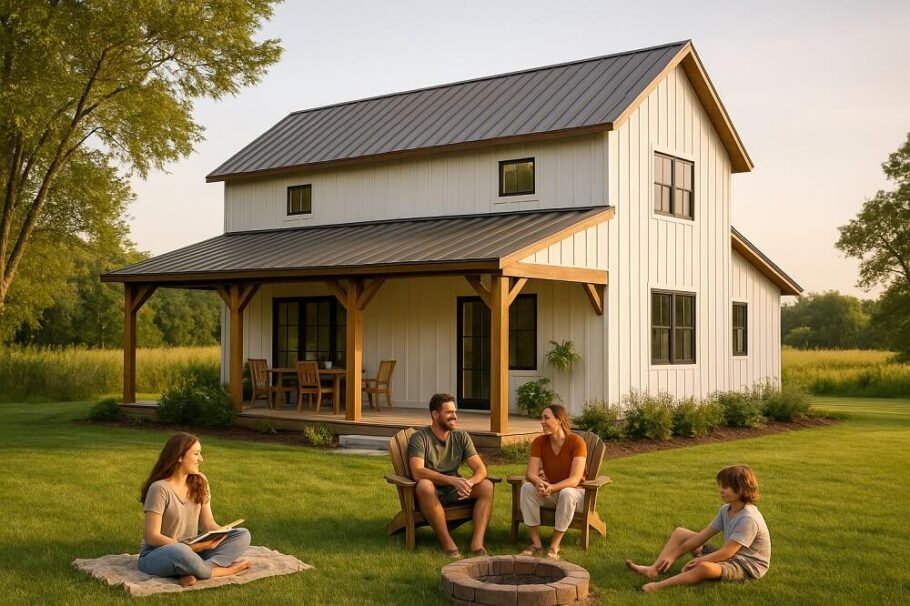
You’ve scrolled past them a thousand times on Pinterest. You might have even stopped your truck on a country highway to stare at one. The barndominium—or “barndo”—is the undisputed rockstar of modern rural architecture. It promises the wide-open space of a Quonset hut or post-frame building with the finish-out of a high-end custom home. You get the shop for your toys and the great room for your family, all under one massive, energy-efficient metal roof.
But here is where the fairy tale often hits a pothole. You call up your insurance agent, the one who has your sedan and your starter home on file, and you say, “I need to insure my new place.” After a long pause, they ask, “So, is it a farm, a business, or a house?”
That question is the million-dollar dilemma. Getting a barndominium insured isn’t as simple as checking a box on a standard homeowners application. If you do it wrong, you could be left with a structure that isn’t valued correctly or, worse, a claim denial when disaster strikes. Let’s break down exactly how to navigate this process so you can protect your investment without losing your mind.
Step 1: Forget Everything You Know About “Regular” Home Insurance
The first hurdle is psychological. You have to stop thinking of your barndo as a house that happens to be made of metal, and start thinking of it as a commercial or agricultural structure that happens to have a kitchen and a bedroom.
Standard homeowners insurance policies (HO-3 policies) are designed for stick-built homes with wood framing, drywall, and shingle roofs. They assume a certain level of risk, construction cost, and replacement methodology. When you present them with a steel frame, concrete slabs, and 20-foot ceilings, their computer systems often spit out an error.
Insurers look at risk factors differently. For example, while wood burns, steel can buckle under extreme heat. While vinyl siding is cheap to replace, a specialized metal panel might require a custom paint match from a specific manufacturer. The “dwelling” coverage on a standard policy simply isn’t calibrated for these variables.
Step 2: The Big Debate: Dwelling, Farm, or Commercial?
This is the core of the challenge. Your insurer will need to classify the risk, and that classification depends entirely on how you use the space.
- The Residential Mix: If your barndo is 60% living space and 40% shop, and the shop is strictly for storing personal vehicles and lawnmowers, you are squarely in the “dwelling” category. You just need a specialized carrier who writes high-value or custom home policies. They will look at the square footage of the living area to determine replacement cost, just like a normal house.
- The “Hobby” Farm: Do you have a few horses in the back pasture or a dozen chickens? You’ve just crossed into “farm property” territory. You may need a farm and ranch policy that covers the dwelling but also provides liability for the livestock or the fence.
- The Side Hustle: Here is where it gets tricky. Do you weld in that shop on weekends? Restore classic cars for profit? Store business inventory? The moment commerce enters the building, the personal lines insurance market usually slams the door. You likely need a commercial property policy for the shop area and a personal policy for the living quarters, or a blended policy that allows for “incidental business occupancy.”
Expert Tip: Be brutally honest with your agent about your usage. If you fib and say it’s just storage, and a client slips on an oil stain in your “hobby” shop, the insurance company may deny the liability claim, arguing you were operating an uninsured business.
Step 3: Navigating the “Replacement Cost” Minefield
One of the biggest mistakes barndo owners make is undervaluing their property. When you build a barndominium, the cost per square foot can be significantly lower than a traditional home, especially if you act as your own general contractor or do some of the finish work yourself.
However, replacement cost is not what you paid to build it.
Replacement cost is what it would cost to rebuild it today if it burned to the ground. This includes:
- Demolition and debris removal of twisted steel.
- The current market price for lumber, steel, and concrete (which fluctuates wildly).
- The cost to bring in specialized contractors who know how to work with post-frame construction, not just drywall hangers.
If you insure it for the $150 per square foot it cost you to build in 2020, but it costs $250 per square foot to rebuild in 2024, you are drastically underinsured. This is called “coinsurance,” and it can leave you holding the bag for a massive portion of the rebuild cost.
You need an agent who will run a “replacement cost estimator” specifically designed for non-standard construction. They may need to input details like “R-38 insulation in ceiling,” “standing seam metal roof,” and “concrete floors with radiant heat” to get an accurate number.
Step 4: The Liability Loophole
Liability is another area where barndos get sticky. If you have a massive shop with an apartment above it, the liability exposure is different than a standard suburban home.
Consider the “attractive nuisance.” A traditional home might have a swimming pool. Your barndo might have a tractor, a dirt bike track in the backyard, or a pond. You need to ensure your liability limits are high enough—usually a $500,000 or $1 million umbrella policy is a wise investment on top of your base policy.
Furthermore, if you have people over to watch the game in your “man cave” shop, and someone gets hurt near your industrial tools, the liability coverage needs to respond. A standard homeowners policy might try to exclude injuries related to “farm machinery” or “business pursuits,” so you need a policy that acknowledges the hybrid nature of the space.
Step 5: Finding “The One” (Your Insurance Agent)
You cannot do this with a faceless online quote generator. You need a real human being—specifically, an independent insurance agent who specializes in rural or high-value properties.
- Captive Agents (like State Farm or Allstate) are great for standard cars and homes, but they have a limited toolbox. If their one company won’t write your barndo, you’re out of luck.
- Independent Agents have contracts with multiple insurance companies. They can shop your unique risk to several “excess and surplus” lines carriers or specialty insurers who actually understand agricultural and post-frame construction.
When you sit down with them, bring your construction plans. Be ready to discuss the square footage breakdown between living and shop space. Talk about the heating source (radiant floor heat is common in barndos and is viewed differently than baseboard heat). Discuss security—these buildings are often in remote areas, so a good security system and fire suppression (like a sprinkler system in the shop) can actually lower your premiums.
Step 6: Don’t Forget the “Umbrella” (Literally)
Once you get the primary policy squared away, ask about an umbrella liability policy. Because barndominiums often sit on larger plots of land, the risk of someone getting hurt on your property—whether it’s a delivery driver slipping on ice or a friend getting a splinter from a workbench—is statistically higher. An umbrella policy kicks in after your standard liability runs out, protecting your assets (and the barndo itself) from a major lawsuit.
The Bottom Line
Getting a barndominium insured is a rite of passage. It’s the moment you realize you’re not just building a house; you’re engineering a lifestyle. The process requires patience, transparency, and a willingness to look beyond the standard insurance marketplace.
Don’t let the insurance headache deter you. The goal is to find coverage that recognizes the beauty of your investment—the seamless blend of function and form. Once you have that policy in hand, with the right replacement cost and solid liability coverage, you can finally sit back in your great room, look out at your shop, and enjoy the quiet satisfaction of knowing you—and your barndo—are fully protected.