
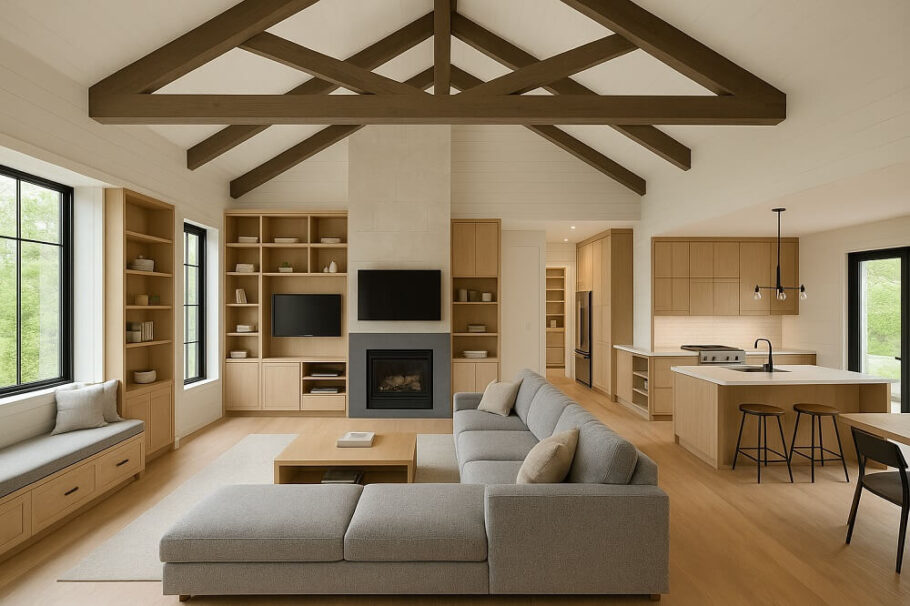
Let’s be honest: when most of us first fall in love with the idea of a barndominium, we aren’t dreaming about the engineering. We’re dreaming about the open space. That massive great room with the vaulted ceilings. The kitchen that flows into the dining area without a single post to bump into. The ability to park a truck and an RV inside the same structure where you’ll later watch a movie.
That wide-open, industrial-chic aesthetic is the entire appeal of the barndo lifestyle. But here is the reality that every owner needs to understand before the concrete is even poured: that openness is only possible because of a silent, invisible hero. I’m talking about the horizontal supports.
If you want your barndominium to stand for fifty years instead of five, you need to understand why these beams, purlins, and girts are non-negotiable. This isn’t just a technicality for the engineers; it’s the difference between a forever home and a very expensive repair bill.
The Skeleton Analogy (And Why It Matters)
Think of your barndominium like a human body. The vertical posts—the columns embedded in the concrete—are the legs. They hold everything up against gravity. But if a human body was just legs and a skull, it would collapse the moment the wind blew. You need a spine and ribs to hold everything in place.
In a post-frame building (which is the technical term for what most barndos are), the horizontal supports are the ribs and spine. They serve two primary functions that work together: bracing and transferring loads.
When the wind slams into the side of your building, it doesn’t just politely stop. That energy has to go somewhere. If you only have vertical posts, the wind will push those posts over like dominoes. The horizontal members catch that force and transfer it horizontally across the building, distributing the stress to the ground and the end walls. Without them, your barndo is just a sail waiting to catch the wrong breeze.
Fighting the “Kick-Out” (Wall Spread)
One of the most critical jobs of horizontal supports—specifically the ceiling joists or the tie beams—is to prevent “wall spread.”
Imagine your barndominium roof. It’s heavy. It’s sitting on top of those beautiful tall sidewalls. Gravity is pulling the roof down, but because the roof is pitched (angled), it also wants to push outward. It’s like standing on a slippery floor with your feet wide apart; your natural instinct is to slide outward.
If you don’t tie those two sidewalls together at the top, the weight of the roof will slowly, or not so slowly, push the tops of the walls outward. This is called “racking.” When the walls rack, several things happen:
- Doors and windows stop working. That custom sliding barn door you paid a fortune for? It won’t slide anymore because the frame is now a parallelogram instead of a rectangle.
- The roof sags. Eventually, the ridge of the roof will dip.
- Cracks appear. Drywall (if you have it) will crack at the corners.
The horizontal ceiling joists or the bottom chord of your roof trusses act like a handrail. They grab the top of one wall, stretch across the void, and grab the other wall, saying, “You can’t move apart. I’m holding you together.”
Supporting the Mezzanine or Loft
This is where the “barndominium” part gets specific. Unlike a standard garage or a plain barn, a barndo usually has living space. And often, that living space involves a loft, a bedroom upstairs, or a mezzanine office.
Those floors don’t float in mid-air. They are horizontal platforms. The beams that support the loft floor are arguably the most important horizontal members in the entire build because they are carrying live loads (people, furniture, dancing).
But here is the engineering secret: those loft floor joists don’t just carry the weight down; they also act as a massive horizontal diaphragm. They tie the sidewalls together at a midpoint, not just at the roof. This drastically reduces the “unsupported span” of your vertical posts. By breaking the wall height into two smaller sections (from floor to loft, and loft to ceiling), you create a wall that is exponentially stronger against buckling.
If you are planning a barndominium with a second story, the installation of those horizontal floor trusses must be meticulous. If they aren’t specced correctly for the load, you won’t just have a bouncy floor; you could have a structural failure. The beam has to be deep enough and strong enough to span the width of the building without sagging in the middle.
The Role of Purlins and Girts
Let’s get down to the nitty-gritty of the metal skin. When you look at a barndominium from the outside, you see the metal panels. But what are they screwed into?
On the roof, you have purlins. These are horizontal members that run perpendicular to the rafters or trusses. The metal roof attaches to these.
On the walls, you have girts. These are the horizontal members running between the vertical posts that the metal siding attaches to.
You might think these are just convenient nailers (or screw-ers), but they serve a massive structural purpose. They shorten the span of the vertical columns. A 20-foot tall 6×6 post is relatively easy to bend in the middle if you push on it. But if you bolt horizontal girts to it every 4 feet up the height, you create a composite structure. It becomes incredibly difficult to bend that post because the girts are holding it in place. They turn a collection of independent poles into a unified wall system.
If an engineer skimps on the size or spacing of girts to save money, you risk “oil-canning” (wavy metal) or, worse, the metal ripping off the screws during a wind event.
Resisting Uplift (The Bernoulli Effect)
This is a concept many people overlook. In a windstorm, air moves faster over the top of a roof than underneath it. This creates lift—the same aerodynamic principle that allows airplanes to take off. A barndominium with a light-weight metal roof is essentially an airplane trying to take off in a storm.
The horizontal supports are the anchors that prevent this. The roof purlins transfer the uplift force from the metal sheets to the trusses. The trusses then transfer that force down through the walls. However, the ceiling joists (horizontal) play a role here by tying the interior walls together, ensuring the whole “box” stays seated on the foundation.
Without a properly engineered horizontal system tying the roof to the walls, a strong gust can literally rip the roof off the structure, leaving the walls standing but exposing the interior to total destruction. This is known as the “Derecho” or tornado risk, and it’s a primary reason agricultural buildings fail—because corners were cut on the horizontal bracing.
The Problem with “Open Concept” Obsession
I work with a lot of DIY owners who look at the engineer’s plans and say, “Can we delete that beam? It’s in the way of where I want to put the pool table.”
This is dangerous territory. The desire for an open-concept floor plan is the enemy of structural simplicity. Every time you want a massive opening—a 16-foot wide sliding glass door, or a 14-foot overhead garage door—you are removing a section of wall. That wall was a structural element. When you take it out, you have to put that structure back in elsewhere.
This is why we use headers. A header is a horizontal beam that spans the top of a door or window. It collects all the load from the roof and walls above that opening and redirects it sideways to the jack studs or columns on either side.
If you want a wall of glass to look at your sunset view, you need a massive engineered horizontal header (often a laminated veneer lumber (LVL) or steel I-beam) to carry the load. Skimping on this horizontal member is the fastest way to end up with a sagging roof line and a door that won’t close.
Real-World Consequences of Neglect
I’ve been on properties where the “builder” (and I use that term loosely) decided that horizontal bracing wasn’t necessary because the metal was screwed directly to the posts. The result was a building that “walked.” Over time, due to wind pressure and the expansion and contraction of the metal, the entire building shifted on its foundation. The posts were still vertical, but the building was twisted like a rhombus.
In another case, an owner removed a horizontal beam in their shop area to fit in a larger RV. They didn’t install a proper header or support column because they didn’t want to block the space. Within a year, the ceiling developed a noticeable sag, and the concrete slab actually cracked where the weight re-distributed.
The cost to fix that—to install a temporary wall, jack the roof back up, and weld in a steel beam—was four times what it would have cost to do it right the first time. It also ruined the aesthetics of their interior, forcing them to have a support column right where they didn’t want one anyway.
Practical Advice for the Owner-Builder
If you are in the planning stages of your barndominium, here is what you need to ask your builder or structural engineer regarding horizontal supports:
- Ask about “diaphragm action.” How is the building transferring lateral (sideways) loads? Is it relying on the metal skin (which requires very specific screw patterns) or on X-bracing and solid blocking?
- Check the span tables. If you are building a loft, don’t guess on the floor joists. A 2×6 might be fine for a closet, but a 2×12 or engineered I-joist might be required for a 24-foot clear span living room.
- Don’t let the framers skip the “blocking.” Blocking refers to short, solid horizontal pieces nailed between studs or joists. It looks like a nuisance, but it prevents the joists from twisting over time and provides fire blocking inside the walls.
- Consider “moment frames” for big openings. If you want a massive garage door opening on a sidewall, a standard post-and-beam connection might not be enough. You may need a moment frame—a rigid connection between the horizontal header and the vertical columns that can resist the bending forces without a diagonal brace.
Conclusion
Your barndominium is more than just a place to park toys and hang a TV. It is a structure engaged in a constant, silent battle against gravity, wind, and time. The vertical posts may get all the glory for holding up the roof, but the horizontal supports—the joists, the purlins, the girts, and the headers—are the unsung heroes that keep everything square, stable, and standing.
When you look at your wide-open floor plan, remember that it is the result of careful engineering hidden in the walls and above the ceiling. Respect those lines. Don’t cut them. Don’t move them without a professional. They are the difference between a dream home and a structural nightmare.