
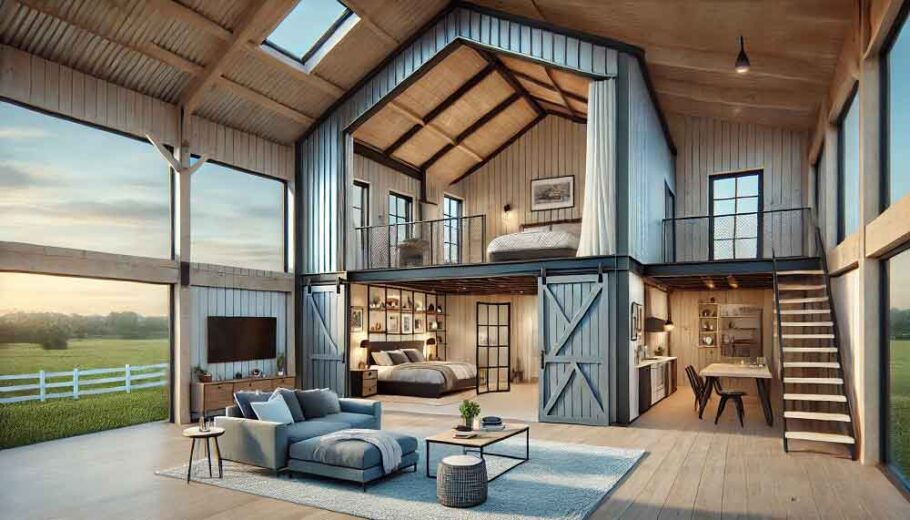
If you’ve spent any time scrolling through real estate apps or home renovation blogs over the last five years, you’ve seen them: the gleaming metal roofs, the expansive glass walls, and the cavernous, open interiors that feel part agricultural workshop, part Soho loft. We call them Barndominiums.
For the uninitiated, the term often conjures images of a red metal shed converted into a rustic hunting lodge. But we’ve moved far beyond that. We are currently witnessing the maturation of the barndominium into a serious architectural statement. At the heart of this evolution is a principle that architects and designers are embracing with gusto: Structural Expressionism.
Today, I want to talk about what happens when we stop trying to hide the bones of a building and start celebrating them. This is the era of the naked steel frame, the exposed column, and the purlin that pulls double duty as art.
The Anatomy of Honesty
To understand Structural Expressionism, we have to look at how we traditionally build homes. For the past century, residential construction has been obsessed with hiding the process. We frame with dimensional lumber, sheathe it in OSB, wrap it in house wrap, and then clad it in brick, vinyl, or stucco. By the time the drywall goes up, you have absolutely no idea how the house is standing. The structure is a secret.
The barndominium, particularly the post-frame or rigid-frame steel building, inherently resists this secrecy.
When you erect a clear-span steel frame, you are creating a skeleton of immense strength. In traditional residential design, we might look at that steel I-beam and immediately box it in with drywall to create a “normal” looking room. But in the Structural Expressionist approach, we ask a different question: What if that beam is the room?
Structural Expressionism in barndominium design is the philosophy of revealing and emphasizing the load-bearing elements. The columns, rafters, purlins, and girts aren’t just functional necessities; they are the defining aesthetic features. They dictate the rhythm of the space, the perception of volume, and the visual weight of the home.
The Visual Vocabulary of Steel
So, what does this look like in practice? It starts with the frame.
Imagine walking into a great room. The ceiling soars twenty-five feet high. Crossing that void is a series of massive steel rafters, perhaps painted a matte black or left with the raw, industrial texture of mill scale, protected only by a clear sealant. These aren’t delicate crown moldings; they are bold, graphic lines that draw your eye across the length of the space.
The columns that support these rafters stand proudly in the corners of the living area, or sometimes right in the middle of the open floor plan, defining zones without the need for walls. A dining area might be nestled between two steel columns, the columns themselves acting as a modern-day equivalent of a colonnade.
Then, there are the purlins—the horizontal members that run between the rafters to support the roof deck. In a typical home, these are buried in the attic. In an expressive barndominium, they are often left exposed, creating a stunning visual texture on the ceiling. When combined with spray foam insulation on the roof deck, these purlins become a grid of shadow and light that adds depth and complexity to the interior volume.
Why We Love the “Blunt” Aesthetic
There is a psychological component to this design style that I find fascinating. In a world that is increasingly digital, virtual, and ephemeral, there is a deep human craving for the tangible, the authentic, and the permanent.
Structural Expressionism scratches that itch.
When you look at a raw steel column, you understand its purpose immediately. You see the welds, the bolt connections, the sheer mass of the material. There is no deception. It doesn’t pretend to be a Greek column wrapped in plaster. It is what it is: a piece of high-strength steel holding up a ton of weight.
This honesty is incredibly grounding. It brings a sense of stability and security that is different from the cozy warmth of a stud-framed cottage. It’s a fortress mentality, but refined.
This isn’t about living in a cold, unfinished warehouse. The magic happens in the contrast. You pair the expressive, industrial steel with warm elements that soften the blow. Think wide-plank white oak flooring running up to the base of a raw steel column. Imagine a plush, velvet sectional sitting beneath a cantilevered steel mezzanine. The steel provides the structure and the visual tension; the interior design provides the comfort and the warmth. The two are in a beautiful, necessary dialogue.
The Function of Form
Beyond the pure aesthetics, Structural Expressionism offers tangible functional benefits in a barndominium.
First and foremost is the clear-span capability. By expressing the structure, we are acknowledging that we don’t need interior load-bearing walls. This allows for incredible flexibility in the floor plan. You can park an RV in the living room today (if that’s your thing) and build a full wall to create two bedrooms next year. The structure doesn’t care. It’s all hanging from that exposed frame.
Second, it solves the “big box” problem. One of the criticisms of large, open barndominiums is that they can feel like a gymnasium—a vast, empty space with no character. The exposed structural elements break up that volume. They create visual interest at the upper levels. Your eye is constantly traveling along the beams, exploring the connections, and appreciating the engineering. The structure itself becomes the coffering, the tray ceiling, and the molding.
Third, it streamlines maintenance and modifications. Need to run a new electrical line for a pendant light? In a traditionally finished home, you’re cutting drywall and patching. In an expressive barndominium, you might be able to run conduit along the base of a purlin or drop a line directly through a column’s access point. It’s an industrial approach to a residential problem—functional, accessible, and intentionally visible.
The Material Palette: Beyond the Grey
When we talk about Structural Expressionism, the conversation inevitably turns to color and finish.
While the raw steel look is iconic, it is not the only option. The choice of finish on the expressed structure dramatically alters the mood of the space.
- Galvanized or Mill Finish: This is for the purists. It embraces the industrial roots completely. It reflects light in a unique way and acts as a neutral backdrop, allowing colors and textures in furniture and art to pop.
- Matte Black or Charcoal: This is the modern farmhouse-industrial crossover. A black steel frame recedes visually, making it appear sharper and more graphic. It emphasizes the lines and angles of the design, creating a sophisticated, almost ink-drawing quality against white walls or light wood.
- White or Light Grey: This approach lightens the visual load. It maintains the texture and rhythm of the expressed structure but makes the space feel airier and more akin to a traditional Scandinavian or minimalist aesthetic. The steel becomes subtle detailing rather than a bold statement.
- Bare Wood (for Glulam Beams): Not all expressive barndominiums are steel. Glue-laminated timber (Glulam) beams are also rising in popularity. Expressing Glulam structure brings the warmth of wood into the volume of the roof, creating a lodge-like feel that is still structurally robust and expressive.
Is It for You?
Structural Expressionism is not a passive design choice. It is assertive. It demands that you appreciate the beauty of utility.
If you love ornate moldings, soft pastels, and rooms that feel like they are wrapped in a cozy blanket, this might feel too harsh. But if you have ever stood in a train station and marveled at the ironwork, or visited a modern art museum and spent as much time looking at the building as the art inside, this is a style worth exploring.
It requires a different kind of finish work. You don’t need a master plasterer, but you do need a skilled steel erector who understands that his welds are going to be on display. The craftsmanship has to be impeccable because there is nowhere to hide.
In an era where architecture often feels disposable, building a home that exposes its skeleton is a commitment to permanence. It is a declaration that the strength of your home is not a secret to be kept, but a feature to be celebrated.
The barndominium, through the lens of Structural Expressionism, is no longer just a cheap alternative to stick-frame construction. It is a legitimate architectural genre that values honesty, volume, and the raw beauty of the materials that hold us up. It’s not just a place to live; it’s a place that shows you exactly how it works, and that transparency is a beautiful thing.