
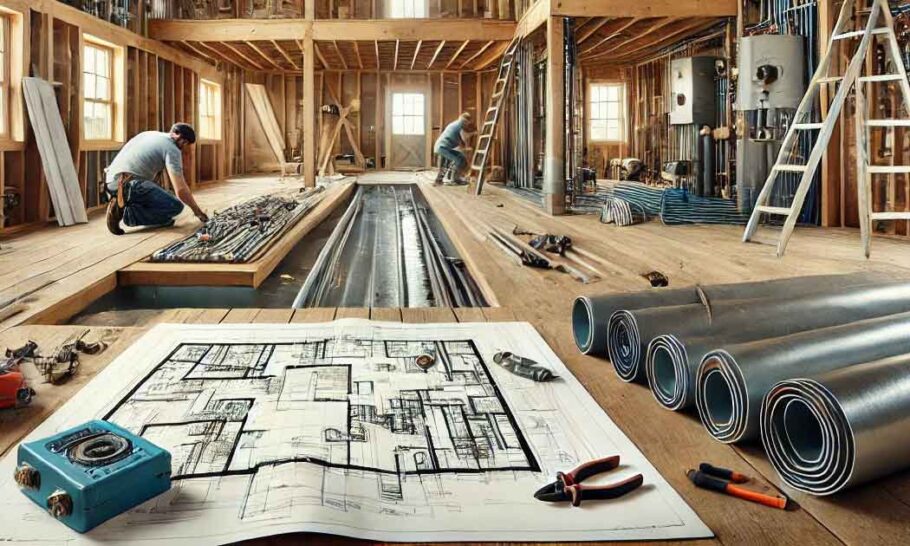
The barndominium craze isn’t slowing down. These steel-framed hybrids offer wide-open spaces, lower construction costs per square foot, and that rural aesthetic so many homeowners want. But here’s something most glossy magazine spreads won’t show you: the plumbing headaches. Running water supply lines and drains through a metal building presents a completely different set of problems than traditional stick-frame construction. And ignoring those differences leads to frozen pipes, slab leaks, and repair bills that wipe out any savings from the build.
The Thermal Bridging Problem Nobody Talks About
Metal conducts heat. That seems obvious, but the implications for plumbing run deep. In a wood-framed house, studs have some insulating value and don’t readily transfer cold from outside to inside. Steel does the opposite. Every pipe bracket, every hanger, every point where plumbing touches the metal structure becomes a thermal bridge. On a cold night, that bracket drops to near-outdoor temperature and sucks heat right out of the pipe.
The real trouble starts when pipes run inside exterior walls. In standard construction, those walls have insulation and the pipes stay reasonably warm. In a barndominium, the metal siding sits on girts (horizontal framing members), and the cavity depth often measures just three or four inches. Squeeze insulation in there, plus a water line, and that pipe sits dangerously close to the cold steel. One hard freeze and the line splits.
The solution isn’t complicated, but it requires planning from day one. Keep all plumbing out of exterior walls. Every supply line, every drain, every vent belongs in interior partition walls or in conditioned crawl spaces. When a pipe must cross an exterior condition, wrap it with continuous closed-cell foam insulation and use plastic hangers with thermal breaks. Some builders run pipes through conduit embedded in the slab just to keep them away from those cold walls.
Condensation and the Dripping Ceiling Problem
Metal buildings breathe differently. When warm, humid air hits a cold metal surface, water condenses. That happens on the underside of steel roofing panels all the time. But it also happens on cold water supply lines running through the ceiling cavity. In a wood house, the pipe sweats a bit and the surrounding wood absorbs the moisture. In a metal building, that condensation drips directly onto the ceiling finish, onto insulation, or onto the steel purlins where it runs down to find a low spot.
The ceiling cavity in most barndominiums is also the roof structure. There’s no attic in the traditional sense. Spray foam insulation on the underside of the roof deck solves part of this problem by keeping the entire assembly warm. But not every barndo gets spray foam. Many use fiberglass batts between the purlins, leaving the metal exposed above the insulation. In that scenario, cold water lines running through the same cavity sweat constantly during humid weather.
Drip loops and condensation pans belong in commercial buildings, not houses. The better approach involves keeping cold water lines out of unconditioned ceiling spaces entirely. Run them through interior walls or under the slab. If they must go overhead, wrap them with closed-cell insulation and install a continuous vapor barrier above the finished ceiling. Some builders take it further and add a second layer of insulation below the pipes to create a thermal break between the line and the living space below.
Venting Through a Metal Roof
Plumbing vents need to exit through the roof. On a standard house, that means cutting a hole, flashing it with rubber or lead, and calling it done. On a corrugated metal roof, the flashing detail gets more complicated. The ribs and valleys create uneven surfaces where standard boots don’t seal. And metal roofs expand and contract significantly with temperature changes, which pulls at flashings and breaks seals over time.
The common fix involves using specialized metal roof flashing boots with flexible rubber bases that conform to the ribbed profile. These work reasonably well, but they still fail faster than on a shingle roof. A more permanent solution eliminates roof penetrations altogether. One approach runs the vent horizontally through a gable wall instead of the roof. Another uses an air admittance valve (AAV) inside the building, though local codes don’t always permit these for main stacks.
For those stuck with roof penetrations, the key lies in oversizing the flashing and using high-grade silicone or polyurethane sealant rather than cheap latex. Also worth noting: locate vents away from valleys where water flows heavily and away from snow slides. A vent pipe makes a great lever for a sheet of sliding snow to rip the flashing right off the roof.
Grounding and Electrical Complications
Here’s a weird one that surprises a lot of people. Metal buildings require grounding of the entire structure. Plumbing pipes, especially copper lines, can become part of the electrical path if they contact the framing or if someone bonds them improperly. In a wood house, copper pipes rarely touch anything conductive except at the water heater. In a steel building, every pipe hanger, every strap, every accidental contact point creates a potential path to ground.
The danger shows up when a electrical fault occurs. Current seeks the path of least resistance to earth. If copper water lines contact the steel frame, and the frame has a proper ground rod, the pipes become a conductor. Someone touching a faucet could get shocked. Worse, stray current accelerates corrosion in copper pipes, leading to pinhole leaks within a few years rather than a few decades.
Dielectric unions at the water heater help isolate the piping system from the steel structure. Plastic pipe hangers and supports prevent contact points along the runs. And for those using PEX instead of copper, most of this problem disappears automatically. PEX doesn’t conduct electricity, so the only metal in the system exists at fixtures and short stub-outs. That’s one reason PEX has become nearly universal in barndominium construction.
The Slab and Under-Slab Plumbing Challenge
Most barndominiums sit on concrete slabs. That means all the under-slab rough plumbing goes in before the concrete pours. In a standard house, that’s straightforward. In a barndominium, the steel columns and their footings interrupt the layout. Those columns sit on concrete piers that go below the frost line, and the slab pours around them. Plumbing lines have to weave between these pier locations, which often forces longer runs and additional fittings.
Every fitting under a slab represents a future failure point. More fittings mean more risk. The smart move involves laying out the plumbing rough-in before marking column locations, then adjusting column positions slightly if needed to avoid conflicts. But the steel building package usually arrives with fixed column locations, so the plumbing has to adapt.
Another under-slab issue relates to insulation. Barndominium slabs often include rigid foam insulation below the concrete to prevent heat loss through the floor. That foam sits where the plumbing should go. The solution involves cutting channels in the foam for the pipes, then backfilling with sand so the concrete doesn’t crush the lines. Some builders pour a separate thin slab just for the plumbing, then add insulation, then pour the final floor. That costs more but eliminates the risk of pipes shifting or getting damaged during the pour.
Freezing Risks in the Floor System
Metal buildings often use a raised floor system with steel joists rather than a slab. This creates a crawl space that is completely exposed to outdoor temperatures unless carefully sealed and insulated. Water lines running through that crawl space freeze solid in cold climates. The steel joists conduct cold efficiently, so the entire space stays near ambient temperature.
Wrapping pipes with heat tape works but requires electricity and eventually fails. Insulating the crawl space perimeter and installing a sealed, conditioned crawl works better but adds cost. The most reliable solution involves keeping all water lines inside the conditioned envelope of the building. That means running them through interior walls or through the floor system with enough insulation below them to keep the pipes on the warm side of the thermal barrier.
Some builders take an interesting approach: they build a small mechanical room or plumbing chase that extends from the slab to the roof, containing all the main supply and drain lines. This chase gets insulated on all six sides and stays warm through passive heat loss from the pipes themselves plus a small heat source if needed. All branch lines run horizontally from this chase inside interior walls. The metal structure never touches the pipes directly.
Drainage Pitch and Long Runs
Barndominiums tend to be long and rectangular. The open floor plan means bathrooms, kitchens, and laundry rooms might sit far from the main stack. Gravity drains need pitch, typically a quarter inch per foot. A toilet fifty feet from the stack requires twelve and a half inches of drop. That becomes challenging in a building with shallow floor trusses or a thin slab.
The workaround involves multiple stacks tied together in the crawl space or attic, or a sewage ejector pump for fixtures that sit too low or too far. But pumps fail and require maintenance. Better to design the floor plan with plumbing fixtures clustered together and stacked vertically if there’s a second floor. A barndominium with bathrooms at both ends of a sixty-foot building needs two separate waste stacks, each vented through the roof.
Under-slab drains need careful attention to bedding and compaction. The soil below a barndominium slab gets compacted heavily to support the concrete and the building’s weight. That compaction can shift drain pipes if they aren’t properly bedded in sand. A shifted pipe loses its pitch, creating slow drains and eventual clogs. Some builders pour a thin mud slab, set the drains on top, then pour the final slab over everything. That keeps the pipes from moving during compaction.
Noise Transmission Through Steel
Water moving through pipes makes noise. In a wood house, the framing absorbs some of that sound. In a steel building, the structure transmits and amplifies it. A toilet flush on the second floor sounds like a waterfall through the entire downstairs. Water hammer—that banging sound when a valve closes suddenly—echoes through the steel frame like someone hitting a bell.
Cast iron drain pipe solves much of the noise problem but costs more and weighs more than PVC or ABS. Wrapping PVC pipes with sound-dampening insulation helps but doesn’t eliminate the transmission through hangers and supports. The best approach combines plastic pipe with rubber-isolated hangers and avoids running drains inside walls adjacent to quiet spaces like bedrooms.
Water hammer arrestors at every quick-closing valve (dishwashers, washing machines, toilets) stop the banging at the source. These small devices contain an air chamber that absorbs the pressure surge. They cost very little compared to the annoyance of listening to pipes bang through the steel frame every time someone flushes.
Putting It All Together
Building a barndominium means accepting that not every standard residential construction method works inside a metal shell. Plumbing probably requires more careful planning than any other system. The key principles come down to a few simple rules: keep pipes out of exterior walls, avoid metal-to-metal contact, insulate everything thoroughly, and cluster fixtures to shorten drain runs. Follow those rules and the plumbing system lasts as long as the building. Ignore them and the barndominium becomes a constant battle against frozen lines, dripping ceilings, and strange electrical problems that no one can quite diagnose.