
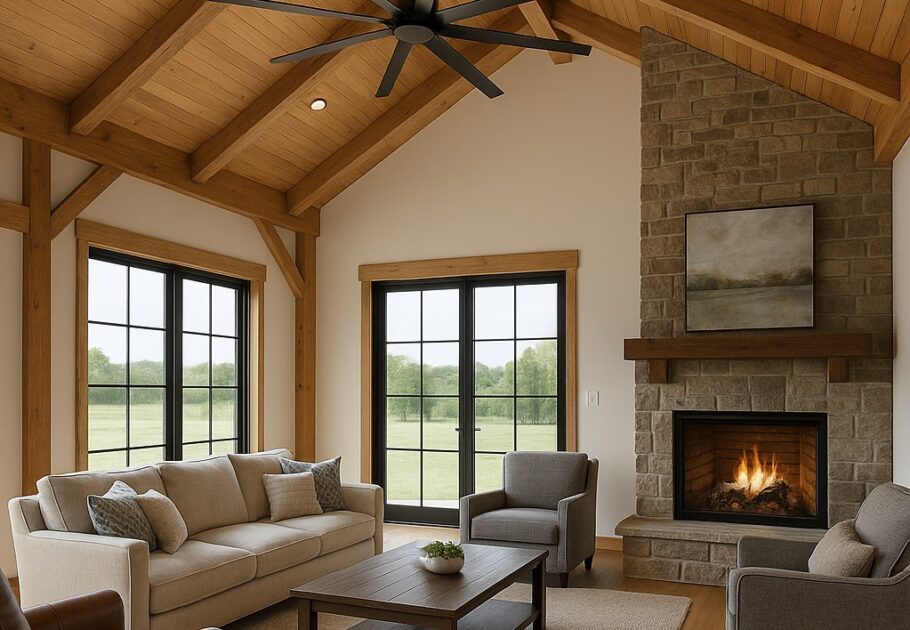
The barndominium has spent the last decade quietly revolutionizing rural and suburban living. What began as a practical solution—a metal barn structure converted into a livable home—has grown into a full-fledged architectural movement. But just when it seemed the barndominium had shown all its cards, a new twist emerges from the drawing boards of innovative builders and homeowners. Meet the convertible barndominium: a building where entire walls are designed to fold, slide, or lift away, transforming indoor living spaces into open-air pavilions at a moment’s notice.
This isn’t just a bigger sliding glass door. This is a fundamental rethinking of what a wall can do. Think of it as the architectural equivalent of a convertible sports car—except instead of putting the top down, entire sections of the building disappear, merging the climate-controlled interior with the surrounding landscape.
The Anatomy of a Disappearing Wall
Understanding how these convertible barndominiums work starts with the wall systems themselves. Traditional barndominiums rely on post-frame construction—heavy timber or steel posts set deep into concrete, with metal siding and roofing stretched across the frame. That structural skeleton is actually perfect for convertible walls. Because the building’s weight is carried by widely spaced vertical posts rather than continuous stud walls, the spaces between those posts become prime candidates for dramatic openings.
Engineers have adapted several mechanisms for these applications. Bi-fold doors remain the most common choice for very large openings—up to forty feet wide or more. Stacked like an accordion, these door panels fold against one another and slide to one or both sides. When closed, they seal like any other wall. When opened, they stack into a fraction of the total width, leaving a nearly clear span.
Multi-slide door systems offer another approach. Panels of glass or insulated metal ride on overhead tracks, sliding horizontally to park behind fixed wall sections. Some designs use pocketing systems where the wall panels disappear completely into concealed cavities within the building envelope. For the truly ambitious, hydraulic lift systems raise entire wall sections upward into a reinforced ceiling pocket, much like a garage door but on a grander scale. When raised, the wall essentially vanishes overhead.
Engineering the Indoor-Outdoor Threshold
Creating a convertible wall isn’t as simple as installing oversized doors. The threshold where interior meets exterior demands careful engineering. Floor levels must be perfectly continuous—no step up or down. That means the concrete slab that serves as the barndominium’s foundation extends outward onto a patio or terrace, with the same finish, same level, same thermal mass. When the wall opens, there’s no tripping hazard, no awkward transition. Just uninterrupted floor plane stretching from the living room into the open air.
Drainage presents another challenge. Any opening wall system must contend with rain, snow melt, and condensation. Designers solve this with slight outward slopes at the threshold, hidden trench drains, and careful flashing details. The goal is a seal that works as reliably as any conventional exterior wall when closed, while directing water away when open.
Structural considerations go beyond the wall itself. The roof overhang matters enormously. A convertible barndominium needs generous eaves—often extending six feet or more beyond the opening. This protects the mechanism when the wall is open and creates a covered pavilion space that remains usable even in light rain. Some designs incorporate retractable awnings or louvered roof extensions that can further customize the covered area.
The Unmatched Benefits of Convertible Living
Why go through all this trouble? The answer lies in how people actually want to live, especially on rural properties where the land itself is the main attraction. A conventional barndominium already offers wide-open floor plans and high ceilings. Adding convertible walls takes that openness to its logical extreme.
Ventilation transforms completely. Instead of relying on air conditioning for eight months of the year, owners can open an entire wall and let natural breezes sweep through the building. For properties situated on ridgelines or near bodies of water, this passive cooling effect is dramatic. Ceiling fans working in concert with an open wall can make summer afternoons comfortable without a single compressor kicking on.
Entertainment potential expands exponentially. A convertible barndominium effectively doubles its footprint when the weather cooperates. The indoor kitchen flows onto an outdoor dining area. The living room sofa faces a patio that becomes an extension of the interior. Birthday parties, holiday gatherings, and casual Sunday barbecues gain the flexibility to spill outside without forcing guests to walk through a standard patio door bottleneck.
For those who work from home or pursue creative hobbies, the convertible wall offers something even more valuable: control over the sensory environment. A painting studio can open to natural north light and fresh air. A workshop can vent fumes instantly. A yoga or meditation space can merge with a garden view, turning a morning practice into an outdoor experience without leaving the mat.
Material Choices That Matter
Not all convertible barndominiums are created equal, and material selection makes the difference between a seamless living experience and a maintenance nightmare. Glass remains the most popular infill for these movable walls, but glass has evolved. Triple-pane, low-emissivity units with argon gas fill and warm-edge spacers provide insulation values approaching a conventional insulated wall. When closed, the space stays comfortable in winter. When open, the panels stack out of the way.
Steel frames for the movable panels echo the barndominium’s industrial heritage. Galvanized or powder-coated steel resists corrosion, handles heavy loads, and requires no painting or staining. For a softer look, thermally modified wood or aluminum-clad wood panels offer warmth without the dimensional instability of raw lumber.
Flooring choices become critical. The continuous slab approach works beautifully with polished concrete, stained concrete, or thin-set tile. These materials shrug off moisture and temperature changes. Wood flooring requires careful detailing at the threshold, usually with a sacrificial transition strip that can be replaced as weather takes its toll. Outdoor rugs help define zones but should be the weather-resistant kind designed for covered patios.
Climate Considerations and Year-Round Use
The convertible barndominium shines brightest in moderate climates—the coastal zones, the high desert, the mountain valleys where summer heat breaks at sunset. But clever design extends the usability into less forgiving regions. Radiant floor heating installed beneath the concrete slab keeps the space warm even with the wall open on a crisp autumn day. Overhead infrared heaters mounted under the eaves allow evening gatherings to continue after the sun drops.
In hot, humid climates, the convertible wall pairs with whole-house fans or energy recovery ventilators. The strategy shifts: open the wall at night to purge heat, close it during the day to lock in coolth. Reflective roof coatings and insulated metal panels on the non-opening sections reduce solar gain. Deep overhangs shade the glass during peak sun hours while still admitting winter light.
Snow country requires heavier engineering. Motorized systems must work reliably below freezing. Insulated panels with high R-values prevent thermal bridging. The threshold needs heat tape to prevent ice buildup that could jam the mechanism. But these challenges are solvable, and a handful of builders in the Mountain West and upper Midwest now specialize in four-season convertible barndominiums.
Real-World Configurations
No two convertible barndominiums look exactly alike because the wall placement responds to the site. On a property with a southern exposure and distant mountain views, the entire south wall might open. The interior living, dining, and kitchen zones then face the view, with the covered pavilion extending outward as a massive deck. A fireplace or wood stove sits on the interior side of the opening, warming both spaces on cool evenings.
A different approach uses two adjacent walls—say, the west and south sides of a corner living space. When both open, the room becomes a covered courtyard. This L-shaped configuration creates a protected outdoor room sheltered from wind while maintaining sightlines across the property. For corner lots or properties with a view in two directions, this double-opening design maximizes the connection to the land.
Some owners opt for a single convertible wall dividing the garage or workshop from the main living area. When closed, the garage functions normally—parking vehicles, storing equipment. When opened, that space becomes a massive covered patio adjacent to the kitchen. The concrete floor works for both cars and dining tables. This flexibility appeals to those who want a barndominium that adapts to different seasons of life: a workshop today, an event space tomorrow.
The Investment Case
Convertible walls add cost. A high-end bi-fold or multi-slide system with insulated glass and motorized operation can run from fifteen thousand to fifty thousand dollars installed, depending on width and features. That is a significant premium over a standard wall with a French door or sliding patio door.
But the value proposition goes beyond simple return on investment. The convertible barndominium replaces two structures with one. Instead of building a house and a separate pavilion or screened porch, a single building serves both functions. The covered outdoor space never requires its own foundation, roof, or utility runs because those are already part of the main structure. For properties where building codes limit total square footage or impervious surface coverage, convertible walls offer a way to get more usable space without increasing the building’s footprint.
Resale appeal remains an open question—this is still a niche feature. But early indicators suggest that in desirable rural markets, a well-executed convertible barndominium commands attention and premium offers. Buyers recognize the craftsmanship required and the lifestyle benefits offered.
Maintenance and Longevity
Like any mechanical system, convertible walls need regular care. Tracks require cleaning every few months to remove debris. Moving parts benefit from annual lubrication. Gaskets and weather seals eventually wear and need replacement—typically every seven to ten years for high-use applications. Motorized systems have gearboxes and control boards that carry warranties similar to garage door openers.
None of this is prohibitive. The same owners who maintain their HVAC system, water heater, and septic system can handle convertible wall maintenance. And the payoff is immense: a building that changes its relationship with the outdoors at the push of a button.
The Future of the Form
The convertible barndominium sits at the intersection of several architectural trends. The thirst for indoor-outdoor living shows no sign of fading. Post-frame construction continues to gain respect as a legitimate building method rather than a budget compromise. And homeowners increasingly demand spaces that adapt to multiple uses rather than rigid, single-purpose rooms.
As building technology improves, expect to see even more seamless integration. Sensors that close the wall automatically when rain starts. Smart glass that frosts for privacy at night. Solar-powered operating systems that need no grid connection. These innovations will trickle down from luxury custom homes to production barndominiums over the next decade.