
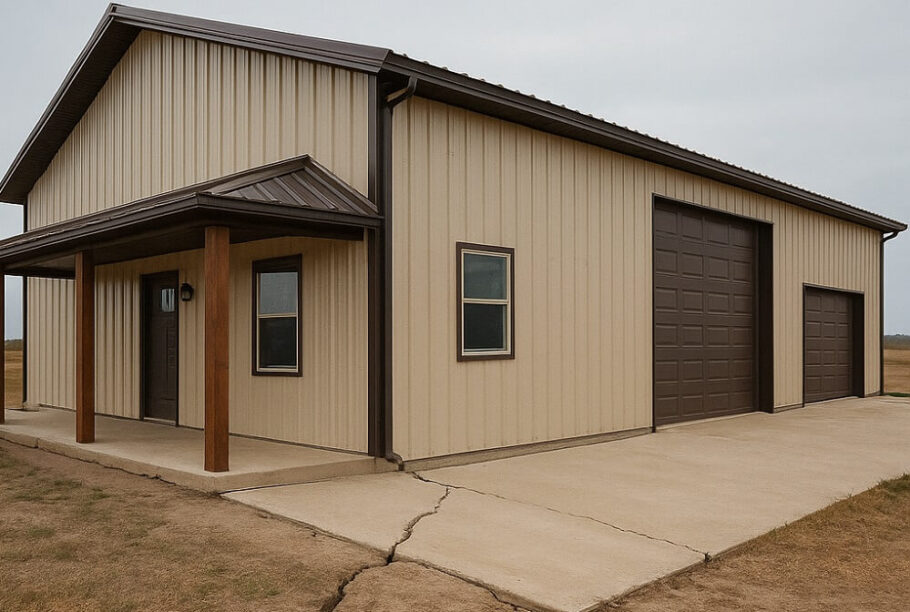
There’s something undeniably appealing about a barndominium. Those clean steel lines, the wide-open spaces inside, the concrete slab underfoot—it all feels solid. Permanent. Like something that’ll stand forever.
But here’s the thing about forever: the ground underneath doesn’t cooperate.
Soil moves. It shrinks when it dries out. It swells when it gets wet. It settles under weight. It shifts and erodes and does all sorts of things that buildings generally wish it wouldn’t. And when different parts of a building settle at different rates—well, that’s where problems start.
What Differential Settlement Actually Means
Most people hear “foundation settlement” and picture a building sinking evenly into the ground. That’s uniform settlement, and honestly? It’s not usually a disaster. The whole structure moves together, like a ship settling at low tide. No drama.
Differential settlement is different. That’s when one corner drops while the other stays put. When a column in the middle settles but the edges don’t. When the ground under part of the slab decides to move while the rest holds steady.
That uneven movement creates stress. Real stress. Walls develop cracks that weren’t there before. Doors start sticking in their frames. Windows that used to slide smoothly now bind up. Rooflines that were perfectly straight develop a subtle twist. In bad cases, structural members get pushed past what they can handle.
The thing about barndominiums is that they’re particularly susceptible to this kind of movement. Those wide spans and open interiors that make them so attractive? They also mean loads get concentrated at specific points—usually where steel columns meet the foundation. If the soil under one column behaves differently than soil under another, the whole building feels it.
Why Some Ground Behaves Better Than Others
Soil conditions vary wildly from one site to the next, and even across a single building site. A barndominium might sit on:
- Clay that expands like a sponge when wet and shrinks and cracks when dry
- Fill dirt that wasn’t properly compacted during grading
- Areas where organic material like buried tree roots is slowly decomposing
- Ground with variable moisture because of drainage patterns or nearby trees
- Transition zones where cut and fill meet on sloped sites
Different soil types behave differently under load. Sandy soil might drain well but settle under vibration. Clay might have good bearing capacity when dry but turn into something entirely different when saturated.
The point is, you don’t know until you look.
Starting With What’s Underground
Before anyone pours concrete or erects steel, there ought to be a soil investigation. Not the cursory kind where someone walks the property and says “looks fine.” A real one. With test pits or borings and a lab analysis.
A proper geotechnical report tells you:
- What kind of soil you’re dealing with
- How much weight it can safely support
- Whether it’s likely to shrink and swell
- How deep you need to go to find stable ground
- Whether the site has settlement potential
Skipping this step is tempting because it costs money and feels like an unnecessary delay. But it’s also the kind of shortcut that leads to major problems later. A few thousand dollars on soil testing can save tens of thousands in foundation repairs down the road.
If the soil report shows expansive clay, the foundation needs to accommodate movement. If there’s soft compressible soil, deeper foundations or soil improvement might be necessary. If the site has fill, compaction testing becomes critical.
Designing without this information is just guessing. And guessing doesn’t work well when the ground starts moving.
Foundation Approaches That Handle Movement
The foundation is where building meets ground. Getting it right makes all the difference.
Stiffened Slabs and Grade Beams
Most barndominiums use slab-on-grade foundations. In areas with decent soil, a simple monolithic slab with thickened edges might be enough. But when settlement is a concern, something stiffer is usually better.
Grade beams are essentially structural ribs built into the slab. They run underneath load-bearing walls and columns, distributing weight more evenly across the foundation. When one area of soil settles slightly, the grade beam helps bridge that spot and spread the load to adjacent areas that haven’t moved.
A well-designed stiffened slab behaves like a shallow raft. It flexes a little without cracking catastrophically.
Post-Tensioning for Problem Soils
In regions with expansive clay, post-tensioned slabs are common. Steel cables (tendons) are run through the slab and tensioned after the concrete cures. This puts the whole slab into compression.
When the soil heaves or settles unevenly, that pre-compression helps the slab resist cracking. It can’t prevent movement entirely, but it controls how the slab responds to it. Cracks stay smaller. Distortion stays within acceptable limits.
Going Deep When Shallow Won’t Work
Sometimes near-surface soils just aren’t reliable. Maybe there’s a layer of organic material that will keep decomposing. Maybe the fill is too deep to compact properly. Maybe the clay activity is just too severe.
In these cases, deep foundations make sense. Options include:
- Drilled piers that extend down to stable strata
- Helical piles screwed into the ground like giant screws
- Driven piles hammered down to refusal
For steel-framed barndominiums, isolated column footings can be supported by these deep elements. The building essentially bypasses the problematic surface soils and bears on deeper ground that doesn’t move as much.
Pier-and-beam systems also work well in highly expansive areas. By elevating the structure above the soil surface, direct interaction between slab and ground is reduced.
Making the Steel Frame More Forgiving
Barndominium frames are typically rigid steel. Strong stuff. But rigid connections transmit movement stresses directly through the structure.
Column Base Details Matter
Instead of welding columns rigidly to base plates, designers sometimes use pinned connections that allow slight rotation. If differential settlement occurs, the column can tilt a tiny amount without transferring full moment into the frame above.
It’s a small detail that makes a big difference.
Letting the Building Breathe
Large buildings need expansion joints. These are essentially gaps that divide the structure into independent segments. Each segment can move slightly relative to its neighbors without transferring stress.
Expansion joints should be placed strategically—where soil conditions change, where building geometry changes, or at regular intervals in long structures.
Concrete slabs also need control joints. These are planned crack locations. The slab will crack somewhere; control joints just determine where and keep cracks neat and narrow instead of random and wide.
Keeping Walls From Fighting the Structure
Interior partition walls are often treated as an afterthought in structural design. But when the foundation moves, those walls feel it.
Slip tracks or deflection tracks at the top of interior walls allow the structure above to move without pushing or pulling on the wall below. The wall can stay put while the ceiling moves slightly—no stress transferred, no drywall cracks.
Similarly, ceilings suspended from roof framing rather than resting on slab-supported walls have more freedom to move independently.
The Hidden Systems Nobody Thinks About
Plumbing, electrical, and HVAC are rarely considered in settlement design. Yet they’re often the first things to fail when movement occurs.
Rigid plumbing embedded in concrete slabs is a particular vulnerability. If the slab cracks or shifts, pipes crack too. Water leaks into the slab, causing more soil movement, creating a vicious cycle.
Better approaches include:
- Using flexible couplings where pipes transition between slab and structure
- Minimizing under-slab plumbing runs
- Routing major lines through accessible chases or attics
- Providing flexible connectors for electrical conduit at transition points
HVAC equipment mounted on slabs should have flexible connections to ductwork. Equipment suspended from framing should allow for slight movement without stressing connections.
Designing utilities to accommodate movement costs a little more upfront. It saves a fortune in repairs later.
Water: The Great Enemy of Stable Ground
So much settlement trouble traces back to water. Too much, too little, or uneven distribution—all create movement.
Expansive clay is particularly sensitive. When it dries out, it shrinks. When it gets wet, it swells. If one side of a building stays moist while the other dries, differential movement is almost guaranteed.
Effective moisture management includes:
- Sloping grade away from the foundation on all sides
- Continuous perimeter drainage that carries water away
- Gutters and downspouts with extensions discharging well away from the building
- Moisture barriers under slabs to reduce capillary rise
- Controlled irrigation that doesn’t soak foundation soils
Tree placement matters enormously. Large trees near one side of a building extract moisture unevenly from soil. Over years, this creates localized shrinkage and settlement. Landscape planning should account for mature root zones.
The goal is consistent moisture conditions across the entire footprint. Uniform moisture means less differential movement.
Spanning Over Problem Areas
When soil conditions vary significantly across a site, structural bridging can prevent localized settlement from affecting the superstructure.
Reinforced grade beams can span across soft zones, transferring loads to firmer ground on either side. Thicker slab sections under concentrated loads distribute weight more broadly. Mat foundations act like a rigid raft, forcing the whole building to move as a unit even if soil conditions vary.
The objective isn’t always to stop settlement entirely. Sometimes it’s to ensure settlement happens uniformly.
Living With Cracks
Concrete cracks. That’s just reality. Designing for differential settlement isn’t about preventing every crack—it’s about controlling them.
Properly placed reinforcement limits crack width. Instead of a single wide crack, reinforcement encourages many fine cracks. The concrete stays together, maintains structural integrity, and doesn’t separate into pieces.
Fiber reinforcement added to concrete mixes provides additional crack control, particularly in plastic shrinkage cracking before the concrete fully cures.
Control joints create weak planes where cracking is expected to occur. They’re not admitting defeat—they’re directing where movement will happen so it doesn’t happen randomly.
Keeping an Eye on Things
Design doesn’t stop when construction ends. Monitoring foundation performance catches problems early.
Simple approaches include:
- Installing settlement markers that can be surveyed periodically
- Taking baseline elevation readings and repeating them annually
- Monitoring crack widths with simple gauges
- Watching door and window operation for changes
Early detection allows corrective action before minor movement becomes major damage. In some cases, soil stabilization methods like polyurethane injection can address localized settlement after it occurs. Underpinning with helical piles can stabilize areas that continue moving.
Regional Differences Matter
What works in one place fails in another.
In arid regions with expansive clay, moisture control and post-tensioned slabs are primary defenses. Keeping water away from the foundation is critical, but so is preventing excessive drying.
In coastal areas with loose sands, deep foundations and erosion protection become priorities. Scour around foundations from storm surge or heavy rain can remove supporting soil rapidly.
In flood-prone regions, elevating the structure and protecting against scour is essential. Slab-on-grade may be the wrong choice entirely.
In areas with deep organic soils, complete foundation replacement with piles or piers may be the only reliable approach.
Good design always considers regional conditions. A Texas solution won’t work in Florida. A California approach may fail in Illinois.
Looking at the Big Picture
A barndominium’s steel frame might look indestructible. But it ultimately depends on the ground beneath it. And ground moves.
Differential settlement isn’t some rare event that only happens on bad sites with terrible soil. It’s a predictable possibility on many sites. Planning for it from the beginning—through geotechnical investigation, thoughtful foundation selection, careful structural detailing, and coordinated moisture management—creates buildings that last.
Strong buildings aren’t the ones that never move. They’re the ones that survive movement without failing.