
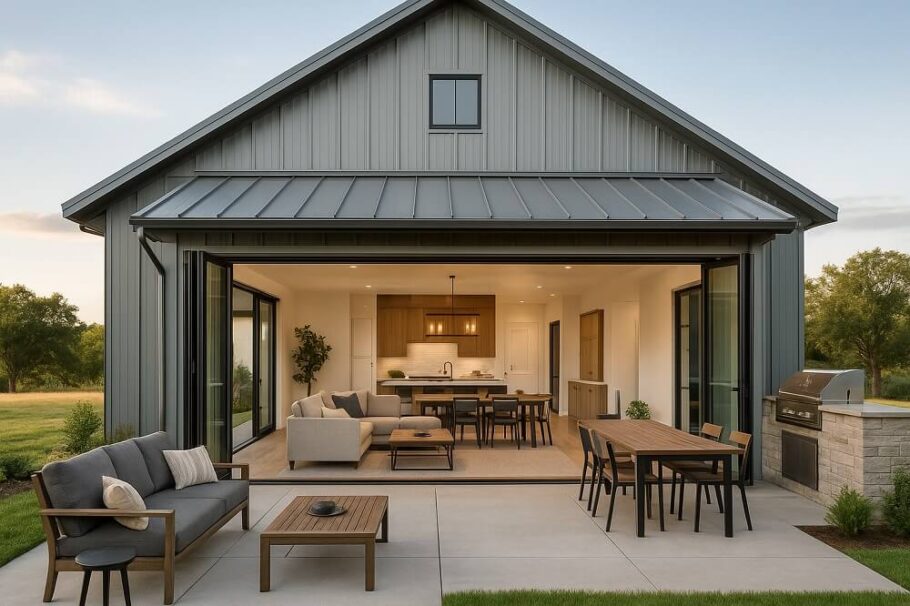
The barndominium has shed its utilitarian skin. What began as a pragmatic blend of shop space and living quarters has evolved into something far more ambitious. Today’s barndominium owners want the raw square footage of post-frame construction paired with the adaptability of modern engineering. And nowhere is that tension between industrial simplicity and architectural sophistication more visible than in the roof—specifically, the growing movement toward kinetic roof structures that move, fold, and reconfigure on command.
A static roof does one job well: it keeps the weather out. But a kinetic roof does something altogether different. It negotiates with the environment. It opens when the stars come out, seals tight before a storm rolls through, and fundamentally changes how a building relates to the sky above it. For barndominiums, which already blur the line between agricultural and residential, adding retractable or articulating roof sections transforms a fixed structure into a living machine.
The Mechanical Logic Behind Moving Roofs
Understanding kinetic roof systems starts with grasping two distinct approaches: retractable and articulating. They sound similar but operate on completely different mechanical principles.
Retractable roof sections slide or telescope along tracks, much like a massive horizontal garage door. Panels nest into one another when open, stacking at one end of the building or retracting into a dedicated storage pocket. This approach works beautifully for barndominiums with long, straight rooflines—think 40-foot clearspans where a central section can slide away to create an open-air courtyard effect. The mechanics are straightforward: electric motors drive pinion gears along toothed racks, with limit switches ensuring everything stops exactly where intended.
Articulating roofs tell a different story. These use hinged panels that pivot rather than slide. Picture a series of rigid sections connected by powered hinges, folding upward and stacking like an accordion or lifting in a single massive plane. Articulating systems excel where headroom matters. A hinged panel can rise vertically from a flat roof, converting a bedroom ceiling into a stargazing platform without consuming lateral space. The tradeoff involves more complex control systems and beefier actuators to manage the changing loads as panels shift orientation.
Engineering the Unpredictable
Any competent builder can frame a static roof. But a kinetic roof demands respect for forces that change by the second. Wind loads present the most obvious challenge. An open roof section becomes a sail. A partially open section creates unpredictable pressure differentials that can tear hinges from their mounts. Engineering solutions include pressure sensors embedded in the roof structure, with control algorithms that automatically close sections when wind speeds exceed safe thresholds. Redundant braking systems lock panels in place the moment wind gusts spike.
Then there is the matter of water. Every joint, hinge, and track presents a potential leak path. Static roof seals rely on gravity and compression. Kinetic seals need to maintain contact through motion, temperature cycles, and minor structural deflection. The best systems use dual-seal arrangements: a primary silicone bulb seal that compresses when panels close, backed by a labyrinth seal that forces water to navigate a tortuous path before reaching anything vulnerable. Drainage channels within the seal carriers handle whatever small amount of moisture gets past the first line of defense.
Snow loads introduce another layer of complexity. A retractable panel designed to slide smoothly in July may refuse to budge under the weight of a January snowfall. Heating elements embedded in the tracks can prevent ice buildup, but they consume power and add failure points. A more elegant solution involves load-sensing limit switches that prevent the roof from attempting an open cycle when sensors detect excessive accumulation. The system simply refuses to move until snow is cleared—a safety feature that protects both the mechanism and everything beneath it.
Materials That Move Without Breaking
Not all steel performs the same when forced to move thousands of times over decades. Kinetic roof structures demand material choices that balance strength, weight, and fatigue resistance.
Aluminum extrusions dominate the high-end market for a reason. They offer excellent strength-to-weight ratios, resist corrosion without heavy coatings, and can be extruded into complex shapes that integrate seal channels, wire raceways, and gear tracks into single profiles. The best systems use 6061-T6 aluminum for main structural members, heat-treated to achieve yield strengths approaching 40,000 psi while weighing less than four pounds per linear foot for typical sections.
Steel still has its place, particularly for articulating hinges and high-load pivot points. Chromoly steel (4130) shows up in critical components where thin sections must handle repeated bending stresses. Stainless steel hardware throughout prevents galvanic corrosion where aluminum meets steel. And nobody skimps on bearings—sealed spherical bearings at every pivot, rated for the full temperature range the building will ever see.
Glazing presents the biggest material headache. Glass looks fantastic in a roof, but a glass panel that must move invites disaster. Laminated safety glass remains the standard, with two or more panes bonded by polyvinyl butyral interlayers that hold broken shards in place. For curved applications or weight-sensitive designs, polycarbonate offers comparable transparency at half the weight—though it scratches more easily and yellows over time. The smart money follows the aerospace playbook: glass where visibility matters most, polycarbonate elsewhere, and never the two bonded together in ways that complicate thermal expansion.
Control Systems That Anticipate Rather Than React
A kinetic roof needs a brain. Not just a switch on the wall, but something that understands weather forecasts, building occupancy, and the mechanical limits of its own moving parts.
Modern systems integrate with building automation platforms, pulling data from local weather stations or internet services. When rain approaches, the roof closes automatically—but not instantly. Gentle closure sequences prioritize noise reduction, moving panels at half speed and pausing at intermediate positions to allow seals to seat properly. Emergency overrides exist for fire scenarios or power failures, with manual crank handles stored at ground level for times when electronics fail.
Position feedback comes from redundant sensors. Hall effect sensors track motor rotation. Linear potentiometers measure absolute panel position. Contact switches confirm seals are fully compressed. The control system compares all three sources; if they disagree, the roof stops and alerts the owner rather than risking damage from a runaway panel.
Power management deserves more attention than it usually receives. Operating a large retractable roof requires serious current—potentially 30 amps or more at 240 volts for a 50-foot-wide section. Backup batteries sized for at least three full open-close cycles provide peace of mind during grid outages. Solar integration makes sense for off-grid barndominiums, though the roof panels themselves must be wired to allow motion without snagging cables. Flexible cable carriers similar to those used on industrial robots solve this neatly, enclosing power and data lines in articulated chains that fold neatly beside the tracks.
Where Kinetic Roofs Make the Most Sense
Not every barndominium needs a moving roof. The engineering and cost (typically $30,000 to $150,000 depending on scale) only make sense for specific applications where transformability delivers genuine value.
Outdoor kitchens benefit enormously from a roof that closes when smoke detectors would otherwise trigger. An articulating section directly above the cooking area can open for ventilation during use, then seal tight when the grills cool. No need for massive exhaust hoods or the associated makeup air systems.
Workshop spaces gain flexibility that changes how they function. A retractable roof over a welding bay removes fumes instantly and naturally, no fans required. Paint booths become usable year-round when the same opening mechanism seals against winter cold. Vehicle lifts can accommodate RVs or boats that would never fit through a standard garage door—just open the roof and lift straight up.
Living areas tell a softer story. Bedrooms with articulating roof panels become sleeping porches at the touch of a button. Living rooms with retractable center sections host indoor-outdoor gatherings without forcing guests to choose between comfort and fresh air. The psychological effect matters more than the practical one; something about seeing the sky from inside a metal building changes how the space feels.
Installation Realities That Separate Success From Failure
Field installation of kinetic roof components demands precision that most barndominium builders have never attempted. The post-frame construction typical of barndominiums—wood or steel columns on concrete piers—works perfectly for supporting moving roof loads, but only if the foundation doesn’t settle unevenly. A differential movement of even a quarter-inch across a 40-foot span will bind sliding panels or twist hinge alignments.
Proper installation begins with surveyed reference points embedded in the foundation. Laser levels verify column heights before any roof framing begins. Steel moment frames at the moving sections distribute loads to multiple columns rather than concentrating forces at single points. Temporary bracing holds everything in alignment until the roof panels are mounted and tested.
Testing deserves its own paragraph. Every kinetic roof should undergo at least 100 full open-close cycles before the building is considered complete. That sounds excessive until watching a system fail at cycle 87, revealing a wire routing issue that would have surfaced three months into occupancy. Documentation of each cycle—operating current, travel time, seal compression—provides baseline data for future troubleshooting.
The Maintenance Reality Check
Moving parts wear out. Owners need to hear this before signing contracts. Annual maintenance checks of any kinetic roof system should include lubricating tracks and hinges with manufacturer-specified compounds (never generic grease, which attracts dust), inspecting every seal for cuts or compression set, testing all limit switches and safety sensors, and running the system through its full range of motion while listening for unusual noises.
The good news is that well-engineered systems demand surprisingly little attention between annual service intervals. Quality linear actuators last 20,000 cycles or more. Seals typically need replacement every five to seven years. Motors might run for a decade before bearings start complaining. The control electronics tend to outlast everything else, though lightning protection remains essential in any region with thunderstorms.
The Future Already in Motion
Kinetic roof technology continues evolving faster than most residential construction sectors can absorb. Shape memory alloys that change length when electrically heated promise actuators with no moving parts beyond the material itself. Photochromic glazing that darkens automatically in bright sunlight reduces cooling loads when roof sections remain open. Machine learning algorithms that study occupant behavior patterns predict when to open or close the roof before anyone touches a control.
None of this belongs exclusively to luxury homes or commercial buildings. The barndominium’s inherent simplicity—wide spans, clear interior volumes, straightforward structural systems—actually makes it an ideal platform for kinetic roof experimentation. No complex internal load-bearing walls to work around. No historic preservation restrictions on roof modifications. Just clear spans and the sky above, connected by engineering that refuses to accept fixed boundaries as permanent limitations.
A barn that breathes sounds like poetry. But it is just good engineering applied to a problem nobody thought to solve fifty years ago. The roof moves. The building transforms. And the line between inside and outside becomes whatever any given moment requires it to be.