
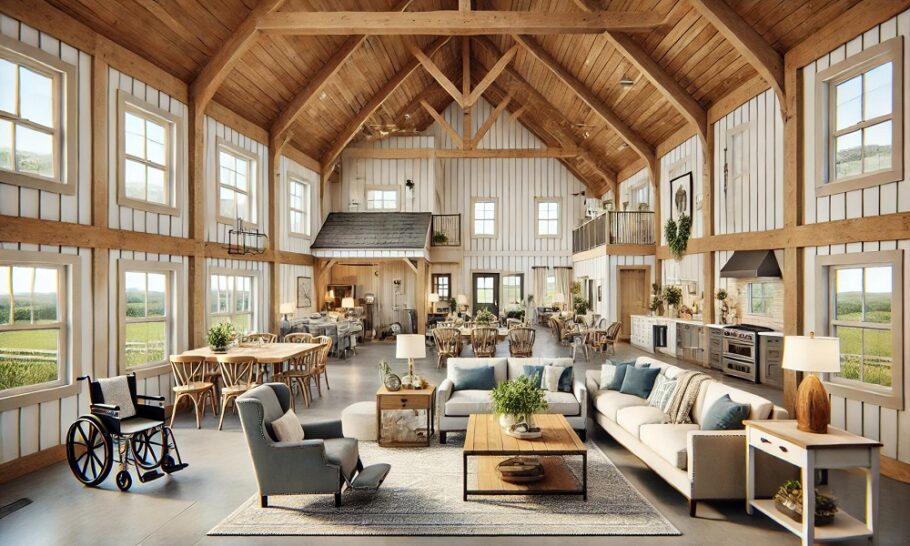
The barndominium movement has taken the rural housing market by storm. These steel-framed structures offer affordability, durability, and that wide-open living space so many people crave. But there is a problem most new barndo owners discover somewhere around their first July in the building. The heat.
Standard post-frame construction wrapped in metal siding has a reputation for turning into an oven when the sun beats down. The knee-jerk solution involves throwing money at the problem. Expensive spray foam insulation, multi-zone HVAC systems, and enough ductwork to cool a small school. But what if the answer to keeping a barndominium comfortable without bankrupting the owner on utility bills has been hiding inside some dirt mounds on the African savanna all along?
Termites figured out climate control millions of years ago. The towering mounds these insects build look like crude sculptures from a distance. Up close, they represent some of the most sophisticated passive ventilation engineering on the planet. And the same principles of keeping a fungus garden at a perfect 87 degrees while the outside temperature swings from freezing nights to scorching afternoons can keep a barndominium livable without constant mechanical intervention.
The Architecture That Never Sleeps
Termite mounds can stretch fifteen feet or more into the air. Inside that towering structure lives a colony of millions, all dependent on a single underground chamber where they cultivate fungus as their primary food source. That fungus demands a remarkably stable temperature and precise oxygen levels. Termites cannot run extension cords out to their mound for a window unit. They have no access to ceiling fans or smart thermostats. So nature gave them architecture instead.
The mound contains an intricate network of tunnels, chimneys, and chambers that work together to drive continuous airflow. Warm air rising from the colony creates a pressure differential. As that air escapes through upper vents, fresh air gets pulled in through peripheral tunnels at the base. The system never stops. It costs nothing to run. And it adjusts automatically as conditions change throughout the day.
Here is what makes this relevant to a metal building on a concrete slab. A barndominium faces the same fundamental challenge as a termite mound. A concentrated heat source (the metal roof and walls absorbing solar radiation) creates rising hot air that needs somewhere to go. The living space below needs a constant supply of cooler, oxygen-rich air. The basic physics are identical. Termites just figured out the shape first.
Translating Insect Geometry to Post-Frame Construction
Applying termite mound logic to a barndominium means abandoning the idea that a house should be a sealed box that relies entirely on forced air. The traditional approach treats the building envelope as a barrier. Keep the outside out. Condition the inside. The biomimetic approach treats the building as a breathing organism. Let the structure manage its own airflow patterns.
The most direct translation involves the roof ridge system. Most barndominiums already incorporate a ridge vent, but the termite mound suggests something more strategic than the standard continuous slot. Termite mounds use multiple chimney outlets at different heights and positions to create layered pressure differences. One tall chimney produces a strong draw. Shorter outlets release lower-pressure air. The interaction between these elements keeps circulation moving even in calm conditions.
For a barndominium, this translates to a split ridge system with carefully sized vent openings placed at multiple points rather than one continuous run. Adding a central cupola or monitor roof section creates an elevated exhaust point that pulls air more aggressively than standard ridge vents. The key detail that most builders miss involves the intake. Termite mounds pull fresh air from the periphery, not directly beneath the exhaust. Intake vents placed low on the shaded sides of the building, particularly the north and east faces, allow cooler air to enter without fighting the upward movement of hot air leaving through the ridge.
The Cupola as a Termite Chimney
The cupola has become a decorative feature on many barndominiums. Owners add them for country charm, slap on some weather vanes, and call it a day. That misses the opportunity completely. A properly designed cupola functions exactly like a termite mound chimney. It captures rising heat and converts it into a pumping action that moves air through the entire structure.
The physics works like this. Sunlight heats the cupola’s interior surfaces, particularly if the cupola gets a dark metal interior. That heated air rises toward the cupola’s own vented peak. As it escapes, it pulls air up from the main building below. This creates a low-pressure zone that draws fresh air through strategically placed intake vents on the lower walls. No fans required. No electricity consumed. Just geometry and the fact that hot air rises.
The difference between a decorative cupola and a functional one comes down to cross-section and baffling. Termite mounds avoid straight, unobstructed vertical shafts because wind gusts can create backdrafts. Their chimneys incorporate twists, partial walls, and irregular shapes that dampen wind effects while maintaining steady thermal draw. A cupola should follow the same logic. Internal vanes or horizontal baffles prevent wind from pushing air back down into the living space while still allowing the thermal stack effect to operate. Most cupolas on the market lack these details because the manufacturers assume nobody actually expects them to work.
Thermal Mass and the Night Flush
Termite mounds succeed partly because of ventilation geometry and partly because of material properties. The mound walls themselves store thermal energy, moderating temperature swings and creating a time lag between peak outside heat and peak interior temperature. A barndominium’s concrete slab and exposed posts can serve the same function, but only if the ventilation strategy accounts for them.
Here is where most passive ventilation designs fail in metal buildings. During the day, the structure needs to minimize air exchange to prevent pulling in hot outside air while relying on the stack effect to exhaust heat from the roof cavity. But at night, when outside temperatures drop below the interior temperature, the strategy reverses. The building needs maximum airflow to pull cool night air across the thermal mass of the slab and posts, chilling that mass so it can absorb heat during the following day.
Termite colonies do this automatically because their mound design creates different flow patterns at different temperatures. The same physics can work in a barndominium with operable vents on a simple temperature or time control. Low intake vents open fully at night, while high exhaust vents close partially to slow the airflow and allow cool air to pool near the slab. By morning, the concrete has dropped several degrees below the expected daytime high, giving the building a thermal buffer that passive ventilation alone cannot achieve.
The Mistakes Most People Make
Walking through the barndominium forums reveals the same passive ventilation failures repeated over and over. Someone installs lots of windows that open, adds some ridge vents, and declares the building naturally ventilated. Then summer arrives and the place becomes unbearable. The problem is not that passive ventilation fails. The problem is that windows and ridge vents alone do not create a controlled pressure differential.
Termite mounds work because the intake and exhaust points are physically separated and sized relative to each other. The intake area is typically smaller than the exhaust area, creating acceleration as air enters the building. Most barndo designs get this backwards. They put large, operable windows on all sides, which destroys any directional pressure difference. Air enters and exits randomly, mostly influenced by whatever direction the wind happens to be blowing at that moment.
Another common failure involves ceiling height. Termite mounds create vertical separation between intake and exhaust because that vertical distance drives the thermal stack effect. A barndominium with eight-foot ceilings cannot generate meaningful stack ventilation regardless of how many vents are installed. The physics simply does not work without at least twelve to fourteen feet of vertical rise from the lowest intake to the highest exhaust. This is why the open floor plan and high ceilings of a typical barndo actually work in favor of passive ventilation, but only if the intake and exhaust points are positioned at the extremes of that vertical range.
Working With Wind Instead of Fighting It
Termite mounds do not ignore wind. They harness it while protecting against its unpredictability. The mound shape creates a pressure gradient around the structure, with high pressure on the windward side and low pressure on the leeward side. That pressure difference drives additional flow through the mound’s peripheral tunnels even when thermal stack conditions are weak.
A barndominium can achieve the same effect through site orientation and landscape planting. The building should be oriented with its long axis perpendicular to prevailing summer winds. Windward side intakes pull fresh air through the structure, while leeward side exhausts release it. Windbreaks planted at the correct distance from the building can accelerate airflow rather than blocking it, similar to how termite mounds use irregular outer surfaces to create localized pressure differences.
The real magic happens when thermal stack effect and wind-driven ventilation work together. A warm day with a light breeze produces upward flow from the stack effect while the wind creates cross-flow near the floor. The two systems operate at different heights without interfering with each other. The result is complete air exchange throughout the building volume without any single vent having to handle the entire load.
Putting It All Together
Designing a barndominium around termite mound principles does not mean abandoning mechanical systems entirely. Even the most perfectly ventilated building needs backup for extreme conditions. But the mechanical load drops dramatically when the building handles most of its own breathing. An exhaust fan in the cupola that only runs during the hottest afternoons. A small whole-house fan that boosts nighttime flush cycles. Minimal air conditioning reserved for the worst heat waves.
The cost savings add up quickly. Smaller HVAC equipment means lower upfront investment. Reduced runtime means lower monthly bills. Fewer moving parts means fewer repairs over the life of the building. And unlike spray foam and sealed attics, passive ventilation never needs replacement. The building simply works the way it was designed to work, year after year, just like those termite mounds that have been standing and breathing for decades.
The next time someone looks at a barndominium plan and worries about heat gain, send them to look at a termite mound. Not the ugly pest-infested mounds that give termites a bad name, but the elegant, self-regulating climate machines that have been keeping colonies comfortable since before humans figured out how to stack rocks into walls. The answers are already out there, buried in dirt and built by insects. All that remains is the willingness to learn from them.