
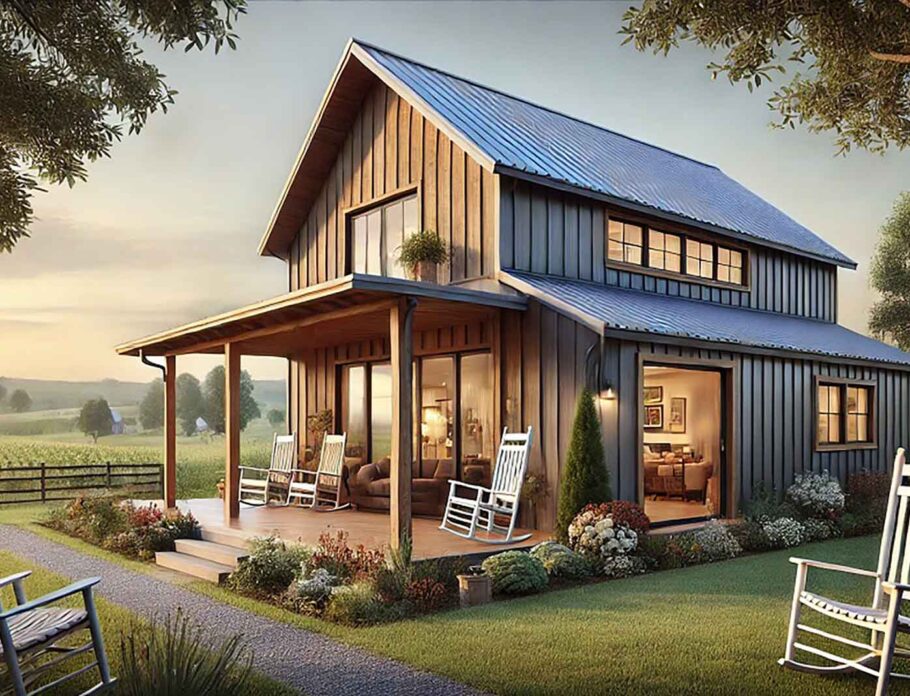
If you’ve spent any time scrolling through real estate listings or home design blogs over the last few years, you’ve likely seen them: the sprawling, rustic-modern structures with soaring ceilings, massive windows, and that distinct corrugated metal exterior. They’re called barndominiums, and they’ve exploded in popularity.
The appeal is obvious. You get the open-concept layout of a warehouse combined with the warmth of a high-end home, often at a lower price per square foot than traditional stick-built construction.
However, if you mention to a friend that you’re building a home out of a giant metal shed, you’ll inevitably get the look. It’s followed by the question: “But isn’t it freezing in the winter and boiling in the summer?”
It’s a fair concern. For decades, metal buildings were strictly for agriculture and industry—places where 40 degrees and a wind gust felt the same inside as out. But modern barndominiums are a different beast entirely. In fact, when built correctly, a barndominium can be significantly more energy-efficient than a conventional wood-frame house.
Let’s break down how to achieve that efficiency, because simply throwing up a red iron structure and hoping for the best will result in exactly the uncomfortable barn you’re trying to avoid.
The “Thermal Envelope” is Everything
The number one mistake rookie barndominium builders make is treating the building like a garage. In a standard home, the insulation is in the walls. In a barndominium, you have two choices: insulate the metal skin or build a separate interior wall structure.
To achieve true energy efficiency, you must create a perfect thermal envelope.
If you are in a moderate climate, spray foam insulation is your best friend. Spraying closed-cell foam directly onto the back of the metal panels does two things. First, it provides a high R-value (the measure of thermal resistance) in a thin space. Second, and most importantly, it creates an air seal. Metal expands and contracts, and screws can loosen over decades. Foam bonds to the metal, preventing the microscopic air leaks that would otherwise turn your home into a sieve.
For those in extreme climates, or those who prefer a more traditional look, consider a “double-wall” method. This involves framing conventional stud walls just inside the steel structure, leaving a gap. You can then insulate those walls with fiberglass or cellulose. This method is slightly more expensive because you lose square footage, but it allows for easier wiring and a more classic drywall finish.
The Roof: Your First Line of Defense
We all know that heat rises. In a barndominium, which often features high cathedral ceilings, that rising heat has a lot of space to fill. If your roof assembly isn’t robust, you’re basically paying to heat the sky.
This is where the “cool roof” concept comes into play. While a dark-colored galvanized steel roof looks great on a modern farmhouse, it absorbs a tremendous amount of solar radiation.
- Radiant Barriers: When installing your metal roof, consider a radiant barrier sheathing. This is a layer of reflective material that sits between the roofing and the structure. It reflects the sun’s heat away from the building before it even has a chance to enter your insulation.
- Ventilation is Key: You cannot forget about the ridge vents and soffit ventilation. In the summer, a properly ventilated attic space (if you have one) or a vented roof cavity will allow super-heated air to escape. Without it, your insulation has to work twice as hard.
Harnessing the Wide-Open Spaces
One of the biggest efficiency challenges in a barndominium is the HVAC (Heating, Ventilation, and Air Conditioning). Traditional homes have separate rooms and hallways that help contain treated air. Barndominiums are famous for their wide-open floor plans—the kitchen, living, and dining rooms are often one giant volume of air.
While this is fantastic for entertaining, it can be a nightmare for a standard HVAC system. A single, large central AC unit will struggle to circulate air evenly, leading to hot and cold spots.
The solution often lies in zoned HVAC systems or mini-split systems.
- Mini-Splits: These ductless systems are incredibly efficient for barndominiums. You can install multiple air-handling units in different zones of the open space, all running off one exterior condenser. This allows you to cool the “living” side of the great room without wasting energy on the “kitchen” side when you aren’t cooking.
- Ceiling Fans are Non-Negotiable: With those high ceilings, you absolutely need ceiling fans—and not just decorative ones. Large-diameter, low-speed fans (like those used in gyms) help to de-stratify the air. They push the warm air trapped near the 20-foot ceiling back down to the floor in the winter, and create a wind-chill effect in the summer.
Glazing: The Glass Problem
Barndominiums often feature massive windows and glass sliding doors to blend the indoor and outdoor living spaces. Glass is historically the weakest link in the thermal envelope.
If you skimp here, you will regret it. You do not want single-pane windows in a metal building.
Invest in double-pane, low-E (low emissivity) glass. Even better, look for windows with thermal breaks—a plastic or polymer barrier between the interior and exterior metal frames of the window itself. Since metal conducts heat and cold so well, a thermal break prevents the cold from traveling through the window frame and into your living room wall.
Consider the orientation of your glass. If you have a wall of 20-foot windows facing the brutal afternoon west sun, you are creating a massive solar heat gain problem. Balance your glass placement. Put larger windows on the north and south sides, and minimize them on the east and west, or use deep overhangs and porches to shade them.
The Slab and the Heat Pump
Don’t forget about the floor. In many barndominiums, the foundation is a thick concrete slab. Concrete is a fantastic thermal mass—it absorbs heat during the day and releases it slowly at night. But if that slab isn’t insulated from the ground, it will suck the warmth right out of your home in the winter.
Make sure your builder installs rigid foam insulation board under the slab and along the edges of the foundation. This keeps the concrete thermally broken from the cold earth.
For the ultimate in efficiency, pair that insulated slab with in-floor radiant heating. Because a barndominium’s structure is so airtight and well-insulated, you don’t need to blast scalding air through vents. Running warm water through tubes in the concrete provides a gentle, even heat that feels luxurious and costs less to operate than forced air.
Renewable Energy Readiness
Finally, if you are considering a barndominium, you are likely someone who values independence and long-term savings. The metal roof of a barndominium is the perfect platform for solar panels.
Unlike asphalt shingles, metal roofs last 40-70 years. You can mount solar panels on standing seams without even penetrating the roof (using clamps), which eliminates the risk of leaks. The large, unbroken roof planes of a barndominium allow for expansive solar arrays that can potentially offset the entire energy usage of the home, including the power needed to run that mini-split system.
The Bottom Line
A barndominium is not inherently energy-efficient just because it’s new. But it has the potential to outperform a traditional home because of its simple geometry and the advanced building science we can apply to it.
By focusing on a continuous thermal envelope, high-performance glazing, and zoned mechanical systems, you can build a metal home that is not only stylish and durable, but also cheap to heat and cool. You really can have the rustic look of a barn with the energy profile of a high-tech building. It just takes a little planning and a refusal to cut corners on the things you can’t see.