
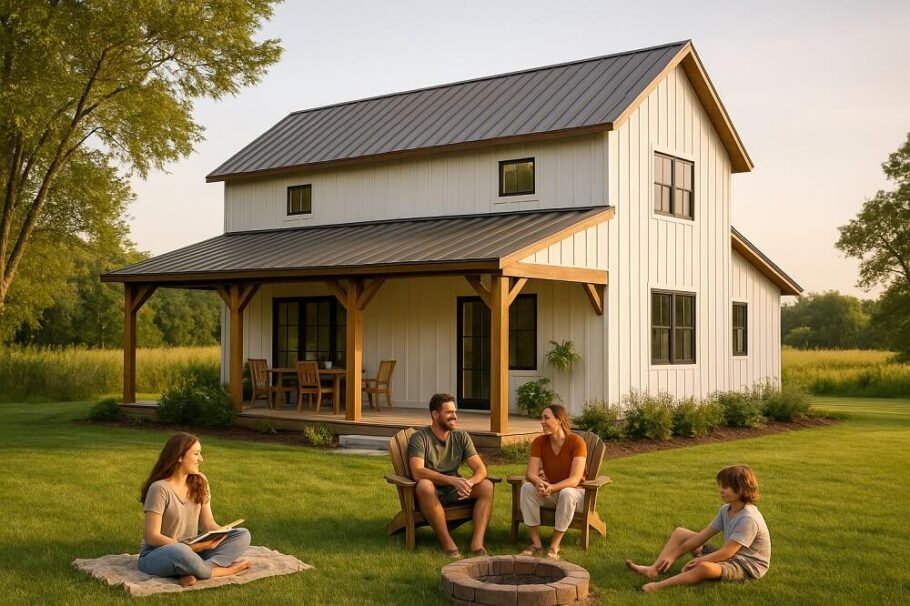
When you hear the word “barndominium,” you might still picture a rustic, metal-clad structure more suited to storing hay than raising a family. But over the last decade, this housing trend has shed its agricultural stereotypes and evolved into one of the most intelligent, stylish, and practical housing solutions on the market, particularly for small families looking to maximize space and minimize wasted square footage.
For a family of three or four, the traditional suburban home often comes with a list of compromises: rooms that sit empty for 360 days a year, sprawling floor plans that disconnect family members, and a mortgage that stretches the budget to its breaking point. The barndominium—or “barndo”—offers a compelling alternative. It is a blank slate, usually a large, open steel or post-frame building, designed to be finished into a living space that prioritizes how you actually live.
If you are a small family considering this path, the opportunity isn’t just about saving money (though that is a significant perk). It is about creating a home that is specifically tailored to your family’s rhythm. Here is how to navigate barndominium design to create a space that is both functional for the chaos of young children and stylish enough for the adults who live there.
Why the “Big Box” Works for a Small Family
The most distinctive feature of a barndominium is the wide-open, uninterrupted interior space. While this can be intimidating at first glance, it is the single greatest asset for a small family. Unlike a traditional stick-built home, where the floor plan is chopped up into small, dedicated boxes (a formal living room, a separate dining room, a kitchen with walls on three sides), the barndo allows for “great room” living.
For families with young children, this is a game-changer. It means you can be prepping dinner in the kitchen while keeping an eye on toddlers building forts in the living area or doing homework at the dining table. The sightlines are clear, fostering connection even when family members are doing different things. There is no need to yell through walls to call everyone for dinner; the space naturally brings people together.
However, an open floor plan requires deliberate design to avoid feeling like a gymnasium or a storage shed. The key is to define zones without building walls. You can achieve this through strategic furniture placement—using the back of a large sectional sofa to delineate the living room from the dining area. Area rugs are essential here; they anchor each “room” within the larger shell. A large rug under the dining table defines the eating zone, while a plush carpet in the living area creates a cozy enclave for movie nights.
The Layout: Planning for the Future (Not Just Today)
When designing a barndominium for a small family, you must think in two timelines: the present and the future.
In the present, you might want the kids’ bedrooms close to the master suite for those midnight wake-ups and middle-of-the-night comfort. This is often achieved by placing the master suite on one end of the rectangle and the secondary bedrooms on the other, with the living space in the middle. This “wing” layout provides privacy for parents once the kids get older, but proximity when they are young.
But what about the future? As children grow into teenagers, they crave privacy. Consider the flexibility of the barndo shell. Could a section of the shop area (if you are building a combination shop/living space) be finished later into a teen suite? Can you rough-in plumbing for a future bathroom in the shop or basement area now, while the walls are open, to save tens of thousands of dollars later?
Furthermore, think about the “forever” aspect. Small families often become empty nesters. The beauty of the barndominium is its adaptability. That fourth bedroom that is no longer needed can easily become a home gym, a craft room, or a large home office. The wide-open nature of the structure means that load-bearing walls are few and far between, giving you the freedom to reconfigure interior partitions down the road with relative ease.
The Art of Zoning in an Open Concept
While the open plan is a blessing, it presents a unique challenge: noise and visual clutter. In a traditional home, you can shove the kids’ toys into their bedroom and shut the door. In a barndo, the living space is often the heart of the home, visible from almost every angle.
To combat this, smart families incorporate “stealth storage.” This isn’t just a few cabinets; it is built-in millage that blends with the architecture. Consider a long wall of floor-to-ceiling bookshelves and cabinetry in the living area. Use lower cabinets with baskets for toy storage—the kids can pull out a basket, play, and shove it back in. The upper shelves can display books, plants, and family photos, adding style without clutter.
Another zoning trick is the strategic use of the kitchen island. In a small family, the kitchen island becomes the command center. It needs to be more than just a prep space. Design it with an overhang for barstools where kids can eat breakfast or do crafts. If you have the square footage, a massive island can even house a small farm sink, a dishwasher, and a beverage fridge, effectively making it the hub of the home and freeing up perimeter counter space for small appliances.
The “Mudroom” Dilemma and the Laundry Solution
If there is one thing small families generate, it is stuff. Sports equipment, backpacks, shoes, jackets, and mail. In a barndominium, you likely have a distinct advantage: the entryway.
Because barndos are often situated on larger plots of land or in rural areas, the entry sequence is crucial. You are not stepping directly from a sidewalk into a living room; you are stepping in from a driveway, a garage, or a porch. Design a dedicated transition zone. If your barndo includes a shop or a garage, the door leading into the living quarters should open into a proper mudroom or a drop zone.
This space should be generous. Include built-in benches with shoe storage underneath, cubbies for each family member, and hooks at different heights so even the little ones can hang up their own coats. If space allows, putting the laundry room adjacent to this mudroom is a stroke of genius. Dirty sports uniforms can come off and go straight into the washer without ever touching the clean living space.
Speaking of laundry, don’t hide it away in a dark, cramped closet. In a barndominium, you have volume. Utilize vertical space for drying racks, hanging rods for delicate items, and cabinetry for detergent. A well-lit, functional laundry room makes the endless cycle of family washing feel less like a chore.
Material Choices: The Aesthetics of Durability
Designing for a small family means designing for durability. You need surfaces that can withstand spills, muddy boots, and the general wear and tear of childhood. The industrial roots of the barndominium actually lend themselves perfectly to this.
For flooring, skip the high-maintenance hardwoods. Luxury vinyl plank (LVP) has come a long way. It looks like wood, feels warmer underfoot than tile, and is virtually indestructible against water and scratches. For high-traffic areas like the entry and kitchen, you might even consider polished concrete. If your barndo is built with a concrete slab, polishing and sealing it creates a beautiful, modern look that is incredibly easy to clean. Throw down some warm rugs to soften the acoustics and add color.
On the walls, the metal siding of a barndominium is usually insulated and covered with drywall on the interior. This gives you a standard surface to work with. However, to lean into the style, consider using board and batten, shiplap, or even corrugated metal as an accent wall in the living room or a bedroom. This adds texture and pays homage to the building’s agricultural aesthetic.
For the kitchen and bathrooms, quartz countertops are a fantastic investment. They are non-porous, meaning they resist staining from spilled juice or art supplies, and they require zero sealing.
Let There Be Light (and Views)
One of the mistakes small family homes make is relying on standard 3×5 windows. In a barndominium, you have the structural ability to go big. Because the building’s weight is often carried by posts or steel frames, the spaces between can be filled with glass.
Take advantage of this. Install large sliding glass doors that open onto a patio or a backyard. This not only floods the interior with natural light (combating the “cave” feeling a metal building can sometimes have) but also visually expands the living space. On a nice day, the patio becomes an extension of the living room.
High clerestory windows are another barndo signature. These are windows placed near the roofline. They allow light to pour in while maintaining privacy and freeing up wall space below for furniture. For a small family, this creates a bright, cheerful environment that boosts mood during the long winter months.
Energy Efficiency and the Bottom Line
Finally, we have to talk about the economics. Small families are often working with tight budgets. The energy efficiency of a well-built barndominium is remarkable. Using spray foam insulation in the walls and roof deck creates an airtight seal. This means your HVAC system doesn’t have to work as hard to cool the high ceilings in the summer or heat the space in the winter.
This efficiency translates to lower utility bills, leaving more money in the budget for family vacations or college funds. Additionally, the low-maintenance exterior—typically steel siding that won’t rot, peel, or need painting every five years—means your weekends are spent enjoying your family, not scraping paint or fixing siding.
Conclusion: A Home Built Around You
Designing a barndominium for a small family is an exercise in intentionality. You are rejecting the notion that a home needs to be a certain size or style to be valid. Instead, you are choosing a structure that allows you to live together in an open, connected space while still providing the private retreats you need.
By focusing on durable materials, smart storage, and a floor plan that can evolve as your children grow, you can create a home that is not just a place to sleep, but a backdrop for your family’s life. It is sturdy enough to handle the chaos of childhood, stylish enough to make you proud to host the holidays, and efficient enough to keep your financial future secure. In the end, that is what a family home should be.