
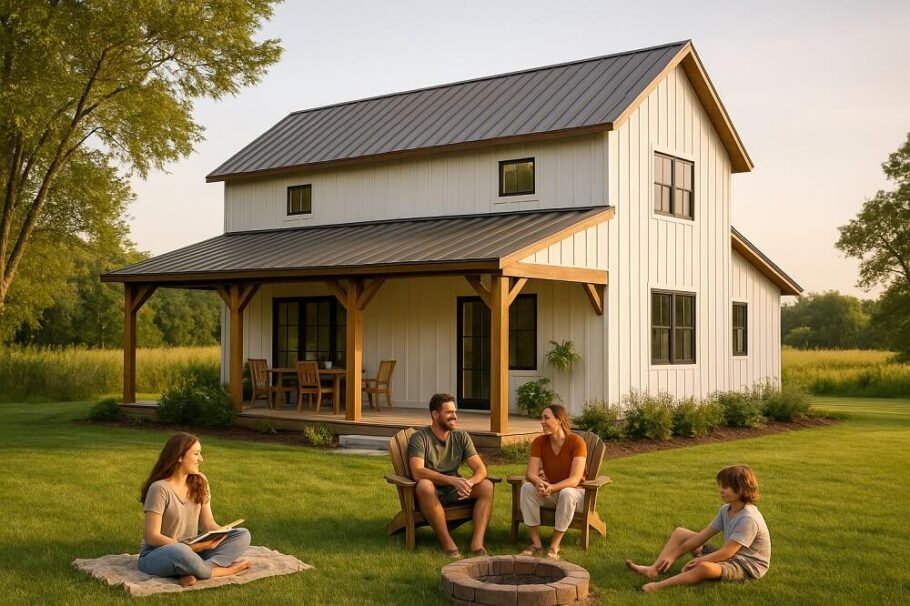
The barndominium movement has evolved far beyond simple single-story workshops with a living space tucked in the corner. Today’s ambitious builds reach upward—two stories, three in some cases—transforming the classic post-frame structure into something that resembles a traditional home more than a farm building. But stacking living space inside a metal shell introduces engineering challenges that catch many owners off guard. Understanding those demands before breaking ground separates a successful multi-story barndo from a costly headache.
Why Multi-Story Changes Everything
Single-story barndominiums benefit from the inherent simplicity of post-frame construction. Large columns set deep into the ground carry roof loads straight down. Walls don’t bear much vertical weight beyond their own. But add a second floor, and suddenly those same columns must support an entirely new category of load: live loads from people, furniture, and activity on the upper level.
That shift changes the structural equation from the ground up. Standard post-frame designs for agricultural buildings assume minimal floor loading. Residential code demands something far different—typically 40 pounds per square foot for living areas and 30 for sleeping rooms. A 2,000-square-foot second floor adds 80,000 pounds of live load capacity that must be designed into the frame. That’s not trivial.
Foundation Engineering for Multi-Story Loads
The foundation represents the first major engineering hurdle. Single-story barndos often get away with relatively simple concrete piers or slab-on-grade with thickened edges. Multi-story structures require deeper thinking about soil bearing capacity and frost lines.
Column embedment depths increase substantially when upper floors enter the picture. Lateral forces from wind pushing against two stories of wall area create significant overturning moments at each column base. Engineers typically specify larger diameter holes, deeper footings, and more rebar than any single-story comparison. Some designs call for continuous grade beams tying all columns together into a unified foundation ring, preventing differential settlement that could crack upper floor assemblies.
Slab design also changes. A second floor transfers loads down through the columns, but interior load-bearing walls on the ground floor—if used—require thickened slab sections or separate footings. Post-frame construction often avoids interior load paths, but multi-story layouts sometimes introduce them to reduce span lengths for upper floor joists.
Soil Considerations That Can Kill a Project
Poor soil conditions that might be acceptable for a single-story barndo can become deal-breakers for two stories. Expansive clays, high water tables, or loose sands all demand mitigation. Helical piers or drilled concrete shafts reaching down to stable strata add cost but provide necessary security. Any engineer worth hiring will require a soils report before stamping multi-story drawings. Skipping that step leads to cracked slabs, sticking doors, and in worst cases, structural failure years down the road.
Vertical Load Paths and Column Sizing
The columns themselves must carry more weight, which means larger steel sections or heavier laminated posts. A typical single-story barndo might use 4×6 or 6×6 solid sawn posts spaced eight or ten feet apart. A two-story version often jumps to 6×8 or 8×8, or switches entirely to engineered glued-laminated timbers or steel I-beams.
Spacing typically tightens as well. Six-foot column spacing instead of eight reduces the load per column, allowing smaller individual members while increasing material count. That trade-off affects both budget and interior flexibility—more columns mean more obstructions when planning room layouts.
Load transfer from the second floor to the columns requires careful connection detailing. Joist hangers, ledger brackets, or welded steel plates must handle not just vertical weight but also potential uplift from wind forces acting on the large wall surfaces common to barndominiums. A missed connection here creates a failure point that progressive collapse could exploit.
Floor System Engineering Between Stories
The floor separating first and second levels arguably receives more engineering attention than any other component. Unlike a conventional wood-framed house where floor joists bear directly on foundation walls or interior beams, the barndominium’s post-and-beam nature means floor systems must span between columns that might be twelve feet apart or more.
Options for Spanning Between Posts
Engineered floor trusses offer one solution. These lightweight but strong assemblies can span twenty feet or more while maintaining shallow depths—typically sixteen to twenty-four inches. Open webs leave room for plumbing, electrical, and HVAC runs, a genuine advantage in multi-story construction where utilities must travel between levels.
I-joists present another path. Oriented strand board webs with solid wood flanges create consistent, predictable performance. They require blocking and bridging at intervals but cost less than trusses for moderate spans up to about eighteen feet.
Steel bar joists represent the premium solution. Welded steel open-web joists handle heavy loads, long spans, and provide the most rigid floor feel. The downside involves weight and attachment details—steel to wood connections require careful engineering to prevent galvanic corrosion and ensure proper load transfer.
No matter which system, the floor diaphragm must also transfer lateral loads from upper walls down to the foundation. That means plywood or oriented strand board sheathing nailed off properly, with blocked panel edges and continuous load paths through shear walls or braced frames.
Lateral Force Resistance in Two-Story Buildings
Wind and seismic demands multiply with height. A twenty-foot-tall wall (ten feet per story) catches significantly more wind load than a ten-foot wall. The building must resist racking—the tendency to lean into a parallelogram shape under side loads.
Single-story barndos often rely on metal siding panels acting as shear panels or simple cross-bracing in the wall plane. Multi-story structures need more robust systems. Structural sheathing (minimum 7/16-inch oriented strand board) nailed with specific schedules and attached to continuous framing creates a shear wall. The catch is that windows and doors interrupt shear walls, requiring careful placement of solid wall sections or the use of alternative systems like let-in bracing or steel moment frames.
Second-story shear walls must align with something below them. Stacked shear walls transfer forces straight down. Offset walls require horizontal struts or floor diaphragms strong enough to redirect loads—possible but more complex and costly.
The Diaphragm Action of Upper Floors
The second floor acts as a horizontal shear diaphragm, collecting wind forces from upper walls and distributing them to the shear walls below. That demands a continuous, well-nailed sheathing surface with no gaps. Any interruption—an open stairwell, a large floor cutout for a vaulted ceiling—requires edge members or transfer beams to route forces around the opening.
Engineers often specify thicker floor sheathing (3/4-inch versus standard 5/8-inch) and tighter nail spacing around the building perimeter for multi-story barndos. Glue-nailing, where construction adhesive supplements mechanical fasteners, improves diaphragm performance but complicates future modifications.
Staircase Engineering and Placement
Stairs present both structural and layout challenges. The stair opening interrupts the floor diaphragm, creating a weak point that needs reinforcement. Headers and trimmers around the stairwell must carry loads that would otherwise pass through that missing floor area.
Egress requirements also bite. Two-story homes need two means of egress from upper levels—usually the main stairs and an exterior door or window meeting size and height requirements. In a barndominium with limited window placement due to the metal panel aesthetic, engineering those escape routes takes forethought.
Stair construction itself matters. Steel stringers bolted to the structure provide the most rigid connection. Wood stringers work but require solid bearing at top and bottom. The landing at the top must tie into the floor diaphragm without creating a hinge point.
Mechanical, Electrical, and Plumbing Integration
Running services through a multi-story barndominium demands coordination that single-story builds avoid. First-floor ceilings become second-floor chases. Plumbing stacks must line up vertically. HVAC ductwork needs space within floor trusses or bulkheads.
The metal framing of a barndominium complicates electrical work. Steel columns and beams require drilled holes or surface-mounted raceways. Grounding becomes more critical—the entire steel structure should bond to the electrical service ground to prevent shock hazards.
Plumbing vent stacks must penetrate the roof, which in a barndominium means flashing around metal roofing panels. Each penetration adds potential leak points. Grouping vents together reduces risk.
HVAC for two-story spaces challenges typical residential equipment. Open floor plans with tall ceilings create stratification—hot air collecting upstairs, cold air downstairs. Zoned systems or multi-head mini-splits often work better than single forced-air units. Ductwork running through unconditioned attic spaces above the second floor requires thick insulation to prevent energy loss.
Insulation and Condensation Control in Multi-Story Metal Buildings
Metal buildings sweat. Warm, humid interior air meeting cold metal panels creates condensation that drips, molds, and rots adjacent materials. Single-story barndos manage this with spray foam insulation directly on the underside of roof and wall panels, creating a sealed thermal envelope.
Multi-story construction complicates this strategy. The second floor creates a horizontal plane that must be insulated separately if the space above the second floor (typically an attic or low-slope roof area) isn’t conditioned. Roof insulation above the second floor ceiling, wall insulation on the exterior walls, and floor insulation between stories if noise or temperature separation matters.
Thermal breaks become critical at every steel-to-wood connection. Uninsulated steel columns transmit cold from outside through the wall assembly to interior surfaces, creating condensation lines and thermal bridging that ruins efficiency. Continuous insulation layers outside the steel frame—rigid foam board under metal siding—provide the most reliable solution but add cost and complexity to wall detailing.
Building Code Hurdles for Multi-Story Barndominiums
Code enforcement varies wildly by jurisdiction, but multi-story barndominiums face more scrutiny than single-story versions. Residential code (IRC) applies to barndominiums in most areas, but the post-frame construction method falls into a gray zone—IRC assumes wood stud framing. Engineers must translate post-frame specifics into code-compliant language that inspectors accept.
Fire resistance requirements change with height. Two-story homes typically need fire-rated gypsum board on garage ceilings and sometimes between stories depending on local amendments. Egress windows on upper floors must meet size and sill height requirements—at least 5.7 square feet of net clear opening with sill no more than 44 inches above the floor.
Stair codes specify riser height (maximum 7-3/4 inches), tread depth (minimum 10 inches), and handrail requirements. Spiral stairs, often tempting for barndominiums with their space-saving nature, face even stricter limits.
Permitting a multi-story barndominium almost always requires sealed engineering drawings. No jurisdiction stamps post-frame plans for two stories without a professional engineer’s wet signature. Plan for that cost—typically $2,000 to $5,000 depending on complexity and local rates.
Cost Implications of Proper Engineering
The budget difference between single-story and multi-story barndominiums extends far beyond extra square footage of materials. Engineering fees increase. Foundations get deeper and wider. Columns grow in size and shrink in spacing. Floor systems cost more per square foot than either the foundation below or the roof above.
A well-engineered multi-story barndo might run $150 to $200 per square foot for the structural package alone—foundation, frame, floor, and roof. Compare that to $100 to $130 for single-story in the same area. The premium pays for genuine safety and durability, not markup.
Cutting corners by using single-story engineering for a two-story design invites disaster. Stories of barndominiums with bouncy second floors, cracking drywall at column connections, or doors that won’t latch after the first year trace back to insufficient engineering. The few thousand dollars saved upfront becomes tens of thousands in repairs—or a complete tear-down.
When to Walk Away from a Multi-Story Design
Some sites and situations simply don’t suit two-story barndominiums. High-wind zones, especially hurricane-prone coastal areas, push lateral loads beyond what post-frame construction handles economically. Poor soil that requires deep foundations for even a single story becomes prohibitively expensive for two. Very narrow lots may not accommodate the wider column spacing needed for reasonable floor plans.
Sometimes the smart choice is a single-story barndominium with a loft rather than a full second story. Lofts avoid the full floor diaphragm, stair egress, and second-story shear wall complications while still providing elevated space for sleeping or storage. The engineering for a loft resembles single-story work with beefed-up ceiling joists—far simpler than a true two-story design.
The Bottom Line on Multi-Story Barndominium Engineering
Multi-story barndominiums offer real advantages—more living space on a given footprint, separation between public and private areas, and views that single-story buildings cannot match. But those benefits come with genuine engineering demands that cannot be ignored or shortcut.
Every multi-story barndominium needs a site-specific structural analysis, a proper soils investigation, and sealed drawings from an engineer experienced in post-frame construction. The floor system requires careful selection based on spans and loads. Lateral force resistance—wind and seismic—must be designed in, not added as an afterthought. And condensation control demands attention to thermal breaks and continuous insulation.
None of this makes multi-story barndominiums impractical. Far from it. Countless successful builds prove the concept works beautifully. But the successes share one trait: they respected engineering from day one. Owners who partnered with qualified professionals, paid for proper designs, and built to those drawings ended up with safe, durable homes that perform as promised. The ones who tried to save money on engineering rarely saved anything at all.