
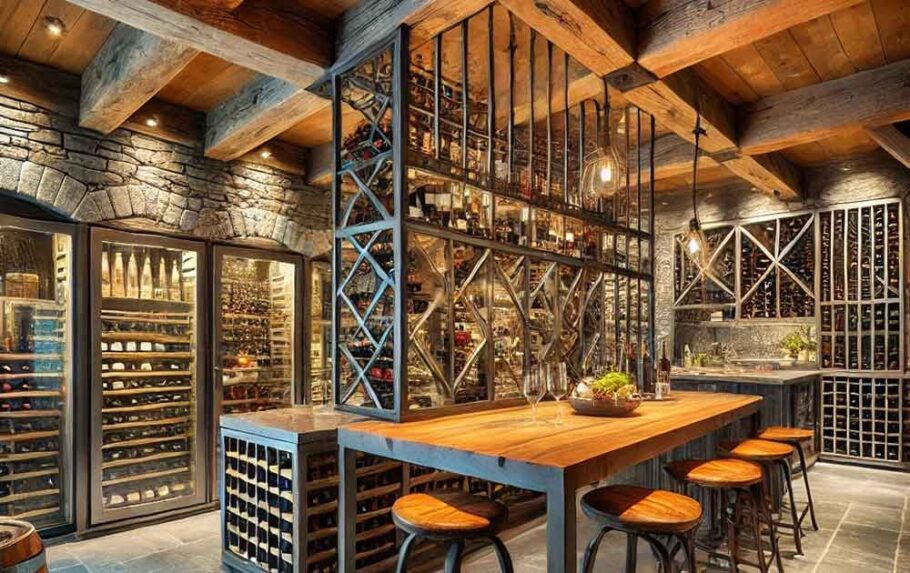
There’s something about walking into a space and not seeing a single column in the way. No posts interrupting the view, no load-bearing walls dictating where the furniture goes—just an open expanse that seems to defy the rules of how buildings are supposed to work. That’s the experience a diagrid barndominium delivers, and it’s why more people are starting to pay attention to this unusual approach to construction.
The idea itself is fairly straightforward, even if the engineering behind it isn’t. Take the basic concept of a barndominium—that practical, barn-inspired structure that’s been showing up everywhere from rural properties to suburban lots—and wrap it in a diagonal steel framework that does all the heavy lifting. Literally. The result is something that looks nothing like what’s next door and functions in ways conventional framing simply can’t match.
So What Exactly Is a Diagrid Barndominium?
The word itself is just a contraction of “diagonal grid,” which describes exactly what you’re looking at. Instead of vertical columns holding up horizontal beams—the way buildings have been framed for centuries—a diagrid uses steel members set at angles, forming a pattern of triangles across the exterior.
Those triangles matter. They’re what make the whole thing work.
Think about it this way: a rectangle, when pushed from the side, wants to collapse into a parallelogram. That’s why traditional buildings need diagonal bracing or shear walls hidden inside them. But a triangle? Push on a triangle and nothing moves unless something breaks. The geometry itself resists deformation. When you cover a building in triangles, suddenly the whole structure becomes inherently stable without needing all the extra internal support systems.
Buildings like London’s “Gherkin” or New York’s Hearst Tower use this principle to reach incredible heights while using less steel than conventional skyscrapers. The same idea applied to a barndominium might seem like overkill until you stand in a room that’s fifty feet across with nothing overhead but ceiling.
Why Bother Putting Them Together?
Barndominiums have always been about flexibility. The whole point was taking the simple, rugged form of a barn and making it livable—open spaces, high ceilings, rooms that could be workshops today and guest quarters tomorrow if you changed your mind. But that flexibility hits a wall, literally, when you need to support the roof.
Traditional framing wants posts, interior walls. Wants something every twenty feet or so to carry the load down to the ground. You can work around it, sure, but you’re always compromising somewhere.
A diagrid changes that equation completely.
The space opens up. Without interior columns, the floor plan becomes whatever you want it to be. Want the living room to flow into the workshop into the home gym without a single post breaking your line of sight? Done. Want to rearrange rooms next year without working around structural elements? Also done.
The structure becomes the architecture. Most buildings hide their framing behind drywall and siding. A diagrid does the opposite—it announces itself. The steel becomes the face of the building, a deliberate pattern that catches light and shadow differently throughout the day. It’s not for everyone, but for those who want something that stands out, it certainly delivers.
There’s an efficiency to it. Because the loads distribute through the grid so effectively, you can often use less steel overall than you would with conventional framing. The material goes where it’s needed most, and the triangulation means everything works together instead of each beam carrying its own isolated load.
How the Barndominium Engineering Actually Works
Without getting too deep into the calculations, the basic principles are worth understanding if you’re considering this approach.
When you stand in a conventionally framed building, the roof weight bears down on beams, which transfer that load to girders, which pass it to columns, which finally send it to the foundation. Wind pushing against the walls gets handled by separate bracing systems—either diagonal steel cables hidden in the walls, or plywood shear panels, or moment connections that resist rotation at the beam-column joints.
A diagrid does both jobs at once. Those diagonal members, typically set at angles between 60 and 70 degrees for optimal performance, carry gravity loads down to the ground while simultaneously acting as bracing against lateral forces. The triangles distribute stress throughout the grid, so no single member bears the brunt of anything. If one element gets overloaded, the load finds another path.
This redundancy is what makes the system so robust. In a conventional frame, if a critical column gets compromised, you’ve got a problem. In a diagrid, the loads just reroute through adjacent members. The structure adapts.
The Real Benefits People Actually Care About
For someone living in one of these buildings, the engineering discussions matter less than what the space feels like day to day.
That feeling of openness is the thing owners mention first. When you’re not looking at posts every twenty feet, the space feels bigger than its actual square footage. Vaulted ceilings become truly dramatic instead of just tall. Long sightlines through the building make it feel like a single, unified space even when different functional areas are defined within it.
Natural light behaves differently. With the diagrid creating a pattern across the facade, glazing gets installed between the steel members rather than in conventional rectangular punched openings. The result is walls that are as much glass as they are structure, with views framed by the diagonal pattern in ways that draw the eye outward.
There’s a solidity to it. Steel frames, especially triangulated ones, don’t creak in the wind or transmit vibrations the way lighter construction might. Standing in a diagrid building during a storm, there’s a sense of being inside something substantial—which, to be fair, you are.
It looks like nothing else in the neighborhood. For properties where standing out is part of the appeal—rural retreats, artist studios, vacation homes meant to make an impression—the diagrid delivers architectural distinction without trying too hard. The pattern is the ornament.
What Makes It Complicated
Nobody should pretend this is the easy path. Diagrid construction comes with challenges that conventional building avoids entirely.
The cost difference is real. Custom steel fabrication, specialized engineering, connections that have to be designed and detailed individually rather than pulled from a catalog—these add up. For projects on tight budgets, conventional framing still makes more sense. The premium varies by project, but it’s there.
Thermal bridging requires serious attention. Steel conducts heat. A lot of it. When structural members run continuously from inside to outside, they create a path for heat to escape in winter and enter in summer. Insulation strategies have to account for this—continuous exterior insulation, thermal breaks at connections, careful detailing to keep the steel from compromising the building envelope. It’s solvable, but it takes thought and money.
Engineering isn’t something you can wing. This isn’t a system where you rough out the design and have the steel fabricator figure it out in the shop. Every member, every connection, every load combination has to be analyzed before anything gets cut. Finding engineers with experience in non-orthogonal framing can be a challenge depending on where you’re building.
Mechanical systems need different thinking. With no interior columns to run ducts and pipes alongside, everything has to be coordinated into floor-ceiling assemblies or exposed as part of the design. The open plan that makes the space so appealing also means there are no hidden chases to route services through. It’s manageable with early planning, but it’s different from conventional construction.
For Someone Considering This Route
If you’re thinking about whether a diagrid barndominium makes sense for your situation, a few things are worth keeping in mind.
Know what you want from the space before you start. The diagrid geometry gets established early and has ripple effects through everything else. If you know you want certain spans, certain ceiling heights, certain relationships between spaces, that information needs to inform the grid design from the beginning.
Build the right team before you need them. Architects who understand exposed structure. Engineers who’ve done triangulated frames before. Fabricators with digital modeling capabilities and experience in custom steel. Finding these people early, before the design is locked in, prevents problems later.
Think about how the building will perform over time. Steel lasts indefinitely with proper protection, but coatings need maintenance. Connections need inspection. Access to the exterior for cleaning and repainting should be considered while the design is still on paper, not after the building is finished with no way to reach the upper portions.
Visit one if you can. There’s no substitute for standing inside a space framed this way. Photos show the pattern, the light, the openness—but they can’t convey the experience of being in a room with no visible means of support, looking up at a ceiling that seems to float overhead without columns to explain how it’s staying there.
Where the Idea Is Headed
The diagrid barndominium fits into a larger pattern in residential design. More people are asking for buildings that don’t look like their neighbors’ houses. More people want spaces that adapt to how they actually live rather than forcing them to adapt to the building. More people are willing to invest in a structure that expresses itself honestly instead of hiding behind finishes.
As design tools get better and fabrication becomes more accessible, the cost barrier will continue to drop. Parametric modeling lets designers explore options quickly. CNC-controlled steel processing makes complex geometry routine. Each built project provides reference for the next.
For now, though, these buildings remain relatively rare—which is part of their appeal. In a world of production homes and standard details, a diagrid barndominium makes a statement simply by existing. It says that somebody cared enough about how their space felt to build it differently. That they valued openness over convention, expression over anonymity.
And standing in the middle of that open space, looking up at the steel pattern that makes it all possible, it’s hard to argue with the result.