
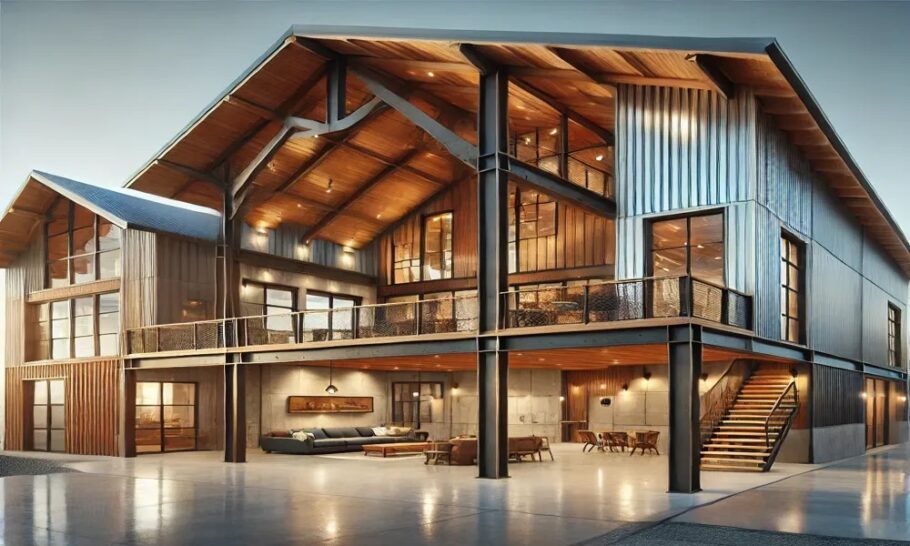
You know how barndominiums have always been about getting the job done? Steel beams, open space, metal walls that don’t quit—these things are built to handle whatever gets thrown at them. But here’s a thought I’ve been turning over lately: what if we stopped thinking about durability as the only win?
What if we built a barndominium that could also, when the time came, be taken apart like it was never there?
That idea has a name. It’s called Design for Disassembly, and it flips the usual way of thinking about construction on its head.
The Basic Idea
Most buildings are put together like they’re going to live forever. Nails get driven, glue gets spread, concrete gets poured, and good luck ever separating any of it without a wrecking bar and a lot of swearing. When the building’s useful life is over—maybe the family moves, maybe the land gets sold, maybe a highway comes through—all that material heads to the landfill.
Design for Disassembly looks at the same building and sees something different. It sees a collection of parts that could be used again. Every beam, every panel, every screw gets chosen and installed with the understanding that someday, someone might want to take it all apart and put it somewhere else.
The questions change. Instead of “how do I make this permanent?” you start asking:
Can I bolt this instead of weld it?
If I take this wall panel off in ten years, will it still be usable?
Do I actually need a concrete slab, or is there something that doesn’t lock me to this piece of ground forever?
What happens to these materials when I don’t need them here anymore?
In a regular house, demolition means trash. In a house built for disassembly, demolition turns into reverse assembly. You’re just doing the steps backward.
Why Barndominiums Make Sense for This
Here’s the thing about barndominiums—they’re already halfway there. Most of them use pre-engineered steel systems, the kind that companies like Morton or Mueller put up. And those systems? They’re bolted together. They use modular panels. They’re designed to be assembled efficiently in the first place.
Compared to a stick-built house where every wall is holding up something else, barndominiums tend to have:
- Steel frames with actual bolts holding them together
- Wide open spaces without load-bearing interior walls
- Metal panels for the outside that screw on and off
- Structural parts that you can actually see and get to
All of that plays nice with disassembly. When you design intentionally for it from the start, you can take those advantages even further.
The Frame: Bolts Beat Welds
The steel frame is what holds everything up. In a conventional building, you might weld connections because it’s fast and strong. But welds are permanent. Cut them apart and you damage the steel. You lose material value and spend a lot of labor getting there.
A frame built for disassembly uses bolted connections. Not just any bolted connections—ones designed to be taken apart and put back together again.
That means:
- Using the same bolt sizes everywhere so you don’t need five different wrenches
- Keeping connection plates where you can actually reach them
- Not burying structural connections inside walls where nobody can get to them
- Labeling beams and columns so whoever comes later knows what goes where
Think of it like really heavy-duty shelving. Every piece comes off, gets inventoried, and bolts back onto something else somewhere else.
Some designers have started building in modular frame bays—sections that can be removed or added without touching the rest of the structure. For somebody who might need to move or expand down the road, that’s not just theory. That’s money in the bank.
Foundations That Don’t Chain You to the Ground
Concrete slabs are the enemy of disassembly. Once that stuff is poured, it’s there. Breaking it up destroys whatever value the concrete had and creates a pile of rubble that’s hard to do anything useful with.
A barndominium built to come apart looks at foundations differently.
There are options:
Pier foundations put the weight on specific points instead of one giant slab. Those piers can come out when you’re done.
Helical piles are steel posts that screw into the ground like giant corkscrews. With the right equipment, you can unscrew them and pull them right back out. The ground barely knows they were there.
Precast concrete blocks can sit under the structure without being permanently attached. Move them around, take them away, reuse them somewhere else.
Elevated steel platforms lift the whole building off the ground. No digging, no pouring, no permanent attachment to the land.
If you’re in flood country or dealing with iffy soil, some of these options help with those problems too. It’s not just about being able to move—it’s about being smarter about how you touch the land in the first place.
The Outside: Panels That Come Off Clean
Metal siding and roofing are actually some of the most reusable materials out there. Corrugated steel panels screwed onto the frame can come right back off with minimal damage if they’ve been installed right.
The trick is discipline.
You have to avoid going crazy with sealants that glue everything together. You use screws with gaskets instead of tapes and adhesives. You layer your flashings in a logical way so they make sense to the person taking them apart. You document which panels go where.
When the day comes to take it down, the roof panels come off first. Then the wall panels. Then the secondary framing underneath. Every piece can go somewhere else and be useful again.
The Inside: Not Built Like a Trap
This is where most disassembly plans fall apart, because conventional interiors are built to be permanent. Drywall screwed and glued to studs. Spray foam that bonds to everything it touches. Tile set in mortar that’s never coming loose.
An interior built for disassembly looks different.
Walls can be metal stud systems bolted to tracks on the floor and ceiling. You can use modular wall panels that come down as units. There are commercial partition systems designed specifically to be demountable—they look like finished walls, but they unbolt.
Wiring and plumbing run through accessible chases, not buried behind finishes. Raised floors—the kind you see in office buildings—let you run everything underneath where you can get to it.
Insulation? Battens or rigid panels, not spray foam that fuses to the steel.
Cabinets and millwork? Modular units that aren’t tied into the structure.
The word to keep in mind is reversible. Can you undo it without destroying something else to get there?
Mechanicals That Don’t Get Trashed
HVAC units, ductwork, plumbing, electrical panels—all of that stuff costs money and takes energy to make. In a conventional tear-down, most of it gets damaged or thrown out.
In a DfD barndominium, you think ahead.
Ductwork runs in accessible sections, not buried where you’d have to cut walls open. Equipment sits on bolted platforms instead of concrete pads. Conduit runs where you can see it or at least get to it. Plumbing uses manifolds so you can disconnect whole sections at once.
When it’s time to move, you disconnect carefully and take it with you. For off-grid setups with solar and batteries and rainwater collection—all that stuff is already modular anyway. It fits the approach naturally.
The Paperwork: Yes, You Need a Manual
Here’s something most homeowners never think about: a building materials passport. It’s exactly what it sounds like—a manual for your building.
It catalogs:
- What size every beam is and where it goes
- What fasteners were used and how tight they should be
- What order the panels go on and come off
- Where every wire and pipe runs
- Who made all this stuff
- How you might reuse it later
When someone needs to change the building or take it apart, they’re not guessing. They have a roadmap.
Some builders go further and tag structural members with permanent ID numbers. Scan them and you know exactly what you’re dealing with.
For a rural property owner, that might mean selling parts of the building if land use changes. For a developer, it might mean picking up a whole structure and moving it somewhere else.
Why You Might Care About Any of This
The environmental piece is straightforward. Construction waste is a huge part of what fills up landfills. Building things so they can come apart keeps materials in use instead of burying them.
But the financial piece matters too.
A regular barndominium depreciates like any other building. A DfD barndominium holds onto value because the parts can be recovered. Steel frames, metal panels, modular components—all of it can be sold, reused, or relocated.
If land values shift or your situation changes, mobility matters. Being able to move your primary structure instead of abandoning it? That’s not science fiction. It’s just engineering with the future in mind.
Growing Over Time
Another angle: phased building.
Start with a smaller barndominium—say 1,200 square feet. Ten years later, you need more room. Instead of knocking out walls or tacking on an addition that fights the original structure, you add modular bays to the steel grid.
Clear-span steel makes that simple in a way that wood framing with load-bearing walls never can.
Same thing if your home business takes off and you need to reconfigure space. Interior modules rearrange without touching the structure. The building grows and changes instead of getting replaced.
It’s Not All Easy
I should be straight with you—this approach has trade-offs.
Design costs more upfront because you have to think through everything in advance. Engineers have to coordinate details that would normally get sorted in the field.
Some finishes won’t work. If you want full stone veneer set in mortar, that’s not coming apart cleanly. The aesthetic leans a little more industrial by necessity.
And some people hear “designed to come apart” and think it must be flimsy. That’s not true—bolted steel is incredibly strong. It’s just reversible. There’s a difference.
What It Looks Like
You might be picturing something that looks temporary. That’s not the case.
A well-designed disassemblable barndominium can be refined and finished. Clean steel lines, wood accents, carefully detailed joints—none of that is off the table.
There’s actually something appealing about exposed connections. When you can see how things go together, craftsmanship becomes part of the look. The building tells you how it was made.
A Real-World Example
Say someone builds a 2,000-square-foot steel barndominium on helical piles. Bolted frame, removable panels, modular interior, accessible mechanicals.
Fifteen years later, a highway project triples the land value. Instead of bulldozing the house, they hire a crew to reverse-assemble it. The steel frame gets cataloged and trucked to new property. Panels and interior pieces follow.
The original site gets a couple of holes where the piles came out. Those fill in. Grass grows. The land is ready for whatever comes next.
The building lives somewhere else.
That’s the idea in practice.
Where This Is Headed
Sustainability standards are tightening. Material costs are unpredictable. Design for Disassembly is going to keep moving from the edges toward the middle.
Barndominiums, with their steel skeletons and modular bones, are in a good spot to lead that shift.
For builders, the takeaway is simple: start thinking beyond the first owner. Connections, materials, systems—all of it should be chosen with an eye toward recovery.
For owners, the question becomes strategic. Do you want a building that’s stuck where it sits when your life changes? Or one that can pick up and move with you?
A Design for Disassembly barndominium isn’t about building something temporary. It’s about building something flexible. Something responsible. Something that holds onto its value instead of losing it.
When you stop treating buildings as disposable and start treating them as collections of usable parts, the whole economics of construction shift.
Out there in the wide-open country where barndominiums belong? That kind of thinking fits right in.