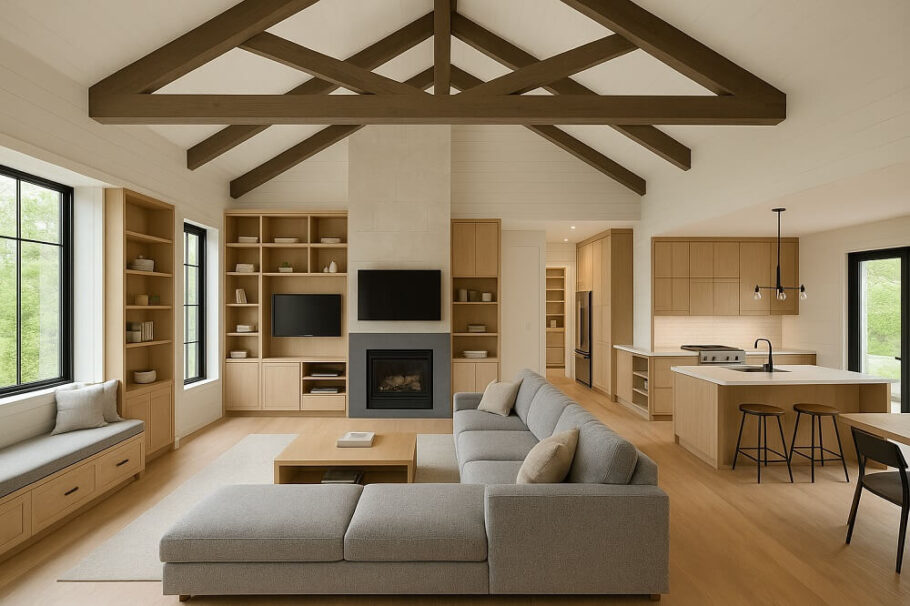
The modern homeowner is no longer satisfied with static spaces. Families grow, careers change, hobbies evolve, and lifestyles shift in ways that traditional floor plans struggle to accommodate. Enter the convertible barndominium—a forward-thinking approach to post-frame and steel-frame living that prioritizes adaptability without sacrificing strength, style, or efficiency.
A convertible barndominium is not just a metal home with open space. It is a deliberately engineered structure designed so rooms, functions, and layouts can transform over time with minimal demolition or rebuilding. Today it might be a family residence with a workshop. Tomorrow it could become a rental unit, home business hub, multi-generational residence, or hybrid living-commercial space.
In this guide, we explore what makes a barndominium truly convertible, how to design one correctly, the structural and mechanical considerations, and why this concept represents the future of long-term residential planning.
What Defines a Convertible Barndominium?
A convertible barndominium is a building that supports multiple future configurations through:
- Non-load-bearing interior partitions
- Modular mechanical and plumbing routing
- Flexible ceiling heights and spans
- Structural systems designed for multiple occupancy types
- Zoning-aware planning for future use changes
Unlike standard homes, where walls, ducts, and plumbing often dictate permanent layouts, a convertible barndominium uses its steel or post-frame skeleton as the primary structural system. Everything inside is treated as adaptable.
This allows the interior to be reconfigured without compromising the building’s integrity.
Why Convertibility Matters More Than Ever
Changing Family Structures
Families now experience more transitions than previous generations. Children leave and return. Parents move in. Remote work reshapes living needs. Convertible layouts allow a home to evolve instead of forcing owners to move.
Rising Construction Costs
Demolishing and rebuilding interior layouts is expensive. Designing convertibility from day one dramatically reduces future renovation costs.
Income Flexibility
A convertible barndominium can shift between:
- Primary residence
- Short-term rental
- Long-term rental
- Mixed-use commercial
- Event space
- Workshop or studio
Few building types offer this level of income adaptability.
Longevity of Investment
Rather than building for a single lifestyle moment, convertibility ensures your barndominium remains relevant for decades.
Core Structural Principles of a Convertible Barndominium
Clear Span Framing
Steel rigid frames or post-frame trusses allow wide open interior spaces without interior load-bearing walls. This is the foundation of convertibility.
With clear spans of 40, 60, or even 80 feet, layouts can be changed repeatedly without structural modification.
Over-Engineered Load Capacity
Designing roof and floor systems to support future mezzanines, lofts, or second stories ensures vertical flexibility later.
Column Placement Strategy
Column spacing is planned so that future walls can align logically without awkward offsets.
Floor Load Ratings
Slabs are designed for heavier live loads so future workshops, gyms, or equipment areas are structurally supported.
Interior Design Strategies That Enable Conversion
Movable Wall Systems
Using:
- Metal stud partitions
- Track-mounted walls
- Panelized wall systems
Allows rooms to be added, removed, or relocated easily.
Consistent Ceiling Heights
Avoid dramatic ceiling drops that restrict future conversions. Uniform heights simplify future reconfiguration.
Door and Window Symmetry
Planning openings so rooms can be subdivided later without requiring new exterior cuts preserves structural integrity and appearance.
Mechanical Planning for Convertibility
Zoning HVAC Systems
Instead of one large HVAC unit, use multiple smaller zones. This allows spaces to be isolated or merged later.
Oversized Mechanical Chases
Dedicated vertical and horizontal chases allow future duct, plumbing, or electrical rerouting without opening finished walls.
Plumbing Stub-Outs
Pre-install capped plumbing lines in strategic locations to support future bathrooms, kitchens, or wet bars.
Electrical Distribution Grids
Rather than single radial circuits, grid-based distribution panels allow easier future branching.
Popular Convertible Barndominium Layout Paths
Residence to Duplex
Initial layout:
- Single family home
Future conversion:
- Two rental units
- Shared mechanical core
- Separate entrances
Home Plus Workshop to Business Facility
Initial layout:
- Living quarters with garage or shop
Future conversion:
- Studio
- Office
- Small manufacturing
- Retail showroom
Family Home to Multi-Generational Living
Initial layout:
- Open great room
- Master suite
- Guest room
Future conversion:
- Two master suites
- Separate kitchenette
- Shared living core
Residence to Event Space
Initial layout:
- Open floor plan
Future conversion:
- Removable partitions
- Restroom expansion
- Storage areas
- Catering prep zone
Convertible Loft and Mezzanine Design
Lofts are a key element of convertible barndominiums.
Design them to be:
- Structurally independent
- Removable or expandable
- Supported by beam grids rather than walls
A loft might start as storage, later become a bedroom, then an office, and finally a rental suite.
Exterior Design for Multi-Use Conversion
Exterior planning matters just as much as interior.
Multiple Entry Points
Separate entrances allow future unit division or business access.
Parking Layout Flexibility
Driveways and parking areas are sized for residential and commercial needs.
Covered Overhangs
Can later become storefront awnings, patio spaces, or loading zones.
Neutral Architectural Style
Avoid overly residential or overly industrial designs. A balanced aesthetic allows smoother functional transitions.
Legal and Zoning Considerations
Before committing to a convertible barndominium, always evaluate:
- Zoning classifications
- Future permitted uses
- Parking requirements
- Fire separation rules
- ADA compliance potential
Designing to meet higher standards initially often saves major renovation costs later.
For example, designing stair widths, door clearances, and restroom spacing with ADA guidelines in mind allows easy future public use.
Cost Comparison: Convertible vs Traditional Build
Initial Cost
Convertible designs typically cost:
- 5–12% more initially
Due to:
- Larger spans
- Stronger framing
- Mechanical foresight
Long-Term Savings
They save significantly by avoiding:
- Structural demolition
- Mechanical relocation
- Slab cutting
- Roof modifications
Over 20 years, convertible designs almost always prove less expensive than rigid layouts.
Common Mistakes That Reduce Convertibility
Over-Using Load-Bearing Interior Walls
This locks the layout permanently.
Under-Sizing Mechanical Systems
Future additions become expensive or impossible.
Ignoring Future Plumbing Locations
Cutting slabs later is costly and disruptive.
Designing Only for Today
Many owners regret not planning for future income or lifestyle changes.
Sustainability Benefits of Convertible Barndominiums
Adaptable buildings reduce demolition waste, extend building life, and reduce material consumption over time.
Instead of tearing down and rebuilding, owners reconfigure.
This aligns perfectly with modern sustainability principles and responsible construction.
Convertible Barndominiums for Business Owners
Entrepreneurs benefit enormously from this model:
- Live-work studios
- Home offices that expand into full offices
- Warehouses that convert into residences
- Retail that converts back to residential
This flexibility protects business investments against market changes.
Designing for Technology Evolution
Future-proof convertible barndominiums also include:
- Conduit pathways for future wiring
- Server or network closets
- Roof reinforcement for solar expansion
- EV charging infrastructure planning
These upgrades cost little during construction but are expensive later.
The Emotional Advantage of Convertibility
Beyond technical benefits, convertible barndominiums provide emotional security.
Owners know they are not trapped by their home’s design. They can adapt rather than relocate. The building supports life’s transitions instead of resisting them.
That psychological freedom is one of the most underrated benefits of convertible design.
Is a Convertible Barndominium Right for You?
If you value:
- Long-term flexibility
- Financial adaptability
- Multi-use potential
- Sustainable living
- Smart construction investment
Then a convertible barndominium is not just a building—it is a strategy.
Final Thoughts
The convertible barndominium represents the next evolution of residential and mixed-use design. It respects the reality that life does not stay still. Careers change. Families evolve. Markets fluctuate. Dreams expand.
By designing a barndominium that can convert gracefully instead of fighting change, you future-proof not only your property—but your lifestyle.