
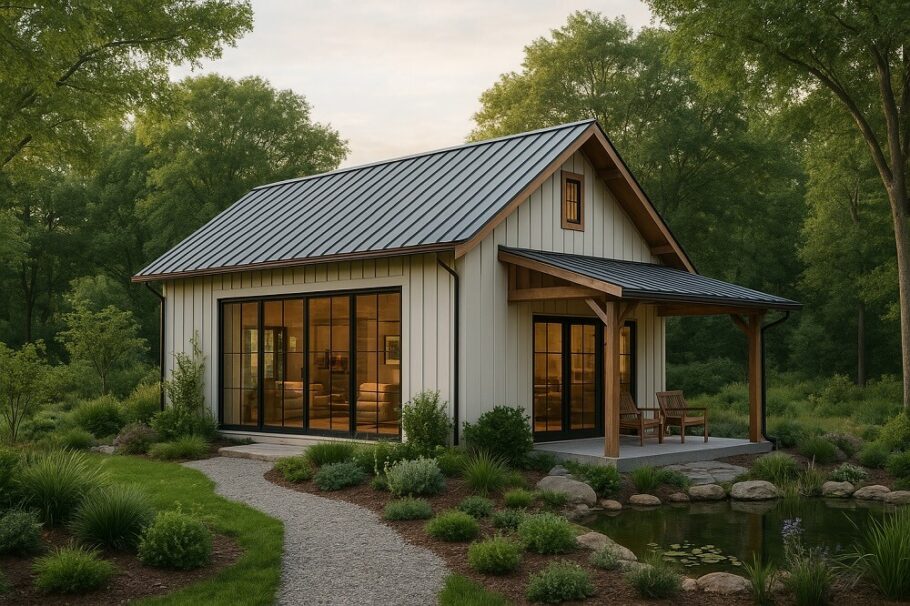
There is a quiet revolution taking place in rural architecture, and it smells faintly of basil and freshly turned earth. The barndominium—once a humble metal building converted for living space—has matured into something far more deliberate. Among the most striking recent examples stands a property known simply as the “Chef’s Garden.” This is not a barndominium with a pretty herb box on the windowsill. This is a home where the kitchen and the garden share a bloodstream.
At first glance, the structure looks like many high-end barndominiums: a gambrel roof, wide plank siding, oversized sliding glass doors, and a deeply pragmatic exterior. But step inside, and the intent becomes immediately clear. The kitchen, sprawling and unapologetically industrial in function, stretches along the entire southern wall. Directly outside that wall—not ten feet away—lie raised beds, cold frames, and a compact vegetable patch arranged in precise geometric rows. No fence, no hedge, not even a full step down from the threshold. Just a weatherproof mat, then soil.
A Marriage of Convenience and Intent
Most homes treat the garden as an afterthought. A plot out back, around the side of the garage, somewhere the hose reaches but the cook rarely visits. The Chef’s Garden barndominium inverts that logic entirely. Here, the garden is not an accessory to the house. The house is an accessory to the garden.
The owners, both classically trained chefs who stepped away from restaurant life, designed the property around a single obsessive question: How close can the harvest be to the heat? The answer they arrived at is almost absurdly direct. The kitchen’s main prep sink sits on the exterior wall, with a pass-through window that opens onto a stainless steel counter outside. A cook can step from the stove to the garden in four paces. In the other direction, from the garden to the range, also four paces.
This proximity changes everything about how the space is used. Herbs are not gathered in a single morning harvest and stored in the refrigerator. They are cut as needed, seconds before hitting the pan. Salad greens go from bed to bowl in under sixty seconds. Root vegetables are brushed free of soil at the outdoor sink, then brought inside still damp with morning dew.
The Anatomy of a Working Kitchen
Let the design speak for itself, because every choice here serves motion. The kitchen itself is arranged in a strict work triangle, but one that incorporates an exterior leg. The cooktop, a six-burner gas range with a griddle, anchors the center island. The main refrigerator stands opposite the island. The prep sink and the garden pass-through occupy the third point. That means a cook can grab eggs from the fridge, step to the prep sink to wash chives, lean through the window to snip a few more, and return to the range without ever backtracking.
Countertops are acid-etched concrete—cool, durable, and indifferent to tomato stains. Flooring transitions from sealed concrete inside to a slip-resistant composite on the outdoor landing, then to decomposed granite paths that weave through the beds. The visual continuity is intentional. No jarring change in material suggests that one space ends and another begins. The eye travels from the butcher block to the broccoli without obstruction.
Upper cabinets exist only on the north wall. The southern exposure remains entirely open, a continuous ribbon of glass framed in black steel. These are not decorative windows. They are operable panels that slide open completely, turning the garden into an open-air pantry on mild days. When fully opened, the kitchen loses its fourth wall entirely. The line between inside and outside becomes a negotiation, not a boundary.
Designing the Beds for the Cook, Not the Landscaper
Most vegetable gardens are arranged for the convenience of the gardener. Rows run north to south for sun exposure. Tall plants go in the back. Trellises face away from the house for aesthetics. The Chef’s Garden throws all of that out. The beds are arranged for the convenience of the cook standing at the stove.
The most frequently used herbs—basil, parsley, cilantro, chives, thyme, rosemary—occupy a raised bed that runs parallel to the kitchen wall, no more than three feet from the pass-through window. Each herb has its own compartment within the bed, labeled not with cute wooden signs but with small metal tags at eye level. An experienced cook doesn’t need labels, but the system helps visiting friends or family members grab the right leaf without guessing.
Next to the herbs, a compact bed of salad greens: arugula, mizuna, oak leaf lettuce, and a perpetual sowing of mesclun mix. This bed sits slightly lower than the herbs, shaded by them in the afternoon but catching full morning sun. The design recognizes that lettuce bolts in high heat, so a simple shade cloth on rollers allows a cook to pull cover over the greens in ten seconds during July afternoons.
Beyond the greens, a triangular bed holds scallions, radishes, and baby carrots—quick vegetables that go from seed to plate in under forty days. These are the workhorses of the kitchen. A cook can lean out, pull three radishes, and have them shaved onto a salad before the dressing emulsifies.
The perennial vegetables and larger plants occupy beds further out. Asparagus, rhubarb, artichokes, and a small patch of perennial kale sit at the garden’s edge, visible but not within arm’s reach of the kitchen. This intentional hierarchy of distance mirrors the frequency of use. What a cook needs daily stays closest. What a cook needs weekly sits twenty feet away. What a cook needs monthly or seasonally occupies the periphery.
Water, Soil, and the Rhythm of the Cook
A kitchen garden designed for direct culinary access requires a different watering philosophy than an ornamental border. The Chef’s Garden uses a hybrid drip and micro-spray system controlled from inside the kitchen. A small panel next to the pass-through window allows the cook to water individual zones without stepping outside. But the design also includes a hand-watering station at each bed, because some tasks—spot watering, washing aphids off a single kale leaf, checking soil moisture—require hands and eyes.
The soil itself receives as much attention as the meals. Each bed was built using a modified square-foot gardening method, with a mix of compost, coconut coir, vermiculite, and aged manure. The beds are narrow—never wider than three feet—so a cook standing at the edge can reach the center without stepping onto the soil. Compacted garden beds are the enemy of a lazy cook. When every step requires effort, the distance from kitchen to garden suddenly feels longer. Keep the cook out of the beds, and the garden stays loose, aerated, and welcoming.
Season extension is built into the framework. Each bed has pre-drilled anchor points for PVC hoops, and a stack of clear polyethylene covers and frost blankets hangs on the wall of the adjacent mudroom. A cook making breakfast in November can glance out the window, see a frost warning on the phone, and throw covers over the remaining basil and cherry tomatoes without putting on a coat. That same cook can uncover the beds the next morning when temperatures rise, extending the season by six weeks on either end.
The Unseen Infrastructure
What makes the Chef’s Garden work is not visible from the kitchen window. Beneath the concrete slab lies a network of hydronic heating pipes that serve the house. The same boiler that warms the floors in winter sends residual heat through a loop that runs just beneath the raised beds. This is not enough to grow tropical plants in a Minnesota January, but it raises the root zone temperature by eight to ten degrees, allowing cold-hardy greens like mâche, claytonia, and spinach to survive light freezes without protection.
A rainwater collection system feeds the garden. The barndominium’s metal roof directs water into two 500-gallon cisterns tucked beneath a wooden deck. A simple pump and filtration system delivers that water to the drip irrigation network. The chef never thinks about water bills. The garden never tastes chlorine or chloramine. And the entire system operates on a timer that respects the cook’s schedule—watering happens at 5:00 AM, before anyone enters the kitchen, so the beds are damp but not sodden during harvest hours.
Compost happens twenty feet from the kitchen door. Two tumbling bins sit behind a small screen of hazelnut shrubs. Vegetable scraps from prep work go straight from the cutting board into a covered bucket beneath the prep sink. At the end of each cooking session, that bucket travels to the compost bins. The cycle from soil to plant to kitchen back to soil takes less than ninety days during the growing season. There is something profoundly satisfying about watching a handful of parmesan rinds and onion skins return to the earth and eventually feed a new crop of garlic scapes.
Aesthetics as a Byproduct of Function
This barndominium does not try to look like a rustic farmhouse or a sleek modern loft. It looks like what it is: a machine for cooking. The aesthetic emerges from utility. Exposed steel beams support the roof. Concrete floors show the faint ghost of footprints. The garden beds are built from untreated cedar and galvanized steel, materials chosen for longevity, not charm. And yet the space feels beautiful in a way that curated interiors rarely achieve. There is an honesty to it. Nothing pretends to be something else.
The connection between kitchen and garden changes how people behave in the space. Guests gravitate to the windows. Children ask to pick the cherry tomatoes. A cook who might otherwise feel isolated while preparing a holiday meal can talk to someone standing in the garden, handing over a sprig of rosemary through the pass-through. The design defeats the loneliness of the kitchen without sacrificing efficiency.
The Practical Truth About Pests and Weather
No honest description of a garden-connected kitchen can ignore the realities of bugs, dirt, and weather. The Chef’s Garden addresses each with straightforward solutions. The pass-through window seals tightly when closed, with a magnetic gasket that keeps ladybugs and fungus gnats where they belong. The outdoor sink includes a garbage disposal and hot water for washing muddy hands and tools before coming inside. A covered boot bench and a rack of gardening clogs sit just outside the door, so no one tracks soil across the kitchen floor.
In heavy rain, the garden is still accessible. A retractable awning mounted above the windows extends twelve feet, creating a dry corridor from the kitchen door to the first row of beds. In summer heat, the same awning provides afternoon shade for the cook standing at the outdoor sink. These are not luxury additions. They are simple solutions to obvious problems, installed because a garden that becomes unpleasant to access in bad weather might as well be a hundred yards away.
Why This Matters Beyond One Property
The Chef’s Garden barndominium matters because it points toward a different way of thinking about home design. For decades, kitchens and gardens have drifted apart. Suburban lots pushed vegetable patches to back corners. Apartment balconies reduced herbs to sad little pots. Restaurant kitchens source from distributors, not from the soil outside the back door. The chef’s home reclaims something ancient and valuable: the simple efficiency of harvesting food and cooking it in the same breath.
This approach does not require a barndominium or a rural setting. The principles scale down. A kitchen window that opens onto a deck planter. A prep sink on an exterior wall. Raised beds within arm’s reach of the stove. Any home can move the garden closer, reduce the friction between wanting an herb and holding it in hand.
What the Chef’s Garden demonstrates, finally, is that distance is the enemy of good cooking. Not the distance between the stove and the refrigerator, or between the knife block and the cutting board. The distance between the cook and the source. Close that gap, even by a few feet, and something shifts. The basil tastes brighter. The lettuce crisper. The cook moves less like someone performing a series of tasks and more like someone completing a single, continuous gesture from soil to plate.
Step into this barndominium’s kitchen, and the message is unmistakable. The garden is not out there. It is right here. And dinner is ten feet away, still growing.