
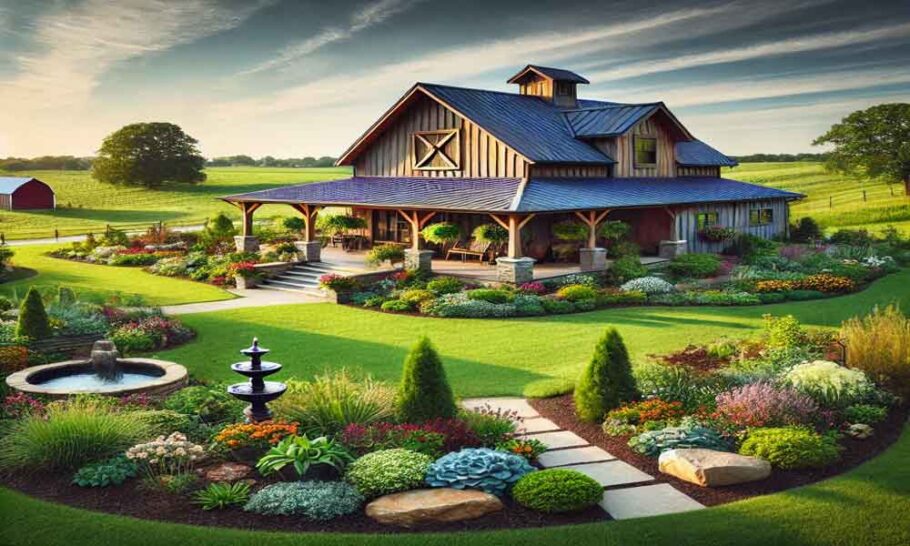
Walk onto any rural property these days and chances are good you will spot one. That soaring metal roof, the clean lines of a post-frame structure, the massive garage doors that hint at both work and worship of weekend toys. The barndominium has well and truly arrived. But here is what separates the forgettable from the truly inspired: the landscape doesn’t stop where the building starts. In the best examples, you cannot tell where one ends and the other begins.
Landscape-integrated design for barndominiums is not an afterthought. It is not a row of foundation shrubs planted the weekend after the concrete was poured. It is the difference between a building that sits on a piece of land and a building that belongs to that piece of land. And as more homeowners trade suburban lawns for acreage with a view, getting this right has become just as important as the floor plan inside.
Breaking the Box Mentality
Most houses fight their surroundings. A traditional two-story colonial dropped into a meadow looks like exactly what it is: an import. Barndominiums have an advantage here because they already borrow from agricultural vernacular. The gambrel roof, the simple massing, the utilitarian materials—these things have existed alongside pastures and hayfields for generations. But that advantage disappears the moment the landscaping turns suburban.
Nothing kills the soul of a barndominium faster than a ring of boxwoods, a crescent of dyed brown mulch, and a flagstone walkway that belongs at a golf course clubhouse. The building wants to stretch out. It wants to feel anchored by the same grasses that move in the wind just beyond the fence line. Integrated design means looking at the clearing where the barndominium sits and asking what was there before. Not what a magazine said should be there.
The Transition Zone That Disappears
Great landscape integration begins in the space where building meets dirt. This transition deserves more thought than a simple foundation planting. For barndominiums, the most successful approach often involves extending the roofline visually through ground plane materials. A wraparound porch or deep overhang creates shelter, but the magic happens when the gravel or crushed stone from the driveway continues under that roof and transitions gradually into larger stone or decomposed granite around the perimeter.
That gradual change does something important. It eliminates the hard edge where the building ends and the world begins. The eye flows from metal wall to stone apron to meadow without ever stopping at a jarring boundary. Rainwater dripping from the eaves falls onto material that handles it naturally. Mud doesn’t collect against the siding. And the whole assembly looks like it evolved rather than being installed.
Letting Water Do the Drawing
Speaking of rain, the way water moves across a property should inform every planting decision around a barndominium. Gutters and downspouts are necessary in many climates, but they do not have to end in plastic splash blocks aimed at a patch of lawn that turns to muck every spring. A shallow swale planted with moisture-loving natives turns roof runoff into a feature. Sedges, rushes, and certain iris varieties thrive on that intermittent water and look entirely at home against a metal building.
Dry streambeds offer another solution that marries function with form. A winding bed of river cobble leading away from a downspout outlet tells a story about where the water goes. It looks intentional, artistic even, while doing real work. The key is to avoid the curlicue, unnatural swirls that announce themselves as decoration. Water flows in relatively straight paths that bend gently around obstacles. Follow that logic and the landscape reads as authentic.
The Working Landscape Aesthetic
Barndominiums grew out of actual barns, and actual barns never sat in the middle of a manicured lawn. They sat in the middle of a working landscape. Embracing that heritage means allowing some roughness around the edges. A swath of native prairie grass that gets mowed once a year. A small fenced area for chickens or goats that doubles as a visual feature visible from the main living space. A hayfield that comes right up to the edge of the gravel parking area.
This approach reduces maintenance dramatically while strengthening the sense of place. The barndominium reads as a farm building that someone happens to live in, which is the entire point. And the wildlife notices too. Birds that avoid a sterile lawn will nest in a patch of bluestem. Pollinators will find the clover and wildflowers that a traditional homeowner might call weeds. The building becomes part of the ecosystem rather than an imposition upon it.
Hardscaping That Learns from the Barn
Patios, walkways, and driveways should borrow from the same palette as the barndominium itself. If the building uses weathered steel for accents, bring that same material into the landscape as edging or a fire ring. If the roof is standing seam in a dark color, echo that tone in the gravel or pavers. Concrete has its place, but a barndominium asks for something grittier. Reclaimed barn timbers make extraordinary benches or pergolas. Corrugated metal panels reappear as raised garden beds or as cladding on an outdoor kitchen.
The drive approach deserves special attention. Too many barndominiums sit at the end of a concrete ribbon that cuts across the property like a zoning violation. A gravel drive that widens gradually as it nears the building feels generous and agricultural. Two parallel strips of concrete with grass growing between them work beautifully for lighter traffic. And the simplest solution of all—no formal drive at all, just a worn path through the grass to a gravel parking area—works better than anything paved.
The View from Inside Matters Most
All of this landscape integration serves a purpose that goes beyond curb appeal. The windows of a barndominium tend to be large, often industrial in scale. Those windows frame the outside world like living paintings. A smart landscape design considers exactly what those frames will hold. The dining table looking west should see the wildflower meadow, not the propane tank. The sofa facing south should look out at the orchard or the pond, not the driveway turnaround.
This means placing elements with interior sightlines in mind. A grove of birch trees might screen the neighbor’s barn while letting through winter light. A cluster of evergreens can block a prevailing wind without blocking a mountain view. The path from the parking area to the front door should be visible from the kitchen window for practical reasons, but it should also wander just enough to feel like a journey rather than a march.
Fire and Function in the Rural Landscape
For barndominiums in fire-prone regions, landscape integration takes on a life-safety dimension that cannot be ignored. The defensible space zones required by fire codes do not have to look like bare dirt and sad gravel. Zone one, the first five feet from the building, works beautifully with noncombustible materials like stone, decomposed granite, or concrete pavers. That same zone can hold potted succulents, a water feature, or metal planters with low-growing ice plants.
Zone two extends from five to thirty feet and allows carefully chosen plants with high moisture content and low resin. Wild strawberries, creeping thyme, and certain sedums hug the ground while providing green coverage. Zone three and beyond can return to native grasses and shrubs, provided they are spaced and maintained properly. A fire-wise landscape can still be lush, beautiful, and fully integrated with the barndominium. It simply requires smarter plant choices and better spacing than the typical ornamental garden.
The Night Landscape
Barndominiums often sit in dark-sky country, and the landscape should honor that. Uplighting trees and grazing light across stone walls creates drama without flooding the sky with wasted lumens. Path lights should be low, shielded, and warm in color temperature. Better yet, skip permanent landscape lighting entirely and rely on a few well-placed portable lights that come on only when needed.
The moon and stars provide the best nighttime landscape design. A clearing that frames the Milky Way, a bench placed to catch the rising moon, a fire pit that casts just enough light to find the next log—these things cost almost nothing and deliver more than any catalog of brass fixtures ever could. The barndominium at night should feel like a shelter in the vast dark, not like a suburban subdivision that lost its way.
Patience as a Design Tool
Integrated landscapes take time to look right, and that is precisely the point. A barndominium surrounded by freshly planted one-gallon perennials looks raw because it is raw. The best designers account for growth and fill and the slow spread of things that spread. They plant some things densely with the understanding that thinning will happen later. They leave gaps for self-sown volunteers. They watch what the land wants to do and steer rather than force.
This runs counter to the instant-gratification approach of most residential landscaping, but barndominiums attract a different kind of owner anyway. Someone willing to build a house out of a pole barn is usually willing to let a landscape find itself over a few seasons. And when it does, when the little bluestem has formed a solid mass and the young oaks have gained some height and the gravel path has settled into a worn track, that is when the barndominium stops being a building on a piece of land and becomes something harder to name. A place, maybe. A proper home that grew there for a reason.