
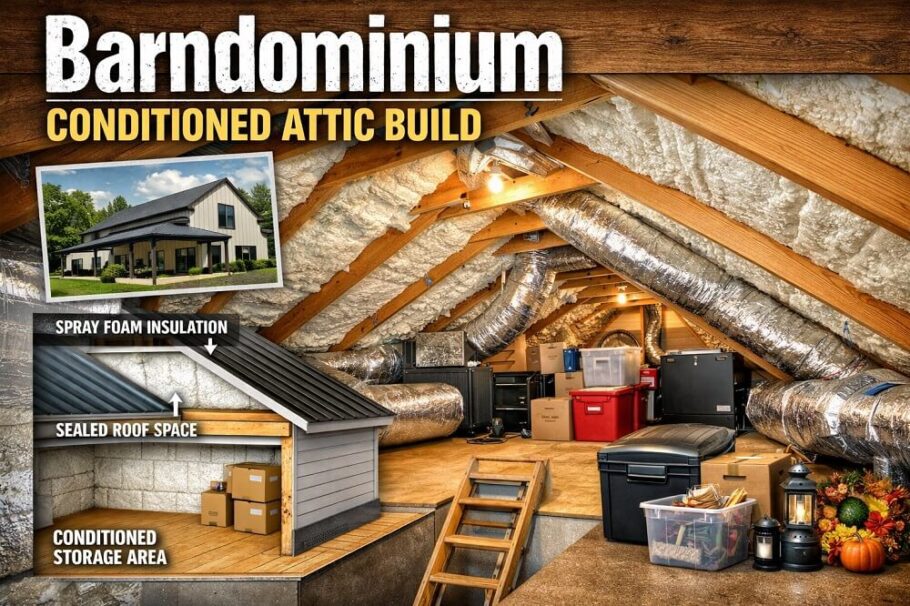
When most people think about a barndominium attic, they picture a hot, dusty space that’s barely usable beyond running a few wires or ducts. Traditionally, attic areas—especially those created by roof trusses—are vented, unconditioned, and exposed to extreme temperatures. In summer they bake, and in winter they freeze. But modern barndominium design is changing that approach.
The conditioned attic is becoming a smart, high-performance upgrade for barndominiums. By sealing and insulating the truss space, builders and owners can transform the attic into a protected, temperature-stable storage area that improves energy efficiency, durability, and long-term comfort.
This article breaks down what a conditioned attic is, why it makes sense for barndominiums, how it’s built, and what to consider before committing to this upgrade.
What Is a Conditioned Attic in a Barndominium?
A conditioned attic is an attic space that is fully sealed and insulated as part of the building’s thermal envelope. Instead of insulating at the ceiling level and ventilating the attic to the outdoors, the insulation is applied directly to the underside of the roof deck and gable walls.
In a barndominium, this usually means insulating along the bottom of the roof panels or roof sheathing, enclosing the entire truss cavity within the conditioned space of the home or shop.
The result is an attic that stays close to indoor temperatures year-round, dramatically reducing heat gain, heat loss, and moisture problems.
Why Conditioned Attics Make Sense for Barndominiums
Barndominiums are uniquely suited for conditioned attic designs. Their wide roof spans, tall trusses, and simple geometry make it easier to create a continuous sealed space compared to conventional homes.
There are several compelling reasons owners are choosing conditioned attics in barndominium builds.
Improved Energy Efficiency
One of the biggest advantages is energy efficiency. In a traditional vented attic, ductwork, air handlers, and wiring are exposed to extreme temperatures. Even well-insulated ducts lose efficiency when sitting in a 130°F attic.
A conditioned attic keeps HVAC components within a mild temperature range, allowing systems to operate closer to their rated efficiency. This can reduce heating and cooling loads, shorten run times, and extend equipment life.
For barndominiums with long duct runs or rooftop mechanical layouts, this benefit is especially significant.
Usable Storage Without Climate Damage
A sealed attic turns wasted truss space into practical storage. Seasonal décor, tools, spare materials, and even sensitive items like documents or electronics can be stored without fear of heat damage, condensation, or pest intrusion.
Because barndominiums often emphasize open living areas and minimal interior walls, indoor storage space can be limited. A conditioned attic helps offset that without adding square footage to the building footprint.
Better Moisture Control
Moisture is a common issue in vented attics, especially in humid climates. Warm, moist air can infiltrate the attic, condense on cold surfaces, and lead to mold growth or wood rot.
Conditioned attics reduce these risks by eliminating uncontrolled airflow and keeping surfaces closer to indoor temperatures. This is particularly beneficial in barndominiums with metal roofing, where condensation can be a serious concern if thermal breaks and vapor control are poorly designed.
Increased Building Durability
By keeping trusses, roof decking, and fasteners within a controlled environment, a conditioned attic reduces thermal stress and moisture cycling. Over time, this can improve the durability of structural components and roof assemblies.
In metal-clad barndominiums, this added protection helps prevent corrosion and fastener fatigue caused by temperature swings.
How a Barndominium Conditioned Attic Is Built
Building a conditioned attic requires careful planning from the design phase. It is not simply a matter of adding more insulation. The entire approach to airflow, moisture, and thermal control changes.
Moving the Thermal Envelope
In a traditional barndominium attic, the thermal boundary is at the ceiling plane. Insulation sits on or above the ceiling, and the attic is vented to the exterior.
In a conditioned attic, the thermal boundary moves to the roofline. Insulation is installed along the underside of the roof panels or roof sheathing, enclosing the attic volume within the conditioned space.
This shift affects everything from insulation selection to mechanical design.
Air Sealing Comes First
Air sealing is the foundation of any successful conditioned attic. Before insulation is installed, all penetrations through the roof and gable walls must be sealed.
This includes:
- Ridge and eave transitions
- Fastener penetrations
- Gable wall joints
- Mechanical and electrical penetrations
In barndominiums, attention must be paid to metal panel seams, purlin connections, and ridge details. Any uncontrolled air leakage can undermine the performance of the entire system.
Insulation Options for Conditioned Attics
Several insulation methods can be used in barndominium conditioned attics, each with pros and cons.
Spray Foam Insulation
Spray foam is the most common choice. Closed-cell foam offers high R-value per inch, excellent air sealing, and added structural rigidity. Open-cell foam provides good air sealing and sound control but requires additional vapor management in some climates.
Spray foam is particularly effective in metal roof assemblies where space is limited and air sealing is critical.
Rigid Foam Board Systems
Rigid foam boards can be installed beneath the roof deck or between framing members. This approach requires meticulous sealing at seams and penetrations but can offer excellent thermal performance when installed correctly.
This method is often paired with interior finishes or protective coverings for fire safety compliance.
Hybrid Systems
Some barndominiums use a hybrid approach, combining spray foam for air sealing with batt or blown insulation to increase overall R-value. This can help manage costs while still achieving performance goals.
Venting Considerations in Conditioned Attics
One of the most misunderstood aspects of conditioned attics is ventilation. A true conditioned attic is typically unvented. Traditional soffit and ridge vents are eliminated or sealed.
Instead, moisture control is achieved through air sealing, vapor control, and controlled mechanical ventilation within the living space.
This is a critical design decision and must comply with local building codes. In some jurisdictions, specific requirements apply to unvented attic assemblies.
Using the Conditioned Attic as Storage
Once the attic is sealed and insulated, it becomes a viable storage zone—but it still needs thoughtful planning.
Structural Load Capacity
Trusses are typically designed for limited attic loads. If the attic will be used for storage, the truss design must account for additional dead and live loads.
This may require reinforced bottom chords, added catwalks, or designated storage platforms.
Access and Safety
Safe access is essential. Pull-down stairs, fixed ladders, or framed access hatches should be planned early in the design. Walkways should be installed to prevent damage to insulation and ceiling materials.
Lighting is also important. Even basic LED fixtures can dramatically improve usability and safety.
Fire Protection and Code Compliance
Many building codes require fire protection for foam insulation, such as ignition or thermal barriers. This may involve applying intumescent coatings or installing drywall or approved coverings.
Always confirm local code requirements before finalizing insulation and finish choices.
Cost Considerations
A conditioned attic typically costs more upfront than a traditional vented attic. Spray foam insulation, air sealing labor, and additional detailing all add to initial expenses.
However, these costs are often offset by:
- Reduced HVAC sizing requirements
- Lower energy bills
- Increased usable space
- Improved durability and resale value
For many barndominium owners, the long-term benefits justify the investment.
Common Mistakes to Avoid
Conditioned attic builds can fail if not executed correctly. Common mistakes include:
- Incomplete air sealing
- Mixing vented and unvented design elements
- Ignoring vapor control requirements
- Under-designing trusses for storage loads
- Skipping code-required fire protection
Working with designers and builders experienced in barndominium construction is essential.
Is a Conditioned Attic Right for Your Barndominium?
A conditioned attic is not necessary for every barndominium, but it can be an excellent upgrade in the right situation. It is especially beneficial if:
- HVAC equipment or ducts are located in the attic
- You need additional storage without expanding the footprint
- You are building in a hot or humid climate
- You want a high-performance, energy-efficient structure
When planned correctly, a conditioned attic transforms unused truss space into a functional, protected asset rather than a liability.
Final Thoughts
The barndominium conditioned attic build represents a shift toward smarter, more efficient construction. By sealing and insulating the truss space, owners gain better energy performance, improved durability, and valuable storage—all without changing the exterior footprint of the building.
As barndominiums continue to evolve from simple utility structures into refined living spaces, conditioned attics are becoming a natural extension of that evolution. With proper design, materials, and execution, this approach can significantly enhance the comfort and functionality of your barndominium for decades to come.