
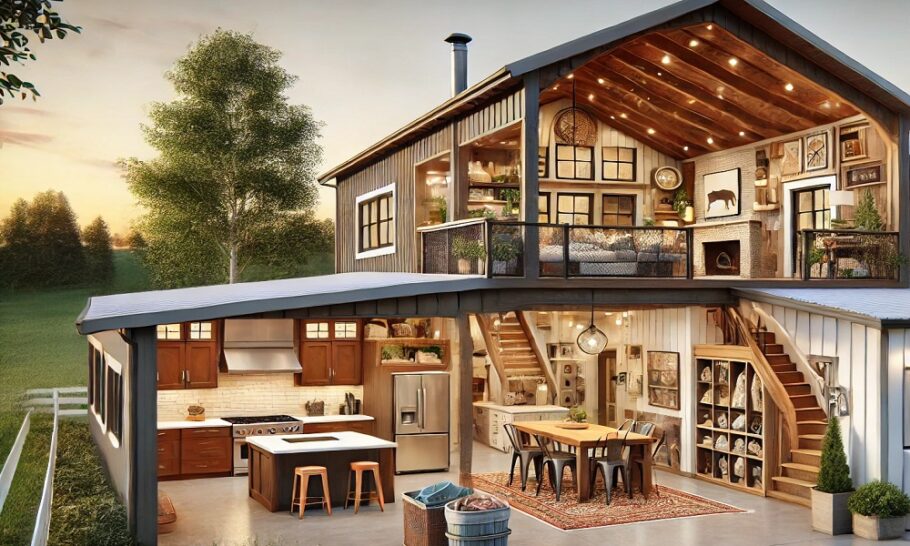
There is a moment that happens in the middle of every traditional home build—or even during the search for an existing house—where you sit down with a calculator, stare at the numbers, and feel a little sick to your stomach. You realize that to get the square footage you want, or the land you want, you are going to have to sacrifice something. Maybe it’s the finish. Maybe it’s the location. Maybe it’s your sanity.
That is precisely why so many people are turning to the barndominium. It isn’t just a trend; it is a logical rebellion against the soaring costs of conventional stick-built homes. But here is the secret that the glossy magazines don’t always tell you: a barndominium isn’t automatically cheap. You can absolutely build a high-end barndominium that costs just as much per square foot as a luxury custom home.
The magic lies in the approach. If you want a cost-effective build—one that gives you the space and the lifestyle without the financial hangover—you have to be smart about it. You have to be the general manager of your own project. You have to make strategic choices long before the first concrete is poured.
Here is how to navigate that process and build a barndominium that is kind to your bank account.
Start with the “Box,” Not the “Barn”
One of the biggest mistakes first-time barndominium builders make is designing their dream home before they understand the structure that will hold it up. In traditional construction, you design the floor plan, and then the framers build walls to match that plan. With a barndominium, you are usually working with a pre-engineered steel building kit or a post-frame (pole barn) structure. This means the skeleton comes first, and the layout fits inside it.
To save money, you need to think in terms of clearspan efficiency. Every corner, bump-out, or irregular angle in your exterior wall requires additional engineering, special cuts, and extra labor. The most cost-effective barndominium is essentially a rectangle with a simple gable roof. It might sound boring, but a simple “box” allows the interior walls to be placed anywhere without fighting the roofline.
Stick to a simple perimeter. You can add visual interest later with a covered porch (which is relatively cheap to add) or with the placement of windows and doors. But keeping the main structure a straightforward shape will drastically lower your material and labor costs.
The “Shell-Only” Gamble: Is It Worth It?
When you get quotes from barndominium kit companies, they usually offer varying levels of completion. You can buy just the materials (the steel, the bolts, the framing), or you can pay for a “dry-in” package where a crew erects the shell and puts the roof on.
If you are even remotely handy, or if you have a friend who is, buying a shell-only package and erecting it yourself (or with a small crew) is the single biggest money-saver in the entire process. Erecting the steel frame and screwing on the siding and roofing is labor-intensive, but it isn’t rocket science. There are countless stories of families spending their weekends with a lift and a impact driver, raising the shell over a few months.
However, you have to be honest with yourself. If you don’t have the time, the physical ability, or the stomach for working at height, hiring the erection crew might be worth the premium. But if you can do it, you are effectively cutting out a huge contractor markup and keeping that money in your pocket to spend on the interior finishes.
Act as Your Own General Contractor (But Do Your Homework)
This is the big one. The general contractor on a traditional home build usually takes a cut of 10% to 20% of the total project cost. On a $300,000 build, that’s $30,000 to $60,000. When you act as your own GC, you keep that money.
But it isn’t “free” money. It’s money you earn by working. Being your own GC means you are the one calling the plumber when the toilet flange is in the wrong spot. It means you are scheduling the insulation crew to come the day after the electrical rough-in is passed by the inspector. It means you are the one managing the chaos.
To do this successfully without losing your mind (or your savings), you need to build a reliable team. Find a local plumber and electrician who have worked in barndominiums before. Metal buildings ground differently than wood-framed houses. The wiring runs through steel studs, which require grommets to prevent chafing. If your trades haven’t done it before, they will charge you for the time it takes them to figure it out.
The key to cost-effective GC’ing is sequencing. If you have to tear out drywall because you forgot to run a conduit for the future solar panels, that cost comes out of your pocket. Make a master schedule and check it twice.
The Material Mindset: Steel vs. Stick
One of the reasons barndominiums can be cheaper is the exterior cladding. Steel siding is generally less expensive than brick, stone, or high-end fiber cement siding. It also goes up much faster. A crew can sheet a 40×60 barndominium in steel panels in a fraction of the time it takes to lay brick.
However, don’t fall into the trap of thinking everything has to be steel. Interior walls, for example, are almost always built with traditional wood studs. That is fine. Wood is still relatively affordable for interior framing.
Where you can save on materials is in the “finish” category. For example, if you love the industrial look, you can leave the ceiling open to the steel roof decking rather than installing drywall. Drywall installation in a barndominium is actually more expensive than in a standard house because the ceilings are often higher and require special lifts or scaffolding. Skipping the drywall on the ceiling can save you thousands. You just have to be okay with spray foam insulation (which you need anyway) being visible on the underside of the roof.
Insulation: Don’t You Dare Skimp Here
This is the one area where trying to save money will cost you in the long run. Barndominiums are made of metal. Metal gets hot. Metal gets cold. If you try to save a few hundred dollars by using lower-grade fiberglass batts in the walls, you will regret it every single month when your energy bill arrives.
The gold standard for barndominiums is closed-cell spray foam insulation. It does two things that are critical for a metal building. First, it has a high R-value per inch, meaning it stops thermal transfer effectively. Second, and more importantly, it creates a moisture barrier and stops air infiltration. It adheres directly to the metal panels, preventing condensation from forming on the inside of the steel (which can lead to rust and mold).
Yes, spray foam is more expensive upfront than rolled insulation. But because it prevents thermal bridging and air leaks so well, you can actually install a smaller HVAC system than the square footage would normally require. That savings on the HVAC unit often offsets the extra cost of the foam.
The Floor Plan: Vertical is Cheaper than Horizontal
This is a simple equation that people often overlook. A 2,000 square foot single-story home has a 2,000 square foot roof and a 2,000 square foot foundation. A 2,000 square foot two-story home has roughly 1,000 square feet of foundation and 1,000 square feet of roof.
Concrete is expensive. Roofing materials are expensive. By building up rather than out, you cut those costs roughly in half. If your land allows for it and your local zoning permits it, a “barndominium” with a loft or a full second floor is significantly cheaper per square foot than a sprawling ranch-style barndominium.
You also save on the length of your driveways and utility runs. A shorter, stouter building is almost always more cost-effective than a long, low one.
Shop Around for the “Barn” Part
The steel building industry is competitive. There are dozens of manufacturers and suppliers. Do not just buy the first kit you see on Instagram. Get quotes from three different companies. When you compare, look at the gauge of the steel (thicker is better but more expensive), the warranty on the paint finish, and what is included in the “package.”
Some kits come with everything: siding, roofing, trim, fasteners, and plans. Others are just the frame. Make sure you are comparing apples to apples. Also, consider the lead time. In recent years, supply chain issues have caused delays. Sometimes paying a little more for a kit that is in stock and ready to ship is actually the “cost-effective” move if it means your crew isn’t sitting around waiting for two months.
The “Sweat Equity” Interiors
Once the shell is up, the windows are in, and the place is dried in, the real savings begin. This is where you can truly transform the cost of the build. If you have ever wanted to learn how to lay tile, hang drywall, or paint, now is the time.
The interior of a barndominium is essentially a blank canvas. Unlike the structural steel erection, which requires specific skills and tools, the interior work is often standard residential finishing. You can tackle it room by room, or even just do the “finish work” like installing trim, painting, and laying flooring.
A major tip for cost-effectiveness here is to stage your living. If you can live in a portion of the barndominium while you finish the rest, you save on rent or a mortgage elsewhere. It might be inconvenient to have your bedroom finished but the kitchen is still a stud wall for a few months, but the financial freedom it provides is immense.
Be Ruthless About Your “Wants”
Finally, the most cost-effective tool you have is a clear vision. Before you start, separate your list into “Structural” and “Cosmetic.” A $10,000 custom front door is cosmetic. A $10,000 upgrade from a 16-foot ceiling to a 20-foot ceiling is structural. You can change a door later. You cannot easily raise the roof.
Focus your money on the things that are hard to change later: the foundation, the insulation, the quality of the windows, and the plumbing rough-ins. Everything else—the countertops, the light fixtures, the faucets—can be upgraded over time.
Building a barndominium on a budget isn’t about building a cheap home. It’s about building an intelligent home. It’s about leveraging the simplicity of a metal building to create a space that is vast and beautiful, without the vast and beautiful price tag that usually comes with it. If you are willing to put in the sweat, manage the chaos, and keep the design simple, you can walk away with a paid-for asset that most people only dream of.