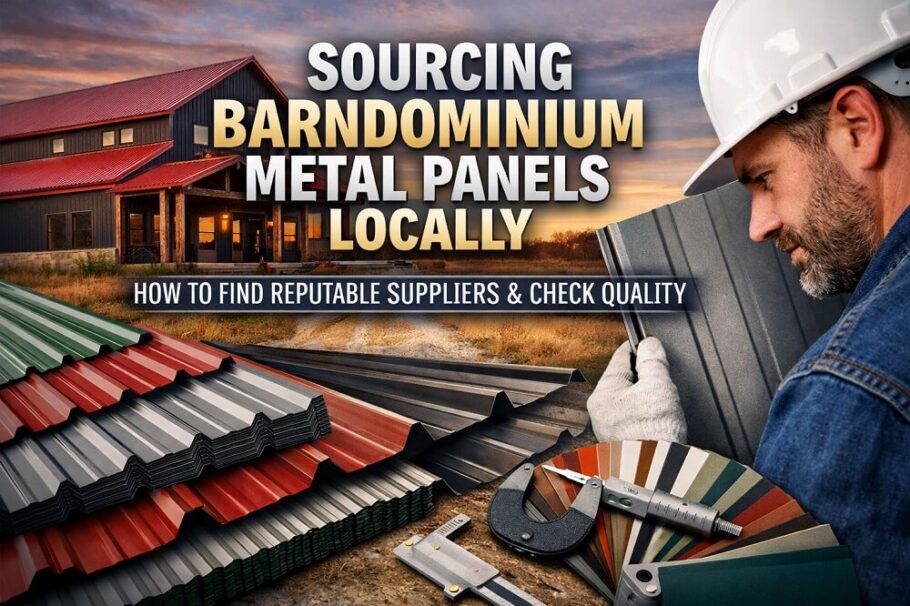
Metal panels are the skin, armor, and long-term weather defense of a barndominium. While floor plans and framing often steal the spotlight, the quality of your metal panels will largely determine how your barndominium performs over the next 30 to 50 years. Poor panels lead to oil canning, premature rust, leaking fasteners, color fading, and costly repairs. High-quality panels, on the other hand, deliver structural reliability, energy efficiency, and curb appeal that lasts.
For many owners and builders, the smartest strategy is to source metal panels locally instead of ordering blindly online or through distant distributors. Local sourcing improves accountability, speeds up replacement, simplifies warranties, and often leads to better technical support. But not all suppliers are equal, and not all panels labeled “steel roofing” are created the same.
This guide walks you through how to find reputable local metal panel suppliers, how to evaluate panel quality like a professional, and how to avoid common sourcing mistakes that can compromise your entire barndominium build.
Why Local Sourcing Matters for Barndominium Panels
Buying locally is not just about convenience. It is about control, verification, and long-term support.
Local suppliers allow you to physically inspect panels before purchase. You can verify coating thickness, color consistency, edge finish, and panel profile accuracy. If damage occurs during delivery or installation, replacements are faster and disputes are easier to resolve. Local suppliers also understand regional climate conditions such as coastal corrosion, heavy rainfall, high winds, or extreme heat, and can recommend appropriate coatings and gauges.
Another advantage is compatibility with local building codes. Many inspectors prefer panel systems that are already proven in the region, which reduces inspection friction and documentation challenges.
Local sourcing also strengthens relationships. A reliable supplier becomes a long-term partner for trims, replacements, expansion phases, and warranty support.
Understanding the Types of Metal Panels Used in Barndominiums
Before evaluating suppliers, you must understand what you are buying.
Most barndominium metal panels fall into three main categories:
Corrugated panels are economical and commonly used for agricultural structures. They can work for barndominiums but often require careful detailing for aesthetics and water management.
R-panel and PBR panels are structural profiles commonly used for commercial and residential metal buildings. They provide excellent strength and are widely accepted for barndominium roofs and walls.
Standing seam panels offer a premium appearance and superior water resistance. They are more expensive but ideal for high-end residential barndominiums.
Material options typically include:
- Galvanized steel, which uses a zinc coating for corrosion resistance.
- Galvalume steel, which uses a zinc-aluminum alloy and offers superior corrosion performance in most environments.
- Aluminum panels, which resist rust completely but are more expensive and less structurally stiff.
- Paint systems usually involve SMP or PVDF coatings. PVDF, often branded as Kynar, provides the best long-term color retention and fade resistance.
Understanding these basics prevents you from being misled by vague marketing claims.
How to Find Reputable Local Metal Panel Suppliers
Finding a good supplier is more than a Google search. You want a supplier with consistent quality control, strong manufacturer relationships, and technical knowledge.
Start with local metal building contractors and barndominium builders. Ask them who they trust and why. Contractors deal with panel quality problems firsthand and know which suppliers consistently deliver.
Visit regional metal roll-forming shops. Many local suppliers fabricate panels in-house, which allows for better quality control and customization.
Check with local building supply centers that specialize in commercial or agricultural structures. These suppliers often carry certified panel systems with proven performance.
Review online ratings, but focus on patterns rather than individual complaints. Pay attention to comments about delivery accuracy, panel consistency, warranty handling, and customer service.
Ask for references from previous residential or barndominium customers. Reputable suppliers will gladly provide them.
A strong supplier should be willing to give you a facility tour, show you coil stock, explain coating systems, and answer technical questions without hesitation.
Questions You Should Ask Every Supplier
Never assume quality. Ask direct questions and evaluate how confidently and clearly the supplier responds.
- Ask where their steel coil is sourced from and whether it is domestic or imported. Domestic mills typically maintain stricter quality standards.
- Ask what coating system is used and the paint thickness in microns. High-quality PVDF coatings typically range around 25 microns.
- Ask about metal gauge options. Common gauges include 29, 26, and 24. Thicker is stronger but more expensive.
- Ask whether panels are ASTM certified and what testing standards they meet.
- Ask about wind uplift ratings and installation approvals for residential use.
- Ask about warranty length, coverage details, and what voids the warranty.
- Ask how panels are packaged and protected during transport.
A supplier who cannot answer these questions clearly is not a supplier you should trust with your barndominium exterior.
How to Inspect Metal Panel Quality in Person
If you can physically inspect panels, you gain a major advantage.
- Look at panel edges. Poor quality panels often show rough cuts, flaking coating, or uneven edges.
- Check coating uniformity. The surface should be smooth and consistent in color and gloss without streaks or thin spots.
- Examine the backside coating. Quality panels protect both sides, not just the exposed surface.
- Check profile accuracy. Panels should stack cleanly without wobble or deformation.
- Look for oil canning tendencies. While some minor waviness is normal in metal, excessive distortion signals poor roll forming or thin material.
- Inspect trim pieces. High-quality suppliers produce trim with the same coating system and thickness as the panels.
- Ask to see older installed projects. Real-world aging tells more than showroom samples.
Evaluating Warranty Claims and Fine Print
Metal panel warranties can look impressive on paper but hide important limitations.
- Paint warranties often cover chalking and fading, but only within specific limits. Understand the acceptable color change thresholds.
- Corrosion warranties often exclude coastal zones, industrial pollution, or improper installation.
- Substrate warranties usually depend on correct fastener types, sealant compatibility, and ventilation design.
- Make sure the warranty is backed by a major coating manufacturer, not just the local supplier.
- Ask whether warranty claims are handled locally or through a third-party manufacturer process.
A warranty is only as good as the company that stands behind it.
Matching Panel Selection to Your Climate
Your local climate should heavily influence your panel choice.
- Coastal environments require high-performance Galvalume or aluminum with premium coatings.
- High-humidity regions demand excellent backside coatings and proper ventilation compatibility.
- High-wind zones require thicker gauges and tested fastening patterns.
- Hot climates benefit from cool-roof coatings that reflect solar radiation.
- Cold climates require panels that handle thermal movement without cracking coatings.
A good local supplier should guide you based on your region, not just sell what is in stock.
Common Mistakes When Buying Metal Panels
- One of the most common mistakes is choosing based on price alone. Low-cost panels often result in higher lifetime costs.
- Another mistake is mixing panel systems and trims from different suppliers, leading to color mismatches and fit problems.
- Many owners fail to verify fastener compatibility with coating systems, causing premature corrosion around screw heads.
- Some buyers skip local inspections and rely solely on brochures or online photos.
- Another frequent error is ordering incorrect quantities due to poor takeoff calculations, which causes delays and color batch mismatches when reordering.
Avoid these mistakes by slowing down and treating panel sourcing as a strategic decision, not a commodity purchase.
Building Long-Term Value Through Supplier Relationships
- A local metal panel supplier is not just a vendor. They are a long-term asset.
- They can help you source replacement panels years later.
- They can provide matching trims for future additions.
- They can assist with warranty documentation.
- They can help troubleshoot leaks or performance issues.
- They can connect you with certified installers who understand their systems.
Barndominium ownership often involves expansions, shop additions, and exterior upgrades. A trusted supplier supports all of these phases.
Coordinating Panels with Your Barndominium Design
Metal panels are not only structural components. They are architectural features.
- Profile choice affects visual scale.
- Color affects heat absorption and style.
- Trim detailing affects perceived craftsmanship.
- Panel orientation changes how the building feels.
Work with your designer or architect to ensure your panel selection aligns with the overall design intent. Your supplier should be willing to provide samples, mockups, and layout advice.
Budgeting for Quality Panels
High-quality metal panels typically represent a moderate portion of the total barndominium budget but protect nearly every other component inside the building.
When budgeting, consider:
- Panel cost
- Trim cost
- Fastener systems
- Underlayment compatibility
- Delivery handling
- Potential waste
- Future replacement availability
A slightly higher upfront cost often saves thousands over the lifespan of the building.
Final Thoughts: Treat Metal Panels as a Long-Term Investment
Your barndominium’s metal panels are not just roofing and siding. They are your first defense against weather, corrosion, and time. Sourcing them locally gives you control, accountability, and confidence.
By choosing reputable suppliers, asking the right questions, inspecting quality firsthand, understanding warranties, and matching materials to your climate, you protect your investment for decades.
A beautiful barndominium starts with smart planning, but it lasts because of smart material choices. When you treat metal panel sourcing as a critical design decision instead of a last-minute purchase, your barndominium will reward you with durability, performance, and pride of ownership for years to come.