
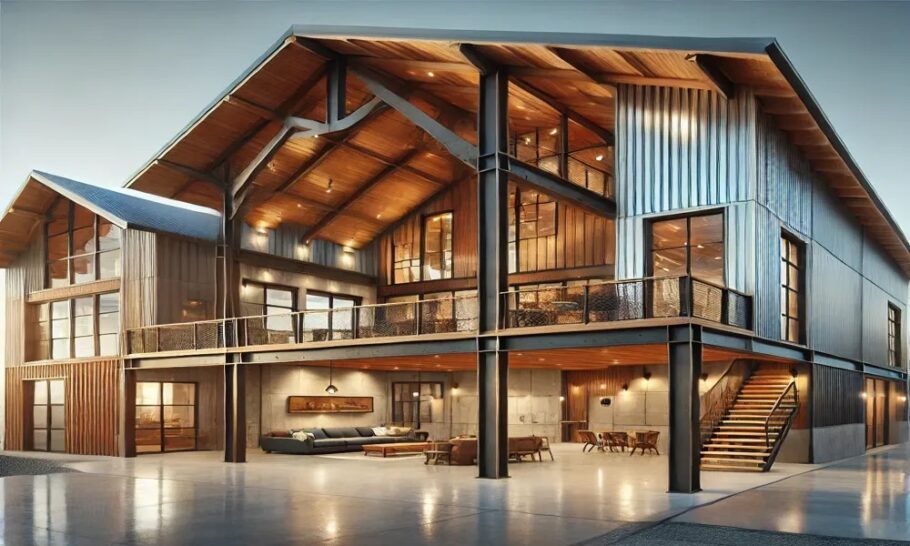
Post‑Frame (Pole Barn) Construction
Post‑frame construction evolved from simple pole barns into highly engineered building systems. The skeleton consists of large‑dimension timber posts—typically 6×6 or 6×8 pressure‑treated lumber—set deep into the ground on concrete footings or embedded in concrete piers. These posts are spaced anywhere from 8 to 12 feet apart. What makes the post‑frame unique is that the roof trusses and wall girts tie directly into those posts, creating a unified diaphragm.
The strength here comes from a few places. First, the posts act as both vertical columns and moment‑resisting elements when properly anchored. Second, the combination of the roof diaphragm (the roof deck and truss assembly) and the wall cladding (often metal panels) distributes lateral loads—like wind or seismic forces—across the entire structure rather than concentrating them at a few points. Modern post‑frame buildings are engineered with advanced truss designs, often using laminated columns or engineered wood products that outperform old‑school solid timbers.
Steel Frame Construction
Steel frame barndominiums are what most people picture when they think of “metal building.” They use a rigid frame of I‑beams or C‑channel steel for columns and rafters. These frames are either welded together at the factory or bolted on‑site. Secondary members like purlins (for the roof) and girts (for walls) span between the main frames, typically every five feet or so.
Steel’s strength is its high strength‑to‑weight ratio. A steel I‑beam can carry enormous loads relative to its size, and steel frames are inherently good at spanning long distances without intermediate supports. That’s why you’ll often see steel barndominiums with wide‑open floor plans—you can clear‑span 40, 60, even 80 feet with a well‑designed rigid frame.
Head‑to‑Head: Structural Strength Factors
Now let’s compare them in the categories that actually define “strong” in a building: load capacity, wind and seismic performance, durability over time, and how they handle fire and corrosion.
Load Capacity (Snow, Roof Live Loads, and Point Loads)
If you’re building in a region with heavy snow, load capacity is non‑negotiable.
A properly engineered steel frame can handle enormous roof loads. Because the main frames are designed as rigid connections, the entire frame resists gravity loads efficiently. Standard steel barndominiums can easily be engineered for snow loads exceeding 100 pounds per square foot (psf)—that’s commercial‑grade capability. The trade‑off is that the frame members themselves are discrete: the load path goes from the roof panels to the purlins to the main frames to the columns to the foundation. Every connection point must be precisely designed.
Post‑frame structures, when engineered correctly, also handle heavy snow remarkably well. I’ve seen post‑frame buildings in the Colorado mountains and upper Michigan rated for 80–100 psf snow loads. The diaphragm action of the roof and the continuous load path from truss to post to foundation spreads the load evenly. One advantage post‑frame has is that the posts are embedded into the ground, providing a degree of rotational resistance that helps with uneven loads—like a snowdrift that piles up on one side. Steel frames rely entirely on their base plates and anchor bolts for that stability, which can sometimes create weak points if the concrete foundation settles unevenly.
For point loads—say, you want to hang a heavy car lift from the structure—steel typically wins. Steel members are predictable and easy to reinforce at specific points. With a post‑frame, you can certainly hang heavy loads, but you’ll usually need to add engineered brackets or reinforce the truss/purlin system because wood members are more prone to localized crushing or splitting under concentrated loads.
Wind and Seismic Resistance
This is where the debate gets interesting.
Steel frames are excellent at resisting high wind and seismic forces because steel is ductile—it can bend and flex without breaking. In a seismic event, a well‑designed steel frame will sway and absorb energy. For wind, the rigid frame acts like a portal, transferring lateral loads down to the foundation. The weak link is often the connection between the steel column and the concrete footing. If anchor bolts are undersized or poorly installed, that connection can fail before the steel itself.
Post‑frame buildings have a different advantage: redundancy. Because the posts are spaced relatively close (often 8 feet) and each one is deeply embedded, there’s no single point of failure. In my experience, post‑frame buildings often outperform steel buildings in hurricane zones—not because the materials are stronger, but because the system distributes uplift and lateral forces across dozens of embedded posts. The metal siding and roofing also act as shear panels when properly fastened, creating a continuous “envelope” that resists racking.
I’ve personally inspected post‑frame barndominiums that stood through EF‑2 tornadoes while nearby conventionally framed houses were leveled. The combination of embedded posts, screw‑fastened metal panels, and continuous load paths gave them a kind of monolithic strength. Steel buildings can achieve similar performance, but it requires careful attention to cross‑bracing or moment connections, and they often need more robust foundations to match the post‑frame’s inherent resistance to uplift.
Longevity and Material Deterioration
Strength over decades isn’t just about initial load ratings—it’s about how materials hold up to moisture, insects, and time.
Steel is impervious to termites and won’t rot, but it does have two enemies: corrosion and galvanic reaction. In humid coastal environments or areas with heavy winter road salt, steel frames require proper coating systems (galvanization, paint, or sacrificial anodes) to prevent rust. I’ve seen steel buildings in the Pacific Northwest develop corrosion at connection points where moisture pooled because the design didn’t allow for drainage. Once rust starts, it can compromise member thickness and connection integrity.
Modern post‑frame use pressure‑treated or naturally rot‑resistant wood for the embedded portion of the posts. The above‑ground wood is typically kiln‑dried and protected by the metal skin. Termites are a concern in some regions, but proper site prep (barriers, treated lumber, and keeping wood away from grade) mitigates that. One advantage wood has is that it doesn’t suffer from hidden corrosion—visual inspections can spot most issues. A steel frame’s critical connections can corrode inside a column base or behind cladding without obvious signs until it’s advanced.
Fire resistance is another angle. Steel doesn’t burn, but it loses strength rapidly when heated. In a typical house fire, unprotected steel can reach failure temperature (around 1,000–1,200°F) within minutes. Wood, while combustible, chars at a predictable rate and retains much of its structural capacity during a fire. Most post‑frame barndominiums use wood that is actually larger than required structurally, providing inherent fire resistance through mass. Steel frames often require fire‑rated coatings or encasement to achieve the same safety level in residential settings.
Foundation and Soil Interaction
A structure is only as strong as its connection to the ground. This is one area where the two systems diverge significantly.
The post‑frame embeds the primary columns directly into the ground—usually 4 to 6 feet deep, with a concrete collar or full concrete pier. The soil itself helps resist uplift and overturning. This works exceptionally well in stable, well‑draining soils. In expansive clay soils (common in Texas and parts of the South), however, the posts can be subject to soil movement that heaves them over time. Engineers now use techniques like “wet‑set” brackets or raised concrete piers to decouple the post from the soil in those conditions.
Steel frames use a slab‑on‑grade foundation with isolated footings at each column. The steel columns are attached via anchor bolts embedded in the concrete. This system is less affected by soil movement because the slab acts as a unified raft, but it puts all the load on those anchor bolts. If the slab cracks or the soil settles unevenly, a steel building can develop racking issues that stress the frame. For poor soil conditions, steel often requires deep foundations (drilled piers) to achieve the same stability that an embedded post gets for free.
Beyond Raw Strength: What “Strong” Really Means for Your Barndominium
When clients ask me which is stronger, I usually flip the question: “Stronger for what purpose?” Because strength isn’t just about withstanding a 150‑mph wind. It’s about the building’s ability to serve your needs without excessive maintenance, unexpected failures, or design compromises.
Design Flexibility and Load‑Bearing Walls
If you want a completely open floor plan with no interior columns, steel frame is hard to beat. A clear‑span rigid frame can give you a cavernous space that’s perfect for workshops, aircraft hangars, or large gatherings. Post‑frame can also achieve clear spans using engineered trusses, but the spacing of posts is typically closer, and you’ll often need interior columns for longer spans beyond about 40 feet.
On the flip side, if you want to hang heavy cabinetry, second‑floor lofts, or masonry finishes, post‑frame wood framing is easier to work with. You can nail directly into the posts and girts, and the structure is forgiving for future modifications. Steel frames require careful planning for attachments—you’ll need to weld or bolt additional framing if you change your mind later.
Construction and Quality Control
A steel frame is fabricated in a factory to precise specifications. When it arrives, the pieces are either bolted or welded per engineered drawings. This means the structural strength is highly consistent, assuming the erection crew follows the plans. The downside is that any field error—a misaligned anchor bolt or a welded connection that doesn’t get full penetration—can create a weak link that isn’t obvious until a high‑load event.
Post‑frame construction relies more on skilled carpentry and precise bracing during assembly. The materials are often sourced locally, and the design can be adjusted on‑the‑fly. Because the structure is built with redundancy, small framing errors rarely compromise overall strength. But if an inexperienced crew fails to install the necessary cross‑bracing or doesn’t properly embed the posts, you can end up with a building that racks or settles prematurely.
Cost vs. Strength Trade‑Offs
Steel frame typically commands a higher upfront material cost, especially if you’re using heavy‑gauge structural steel. However, it can sometimes offset that with faster erection times and lower labor costs. Post‑frame usually has lower material costs but can require more on‑site labor for cutting, fitting, and bracing.
From a pure strength‑per‑dollar perspective, the post‑frame often wins for buildings up to about 60 feet wide in moderate climates. For very large clear spans or sites with extreme snow loads, steel becomes more economical to achieve the required strength without overbuilding.
The Verdict: Which Is Actually Stronger?
After years of working with both systems, here’s my honest take: Neither is universally stronger. Instead, each has specific conditions where it outperforms the other.
If your definition of strength includes:
- Resistance to uplift and distribute lateral loads (like hurricanes or tornadoes) → Post‑frame, with its embedded columns and redundant load paths, often has the edge.
- Ability to clear‑span wide spaces with minimal deflection → Steel frame is the clear winner.
- Long‑term durability in corrosive or high‑moisture environments → Post‑frame, provided you use properly treated wood and keep it dry. Steel can suffer hidden corrosion.
- Resistance to seismic forces without heavy foundation work → Steel, because of its ductility and lighter weight.
- Surviving a fire with structural integrity intact → Post‑frame, due to the charring behavior of large timber.
- Handling heavy point loads or future modifications → Steel gives you more predictable attachment points, but post‑frame is easier to modify later.
I’ve seen steel frames buckle at the knees because of a poorly compacted fill under a slab. I’ve also seen post‑frame buildings twist because someone omitted the permanent rod bracing. In both cases, the “stronger” material didn’t matter—the execution did.