
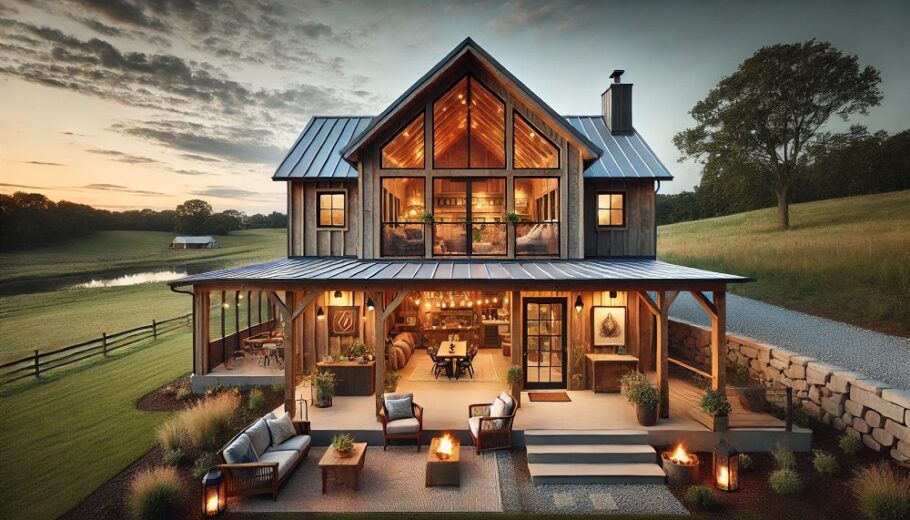
The barndominium boom shows no signs of slowing. Across the Texas Panhandle, the Oklahoma plains, and even up into the Midwest’s tornado-prone corridors, these steel-framed hybrids are replacing traditional stick-built homes. But there is a quiet problem hiding in plain sight—one that only reveals itself when the first serious storm system rolls through. Standard agricultural metal roofing, the kind found on countless pole barns and sheds, was never engineered to keep a family’s living room attached to its walls when a straight-line wind event clocks 120 miles per hour.
The difference between a barndominium that survives a decade of spring storms and one that loses its lid during the first derecho comes down to two things: seam engineering and roof geometry. Neither is particularly glamorous. But for anyone building in a high-wind zone—defined by ASCE 7-22 as areas with basic wind speeds exceeding 115 mph—these factors determine whether the structure functions as a proper home or becomes a very expensive debris generator.
The Physics of Uplift and Why It Destroys Conventional Roofs
Before digging into panel shapes and seam locks, a quick look at what actually pulls a roof off. Wind uplift does not work like a giant hand pressing upward from below. The real mechanism involves pressure differentials. As air accelerates over the roof surface—particularly at the leading edge, ridge, and corners—its velocity increases. Bernoulli’s principle takes over: higher velocity means lower static pressure. The air inside the barndominium, meanwhile, remains at a higher relative pressure. That difference creates suction, effectively trying to lift the roof assembly off its supporting structure.
For a flat or low-slope roof, this suction can be severe. But even on pitched roofs, the edges and corners see localized pressures two to three times higher than the center field. This is where seam failures begin. A single fastener pulling through a panel flange, or a snap-lock seam popping open in the first gust, creates a weak point that unzips the entire row.
Standing Seam versus Exposed Fastener: No Contest
The first decision any builder in a high-wind zone must make involves seam type. Exposed fastener panels—the familiar corrugated or ribbed sheets with screw heads visible every few inches—are common on barns for a reason. They are cheap and fast to install. But they are also fundamentally unsuitable for occupied structures in windy regions.
The problem is not the screw’s pull-out strength from the purlin, though that matters too. The real issue is the neoprene washer that seals each screw head. Over time, thermal cycling and ultraviolet exposure cause these washers to harden and crack. Once a washer fails, water intrudes. But more critically for wind resistance, the clamped connection between panel and structure loosens. A loose screw head no longer holds the panel flange firmly against the purlin. The panel then lifts slightly, flutter begins, and the screw holes elongate. From there, sequential failure is almost guaranteed.
Standing seam systems eliminate this vulnerability entirely. Instead of exposed fasteners penetrating the panel face, standing seam uses concealed clips that attach to the panel’s male and female legs. The clip slides into a seam lock that is then mechanically seamed or snap-locked closed. No holes exist above the roof plane. This means no washers to degrade, no potential leak paths, and—critically for wind uplift—no localized point stresses that concentrate pull-out forces. The entire panel acts as a diaphragm, distributing uplift loads across the clip spacing and into the substructure.
The Mechanical Lock Versus the Snap Lock
Not all standing seam is created equal. The industry distinguishes between snap-lock and mechanically seamed panels, and in high-wind zones the difference is stark. Snap-lock panels use a pre-formed seam that the installer snaps together by hand or with a simple tool. They work fine for moderate wind regions and residential applications with lower roof exposures. But the seam’s holding strength comes entirely from the interference fit between two bent metal edges. Under cyclic loading—wind gusting, backing off, gusting again—snap-lock seams can work themselves partially open.
Mechanically seamed panels, on the other hand, require a specialized electric seamer that travels along the seam, bending the metal through a series of rollers to create a continuous, interlocked double-fold seam. That seam is essentially permanent. Wind tunnel testing from various manufacturers shows that mechanically seamed standing seam panels can resist uplift pressures exceeding 150 psf, far above what any code requires for residential construction in even the highest wind zones. For barndominiums in hurricane-prone coastal areas or the Midwest’s high-risk zones, specifying a mechanically seamed 24-gauge or 22-gauge panel is not overkill—it is the bare minimum.
Aerodynamic Roof Shapes That Reduce Drag and Lift
Seam engineering alone does not solve the problem. The overall geometry of the roof dramatically affects the magnitude of uplift forces in the first place. A poorly shaped roof forces the seam system to work harder. A well-shaped roof reduces the peak pressures before they ever reach the clips.
The most wind-resistant roof shape for a barndominium is a hip roof or a modified hip with a shallow pyramid form. Hip roofs have no vertical gable ends for wind to slam into. Instead, all edges slope, encouraging air to flow around the structure rather than building pressure against a flat wall that then transfers load into the roof deck. For barndominiums, which often have long rectangular footprints, a hip roof with a pitch between 4:12 and 6:12 offers an excellent balance between usable attic space, material cost, and aerodynamic performance.
What about the increasingly popular “monoslope” or shed roof? That shape is common on modern barndominiums, particularly those with a single, dramatic sloping plane from front to back. From a wind engineering perspective, the monoslope is problematic. The high side of the roof creates a sharp leading edge where wind separates violently, producing very high localized suctions. The low side, meanwhile, can experience pressure buildup depending on wind direction. Unless the building orientation is fixed relative to prevailing winds—which is rarely the case—a monoslope roof will always have an exposed high edge pointing into the worst wind direction at some point.
Better choices for high-wind zones include the asymmetrical hip, where all four sides slope but the front pitch may be steeper than the rear, or a true gable roof with substantial overhang protection and reinforced barge rafters. If a gable roof is unavoidable, the gable ends need structural sheathing, not just metal trim, and the ridge must be reinforced with a continuous structural ridge beam rather than simple rafter ties.
The Overhang Problem
Aerodynamic roof design involves more than just the slope and seam details. Overhangs—those generous eaves that give barndominiums their classic barn aesthetic—behave like little wings attached to the roof edge. In moderate winds, they provide shade and keep rain off the walls. In high winds, they become levers. Wind rushing underneath an overhang creates upward pressure on the underside of the soffit and the roof sheathing beyond the exterior wall line. That pressure adds directly to the uplift load on the panel seams and fasteners.
The solution is not to eliminate overhangs entirely, but to engineer them properly. A closed soffit with rigid backing—not perforated vinyl or thin aluminum coil stock—prevents wind from pressurizing the cavity. Even better is a “boxed” or “ladder” overhang where the soffit material attaches to a continuous framework of 2x lumber rather than simple L-brackets and trim coil. For extreme wind zones, some designers eliminate overhangs on the windward sides altogether, or keep them to six inches or less. That may offend traditional barn aesthetics, but a roof that stays attached is more beautiful than one littering the neighbor’s field.
Panel Profile Shapes and Their Role in Drag Reduction
The seam matters, but so does the panel’s intermediate ribs—the minor corrugations between the major seam locks. These ribs stiffen the panel and disrupt airflow in ways that can either help or hurt. Tall, sharp ribs create turbulence that can actually increase localized pressure fluctuations. Low, broad ribs or flat panels with shallow striations tend to produce smoother flow separation and lower peak suctions.
Where does that leave the barndominium builder? In a high-wind zone, specify standing seam panels with a low-profile rib design—typically a “mini-rib” or “striated” panel with ribs no taller than a half-inch. Avoid “deep rib” or “R-panel” standing seam profiles that prioritize stiffness over aerodynamics. Also avoid panels with excessively wide flat pans, which are prone to oil-canning and can deflect enough under wind loading to unzip seams. A pan width of twelve to sixteen inches is a solid choice, balancing panel count, seam spacing, and diaphragm stiffness.
Material Gauge and Coating Considerations
Thicker metal resists tearing at clip attachment points. Twenty-four gauge steel is the standard for residential standing seam, but in high-wind zones twenty-two gauge provides substantially better pull-through resistance at the clip location. The cost increase is modest relative to the overall barndominium budget—often less than ten percent of the roofing line item.
Coating systems matter too, though not directly for wind resistance. A high-quality PVDF or Kynar 500 finish withstands decades of UV exposure without chalking or cracking. This matters because a roof that lasts forty years without coating failure is a roof that never develops weak spots from corrosion around clip attachment holes. Galvalume bare metal is acceptable in dry inland areas, but in coastal zones with salt spray, forty-year PVDF is the safer bet.
Connecting the Roof to the Walls: The Continuous Load Path
A brilliant roof with perfect seams and an aerodynamic shape still fails if the connection from clips to purlins, purlins to rafters, rafters to wall top plates, and top plates to foundation is broken at any link. This is the “continuous load path,” and it is where many barndominium builds cut corners.
Typical pole barn construction uses screws through steel panels into wood purlins spaced four feet apart. For a shop or implement shed, that works fine. For a home in a high-wind zone, four-foot purlin spacing allows the roof panel to deflect too much between supports, putting cyclic bending loads on the seams. Reducing purlin spacing to two feet or less dramatically improves panel performance. Better yet, use a structural steel frame with Z-purlin or C-purlin spaced at maximum twenty-four inches, and ensure each purlin is welded or through-bolted to the rafter with no slip connections.
At the wall interface, the roof structure must tie into a continuous ring beam or a properly anchored top plate system. Barndominiums with concrete stem walls offer an advantage here—anchor bolts can tie the entire perimeter together. Post-frame barndominiums, where treated wood columns are embedded in concrete, require careful attention to the connection between the roof truss and the column top. A metal strap that only wraps around two sides of the column provides far less uplift resistance than a full saddled connection with through-bolts.
Testing Standards and What They Actually Mean
Manufacturers love to throw around test numbers. “UL 580 Class 90” appears on many panel spec sheets. That means the panel assembly passed a static pressure test of ninety pounds per square foot. But UL 580 is a static test—a steady push upward. Real wind is dynamic. Gusts come and go. Panels fail under fatigue, not just ultimate load.
Look instead for panels tested to ASTM E1592, which uses cyclic loading more representative of actual wind events. Also look for Miami-Dade County NOA (Notice of Acceptance) for panels approved for high-velocity hurricane zones. The Florida building code’s TAS 100, 114, and 115 tests include pressure cycling, impact resistance, and structural load tests that expose seam weaknesses static tests miss. A panel with Miami-Dade approval has proven itself against some of the most stringent wind engineering standards in North America.
Putting It All Together for a High-Wind Barndominium
Designing a barndominium roof for high-wind zones requires abandoning a few barn-building habits. Exposed fastener panels have no place on this structure. Snap-lock standing seam works for moderate risk, but mechanically seamed panels deliver true security. Hip roofs outperform gables and monoslopes. Overhangs need reinforcement or elimination. Purlin spacing must tighten up. And the entire assembly—from panel face down to foundation anchor—needs a continuous, engineered load path.
None of this makes the barndominium look different from the outside. A mechanically seamed standing seam hip roof with closed soffits and twenty-two gauge steel looks essentially identical to a cheaper, weaker version. The difference only shows up on the weather radar, when that red and purple cell tracks directly overhead. One roof pops a seam, unzips two rows, and starts peeling back like a sardine can. The other roof sheds the wind, holds the clips, and keeps the living room dry.
That is the whole point of aerodynamic barndominium roof design. Not aesthetics. Not cost savings. Just survival, season after season, in the places where the wind does not ask permission.