
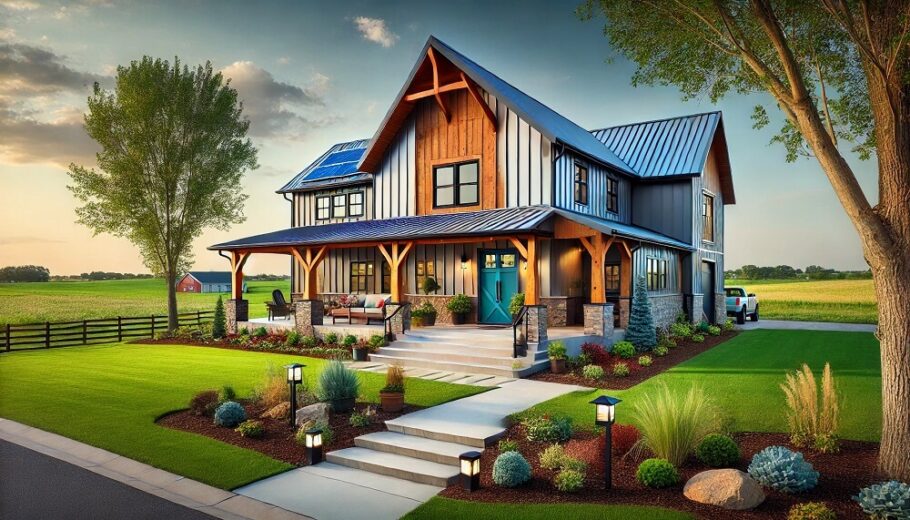
A reputation for toughness has been earned by barndominiums. Greater resilience than many traditional wood-frame homes is offered by their steel frames, open layouts, and straightforward roof designs. For those residing in areas prone to tornadoes, hurricanes, wildfires, or who simply desire preparedness for the unexpected, toughness alone is often insufficient. At that point, the integration of a safe room into the barndominium ceases to be an optional extra and becomes a fundamental component of the initial plan.
The concept being discussed is not merely the addition of thicker drywall. Serious thought and engineering are required for the design of a genuine safe room within a barndominium. Consideration must be given to how it will withstand extreme wind forces, prevent debris penetration, maintain air exchange, and remain anchored to the foundation when the surrounding structure may fail. When executed correctly, that safe room is transformed into an integral part of the building’s structural framework—the overall strength is enhanced rather than the space simply being inserted into the middle of the floor plan.
An examination of how this challenge is approached by builders and engineers follows, blending rigorous structural work with a space that still functions as part of the home.
What Is Meant by “Safe Room” in Structural Terms?
In simplest terms, a hardened space designed to preserve life during the most severe storms is what a safe room is. In the U.S., the governing guidelines are provided by FEMA and the ICC—specifically FEMA P-361 and ICC 500. These are not mere suggestions but performance standards derived from real-world data.
From an engineering perspective, numerous requirements must be met by a safe room:
- Wind loads that would flatten a typical house (such as 250 mph tornado winds) must be resisted.
- A 2×4 traveling at over 100 mph must be stopped from penetrating the wall.
- Structural independence must be maintained even if the rest of the building collapses.
- Anchorage to the foundation must be so secure that movement is impossible.
- Adequate air exchange and a means of egress that will not fail during an emergency must be provided.
The difficulty with a barndominium lies in reconciling these requirements with large-span, open steel framing.
Why Barndominiums Are Well-Suited for This Application
Construction of barndominiums typically involves steel frames or post-frame systems. Two significant advantages are offered by this approach:
- Unobstructed Floors: Because load-bearing interior walls are absent, a reinforced concrete core can be placed almost anywhere without disrupting the primary structural layout.
- Inherent Strength: Significant strength is already possessed by the steel columns and rafters. Improved load paths are created if the safe room is properly tied into them.
However, a critical point must be emphasized: high-velocity lumber penetration will not be stopped by the exterior metal siding and standard insulation of a barndominium. The safe room must function as its own hardened enclosure, independent of the outer shell.
The Engineering Required for the Walls
Reinforced concrete or concrete block construction is used for the most reliable safe rooms. Mass and reinforcement are essential.
Cast-in-Place Concrete Walls
Cast-in-place concrete, typically 6 to 8 inches thick with a dense rebar grid, is considered the gold standard. Numerous calculations are performed by engineers: the wind pressure based on geographical location, the impact resistance required of the wall, and the shear and bending forces it will experience. The method of anchoring it to the slab must also be precisely determined. The rebar pattern is not arbitrary—it is designed to provide the wall with some ductility. Cracking under extreme stress is acceptable for a concrete wall, provided collapse does not occur. Bending, not breaking, is the goal.
ICFs: A Viable Alternative
Insulated Concrete Forms are gaining popularity for this application. Stacked foam blocks are filled with rebar and concrete, resulting in a solid, well-insulated concrete wall. In a barndominium, dual purpose is served by an ICF safe room: storm shelter provision and energy-efficient thermal mass contribution.
Concrete Block (CMU) as an Option
FEMA standards can be met by fully grouted and reinforced concrete masonry units, but meticulous attention to detail is required. Every cell within the block must be filled with grout, continuous reinforcement must be provided by the rebar, and rock-solid connections to the floor and roof are mandatory.
The Critical Nature of the Roof
Instances have been reported where safe room walls performed adequately, but the roof was lost. Such an outcome constitutes a failure.
Uplift forces that can easily exceed 150 pounds per square foot must be resisted by the safe room roof. Typical engineering designs for this include:
- A reinforced concrete slab.
- Heavy steel plate.
- Precast concrete panels.
- A steel deck with a concrete topping.
Redundancy is built into every connection, which is either bolted or welded. Sizing of anchor bolts is based on calculations, not estimates. Furthermore, in a barndominium with a metal roof, structural independence must be maintained by the safe room’s roof. Reliance on the main building’s roof for hold-down is unacceptable.
The Door as the Critical Weak Point
A concrete box of any strength can be rendered useless by an inadequate door.
Laboratory testing is performed on certified safe room doors. Fifteen-pound 2x4s are fired at them at speeds exceeding 100 mph. The pressure fluctuations of major storms are simulated. These are not standard commercial doors. Reinforced cores, heavy-duty hinges, and multi-point locking systems that engage the frame at several points are incorporated. Direct anchorage of the door frame into concrete or reinforced masonry is required—attachment to wood studs or drywall is unacceptable.
Door swing direction is also a significant consideration. In tornado-prone regions, outward-swinging doors are preferable because debris accumulation against an inward-swinging door could prevent it from being opened.
The Necessity of Ventilation
Once occupants are sealed inside, breathable air is required. This is a life-safety consideration.
Engineered safe room vents must be designed to:
- Withstand debris impact without failure.
- Incorporate steel baffles to stop projectile penetration.
- Prevent wind and rain from being forced through.
For most residential safe rooms, passive vents provide sufficient air exchange for the duration of a storm. If occupancy is expected to be high, mechanical ventilation with battery backup may be necessary. If a generator will be operated nearby, carbon monoxide intrusion must also be addressed.
Integration into the Home’s Layout
A safe room should not feel like a prison cell. In a well-designed barndominium, the space is utilized for dual purposes. It could function as:
- A large master closet.
- A bathroom.
- A home office.
- A pantry.
- A storage room.
Placement near the center of the house, away from exterior walls, is recommended. For slab-on-grade construction, that interior location also simplifies foundation engineering. Consideration should be given to its users: Is it accessible from the bedrooms? Can elderly family members reach it easily? Is the pathway clear? Is emergency lighting provided?
Variation in Wind Loads by Geography
Geographic location significantly alters the engineering approach. Hurricanes impose sustained wind loads for hours. Tornadoes deliver extreme forces but over a shorter duration. Calculation of the actual pressures the safe room must resist is performed by engineers using wind maps and exposure categories.
In a barndominium featuring large overhead doors—common in the shop area—safe room design becomes even more critical. Failure of that large door allows wind to pressurize the entire building, potentially leading to roof loss. This will not affect a structurally independent internal safe room.
Considerations for Security Threats
For some, a safe room that provides protection from both storms and security threats is desired. This introduces additional layers. Features that might be incorporated include:
- Ballistic-rated wall assemblies.
- Partial steel plate lining.
- Integrated surveillance and communication systems.
- Battery-powered lighting and outlets.
Care must be taken to ensure these additions do not compromise the room’s structural integrity.
Wildfire Protection Capabilities
In fire-prone regions, a concrete or masonry safe room is inherently constructed of non-combustible materials. It can serve as a place of last resort if evacuation is impossible. Survivability can be significantly enhanced by fire-rated doors and vents with dampers that seal shut.
Cost and Return on Investment
Costs vary considerably based on region and material choices.
- A basic reinforced concrete block room is generally the most budget-friendly option.
- Poured-in-place concrete commands a higher cost.
- ICF construction falls in the mid-to-high range.
- A fully certified FEMA room with complete documentation represents a significant investment.
However, a crucial point is that construction during the initial build phase is considerably less expensive than retrofitting later. Insurance premium reductions may also be available in some jurisdictions. More importantly, protection is provided for things of immeasurable value.
Achieving Certification
If official recognition is desired, the room can be inspected and certified to meet FEMA or ICC standards. Required documentation typically includes:
- Engineered drawings.
- Material specifications.
- Inspection reports from the construction phase.
- Details of all fasteners and anchors.
- Door certification documentation.
Engaging an engineer familiar with safe room design from the outset prevents future complications and expenses.
The Importance of Psychological Comfort
A safe room’s purpose is not solely structural—it is also psychological. Good design incorporates:
- Adequate lighting.
- Comfortable seating.
- Storage for water and emergency supplies.
- Means of communication or receiving information.
- Sound insulation to mitigate the noise of the storm.
Anxiety is increased by a dark, cramped space. A secure retreat is created by a well-considered design.
Common Implementation Errors
Even experienced builders can make critical errors. These include:
- Tying safe room walls to standard framing.
- Using a standard exterior door.
- Inadequate anchor bolt embedment depth.
- Neglecting to engineer the roof to the same standard as the walls.
- Placing the safe room on an exterior corner.
- Overlooking ventilation requirements.
Any of these errors can render the room ineffective when it is most needed.
Future Trends
As weather patterns become more volatile, safe rooms are increasingly viewed as a standard feature rather than a luxury. Integration is being simplified by new materials and methods, such as prefabricated concrete panels and modular steel cores. In a contemporary barndominium, the safe room need not be an awkward addition. It can be a discreet, aesthetically pleasing, and exceptionally robust component of the home.
Conclusion
A collaborative effort involving architects, structural engineers, and knowledgeable builders is required for the successful integration of a safe room into a barndominium. Precision is demanded in every calculation, connection, and material selection.
When executed properly, the result transcends a mere code-compliant space. Peace of mind is provided. During extreme wind and flying debris, that reinforced core stands as the barrier between chaos and one’s family. Within a building style celebrated for its strength and simplicity, the safe room represents the ultimate expression of intelligent, thoughtful design.