
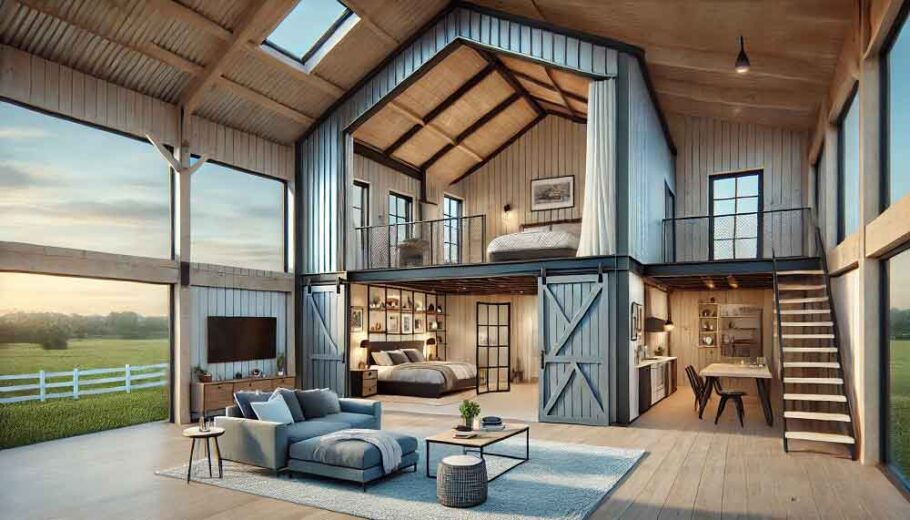
The biggest challenge—and the greatest opportunity—with a barndominium is the interior. You’re dealing with a wide-open canvas. While that sounds liberating, it can actually be intimidating. If you’re not careful, that spacious barndo can feel cold, echoey, and empty, like you’re living in an aircraft hangar. On the flip side, if you try too hard to fight the space, you can end up cluttering it up and losing the very thing that made you want a barndominium in the first place: the openness.
The sweet spot is finding that balance between cozy and spacious. You want it to feel like a warm hug when you walk in, but you also want to be able to host a party without people feeling like they’re stacked on top of each other. After working on a few of these projects and seeing what works (and what really doesn’t), I’ve put together some thoughts on how to customize your barndominium interior to get that perfect blend of comfort and airiness.
1. Define Zones Without Building Walls
The number one rule of barndominium design is accepting that you probably don’t have a lot of interior walls. The great room—kitchen, dining, and living area—is usually one massive, continuous space. You can’t just push a sofa against a wall and call it a day, because often, there are no interior walls to push it against.
To make the space feel cozy, you need to create distinct zones for different activities. This tricks your eye into seeing separate, intimate areas rather than one giant void.
- Furniture as Room Dividers: Your furniture is your best tool here. Instead of lining everything against the perimeter, float your furniture in the middle of the room. The back of a large sectional sofa can act as a visual barrier between the “living room” and the “dining room.” A long, low console table placed behind a sofa can hold lamps and decor, solidifying that divide.
- Area Rugs are Your Best Friend: You cannot have enough area rugs in a barndominium. In a standard home, rugs define the furniture grouping. In a barndo, they literally define the room. You need a rug for the living area that is large enough for all the front legs of your furniture to sit on it. You need a separate rug under the dining table. This anchors each zone and gives it a distinct identity. When you step off the hard flooring onto the rug, your brain registers that you are entering a specific “room.”
- Strategic Lighting: Lighting is the unsung hero of zoning. In an open space, relying on one set of overhead lights will make the whole place feel flat and cavernous. You need layers. A low-hanging cluster of pendants over the dining table pulls the eye down and creates an intimate dining zone. A striking linear chandelier over the kitchen island carves out the workspace. Arc floor lamps placed strategically in the living area create pools of light for reading nooks. By keeping the light low and focused in specific areas, you make the ceiling feel higher and the space feel more intimate.
2. Embrace Texture to Warm Up the Space
Let’s be honest: steel, concrete, and drywall can be cold. They are hard surfaces that reflect sound and light in a way that can feel sterile. To get that “cozy” factor, you have to bombard the space with texture. Texture absorbs sound, softens the light, and makes a room feel touchable and lived-in.
Think about what makes a cabin feel cozy: wood, wool, and stone. Now, think about how to translate that into your metal building.
- The Great Wood Debate: You have to decide where to put your wood. If you have the budget, adding wood planks to an accent wall or even to the ceiling (more on that later) can change the entire feel of the place. Reclaimed barn wood is a popular choice because it fits the aesthetic perfectly. If that’s out of budget, look at shiplap or even faux wood beams. They add that visual warmth without the structural headache.
- Soft Furnishings are Key: This is where you can go to town. Think chunky knit blankets draped over the sofa, velvet or linen upholstery (which adds softness), and lots of cushions. Linen curtains—even if you just hang them on either side of a window to soften the edges—add a softness that hard walls and metal windows lack.
- Natural Elements: Bring the outside in. Large potted plants (or high-quality fakes if you lack a green thumb) breathe life into a space. Woven baskets for storage, jute or sisal rugs layered under your main wool rug, and stone accents on the kitchen island or a fireplace will all ground the space and make it feel more organic and less industrial.
3. Don’t Be Afraid to Go Dark
This sounds counterintuitive when you’re trying to make a space feel spacious, doesn’t it? Conventional wisdom says white makes a room feel bigger. But in a vast, open barndominium, too much white or beige can actually make the space feel flat and impersonal. It lacks depth.
Using darker, richer colors on the walls or cabinets can actually make a large space feel more intimate and grounded. Dark colors absorb light, which softens the edges of the room. They make the walls feel like they are wrapping around you, rather than receding into the distance.
- The Kitchen Island Statement: One of the most effective tricks I’ve seen is painting the kitchen island a deep, moody color—like navy, charcoal, or forest green. It becomes an anchor point in the center of the open floor plan. It’s a bold, grounded object that your eye can rest on amidst the sea of open space.
- Moody Living Areas: If your living room is part of the great room, consider painting that specific zone a deeper shade. You can stop the paint at a logical architectural point, or even use a change in wall material (like transitioning from drywall to shiplap) to signal the shift. A dark accent wall behind the TV or sofa creates a sense of enclosure.
4. Tame the Vaulted Ceiling
That massive, vaulted ceiling is the hallmark of a barndominium. It’s what gives you that incredible sense of volume. But if left untreated, it can feel like a black hole up there, sucking the warmth right out of the room. You need to bring the eye down and add interest up high.
- Faux Beams: This is arguably the most impactful change you can make. Installing large, faux wood beams across the ceiling breaks up the expanse of metal or drywall. They add architectural interest, warmth, and a rustic touch. Even if you just do two or three major beams running the length of the main living area, it changes the entire character of the space. It adds weight and detail, making the ceiling feel intentional rather than just “there.”
- Ceiling Fans on a Different Level: Don’t skimp on ceiling fans, but don’t hang them 20 feet in the air where they are useless. If you have a two-story ceiling, you need commercial-grade fans on long downrods to bring them down to a height where they can actually circulate air and be seen. A beautiful wooden fan adds another layer of texture up high.
- Consider a Loft: If you have the height and the space, a loft is the ultimate cozy addition. It creates a second level that overlooks the main space. This does two things: it adds usable square footage, and it visually breaks up the vertical void. The area under the loft becomes a nook—a perfect spot for a dining area or a reading corner—making that part of the main floor feel instantly more intimate.
5. Choose Furniture with Purpose and Scale
In a standard living room, you worry about a sofa being too big. In a barndominium, your biggest risk is buying furniture that is too small. Tiny furniture floating in the middle of a cavernous space will look like dollhouse furniture and will make the emptiness feel even more pronounced.
- Go Big or Go Home: Invest in a large, deep sectional. Look for sofas with high backs and substantial arms. A massive, overstuffed sofa anchored on a large rug will fill the visual space and create a real sense of a “living room.”
- Create Conversation Areas: Don’t just line up furniture against a wall. In a large space, you have the luxury of creating a second conversation area. Maybe it’s a couple of armchairs by a window with a small table between them, or a bench with a fireplace. This fills the square footage in a functional way.
- Vertical Storage: Use your vertical space for storage. Floor-to-ceiling bookshelves or built-in cabinetry on one wall not only provide tons of storage but also draw the eye up, emphasizing the height while also warming up the wall surface.
6. Don’t Neglect the Entry
In many barndominium layouts, the front door opens directly into the great room. There is no foyer, no transition space. You go from outside to “living room” in one step. This can feel jarring and can also make the space feel less tidy, as you’re immediately confronted with the entirety of the house.
Create a virtual entryway. Place a large, substantial console table or a low bench against the wall near the door. Put a lamp on it, a tray for keys, and a basket underneath for shoes. Hang a mirror above it. This defines the entry zone and gives you a place to “land” when you come inside, creating a buffer between the outdoors and your living space.
7. The Glow of the Hearth
If there is one thing that screams “cozy,” it’s a fireplace. In a barndominium, a fireplace isn’t just a nice-to-have; it’s an essential tool for creating warmth and focus.
A large stone fireplace on a main wall gives you a natural focal point for the entire great room. You can arrange all your furniture to face it, which instantly creates a gathered, communal feeling. If you can, do a double-sided fireplace that can be enjoyed from the living area and a porch or patio, extending that cozy feel both inside and out.
Customizing your barndominium is a balancing act. You are the curator of a massive, beautiful, empty space. Your job is to fill it with intention—not with clutter, but with anchors. Anchors of color, texture, and light. By creating distinct zones, warming up the surfaces, and scaling your furniture appropriately, you can take that metal building and turn it into the coziest, most welcoming home on the block. It’s a big project, but when you’re curled up under a blanket watching the snow fall through those big windows, you’ll know you got it just right.