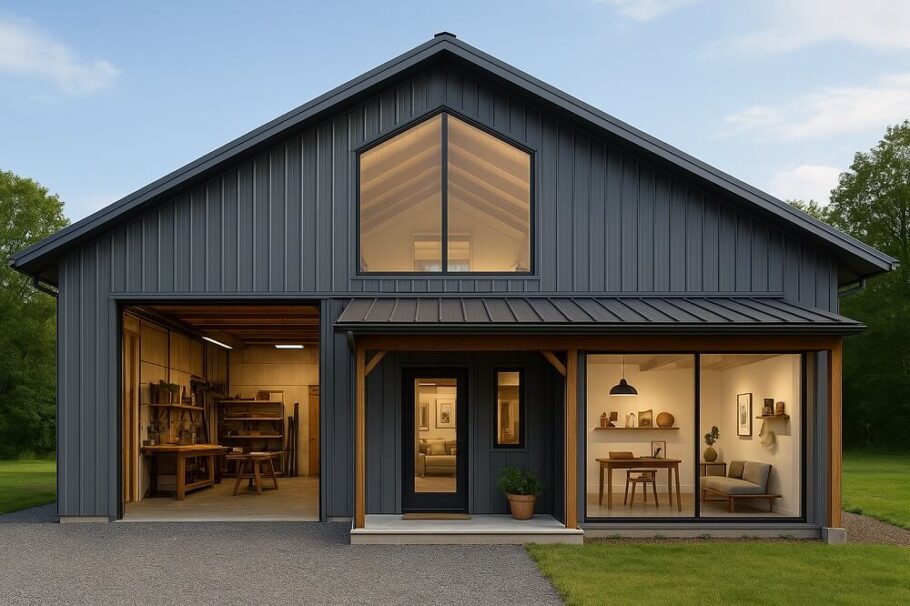
Barndominiums are known for their flexibility, efficiency, and bold architectural potential. But despite their popularity, many barndominium projects stumble at a critical moment: the inspection phase. Failed inspections delay occupancy, increase costs, frustrate homeowners, and can even require partial demolition if violations are severe.
Unlike conventional homes, barndominiums combine agricultural-style structures with residential standards. That hybrid nature creates unique inspection challenges. Inspectors evaluate them using residential building codes, even when the structure feels more like a metal barn. Builders who overlook that reality often pay the price.
This guide breaks down the top five reasons barndominiums fail inspection, why those failures happen, and how to prevent them long before the inspector arrives.
Why Barndominium Inspections Are Less Forgiving Than You Think
Inspections exist to protect safety, durability, and long-term livability. With barndominiums, inspectors pay special attention to:
- Structural load paths in metal or post-frame systems
- Moisture control and thermal envelope design
- Fire separation between living and shop areas
- Energy code compliance
- Plumbing and electrical routing inside unconventional wall assemblies
Because barndominiums deviate from typical residential framing, inspectors scrutinize details more closely. Assumptions that “this works in barns” often do not hold up under residential code.
Now let’s examine the five most common failure points.
1. Improper Foundation Design and Preparation
Why It Fails
Foundation problems are the number one inspection failure for barndominiums. Typical issues include:
- Footings not deep enough for frost depth
- Inadequate rebar placement
- Slab thickness below minimum code
- Poor soil compaction
- Missing vapor barriers
- Anchor bolts incorrectly spaced or embedded
Many barndominium owners attempt to reuse agricultural slab designs that are not suitable for residential loads or code requirements.
Why Inspectors Reject It
The foundation is the entire building’s structural base. Inspectors know that any defect here affects the life of the structure. Residential codes require strict compliance with:
- Minimum footing dimensions
- Load-bearing calculations
- Moisture isolation
- Termite protection (in many regions)
How to Avoid It
- Hire a structural engineer familiar with barndominium loads
- Use a geotechnical soil test when required
- Follow residential slab standards, not barn standards
- Install vapor barriers and insulation exactly as specified
- Verify anchor bolt placement before concrete pour
A foundation inspection is nearly impossible to fix later. Get it right the first time.
2. Structural Framing That Doesn’t Meet Residential Code
Why It Fails
Barndominiums often use post-frame or steel-frame systems. While structurally strong, these systems must still meet residential code requirements for:
- Wall bracing
- Load transfer paths
- Wind uplift resistance
- Seismic detailing
- Floor diaphragm connections
Common failures include:
- Posts spaced too far apart
- Missing shear walls
- Inadequate roof bracing
- Improper truss connections
- Unapproved framing modifications
Why Inspectors Reject It
Inspectors are responsible for verifying that loads transfer safely from roof to foundation. If they cannot clearly trace that path using code-approved methods, the structure fails.
Metal framing does not automatically equal compliance.
How to Avoid It
- Use stamped structural drawings from an engineer
- Do not alter framing layouts in the field
- Install all required bracing, clips, and connectors
- Keep manufacturer documentation on-site
- Follow truss placement and fastening schedules exactly
When inspectors see professional engineering plans followed correctly, approval becomes far easier.
3. Poor Insulation and Thermal Envelope Design
Why It Fails
Barndominiums frequently fail energy code inspections due to:
- Missing insulation in metal walls
- Incorrect R-values
- Thermal bridging through steel framing
- No air sealing
- No vapor retarder in cold climates
- Condensation risks inside wall cavities
Metal buildings transfer heat rapidly. Without proper insulation strategy, they violate energy and moisture codes.
Why Inspectors Reject It
Energy codes are strictly enforced in most regions. Inspectors test:
- Insulation thickness
- Installation quality
- Air sealing around penetrations
- Roof and wall R-values
- Window and door performance
Gaps, compression, or wrong materials lead to immediate failure.
How to Avoid It
- Design insulation system during planning, not after framing
- Use closed-cell spray foam or hybrid systems for metal walls
- Seal all penetrations with approved materials
- Install continuous exterior insulation when required
- Match R-values to local climate zone
A barndominium is only as comfortable and efficient as its envelope design.
4. Fire Separation and Life Safety Violations
Why It Fails
Many barndominiums include workshops, garages, or storage areas under the same roof as living spaces. Common failures include:
- Missing fire-rated wall assemblies
- No fire separation between shop and living area
- Improper door ratings
- Exposed steel or framing without fire protection
- No fire blocking inside wall cavities
Why Inspectors Reject It
Residential codes prioritize fire containment. If a fire starts in a shop, the structure must slow its spread to allow safe evacuation.
Barndominiums often fail because builders treat the shop area like an agricultural space instead of a residential risk zone.
How to Avoid It
- Install fire-rated drywall between living and shop spaces
- Use fire-rated doors with self-closing hardware
- Seal all penetrations in rated assemblies
- Install fire blocking at required intervals
- Follow local code for mixed-use separation
Fire separation is not optional in hybrid barndominium layouts.
5. Plumbing and Electrical Routing Errors
Why It Fails
Metal and post-frame construction complicates mechanical systems. Frequent problems include:
- Electrical wiring run without proper protection
- No nail plates over studs
- Plumbing lines too close to exterior walls
- Poor slope on drain lines
- Improper venting
- Missing access panels
- Overfilled electrical boxes
Why Inspectors Reject It
Inspectors check for long-term safety and serviceability. Improper routing increases fire risk, freezing risk, and maintenance problems.
How to Avoid It
- Coordinate framing and mechanical layouts early
- Use conduit or protective plates where required
- Keep plumbing inside insulated envelope
- Label electrical circuits properly
- Maintain correct spacing and fastening
Professional coordination between trades is essential in barndominium builds.
Bonus Failures That Frequently Appear
While the top five cover most rejections, inspectors also commonly flag:
- Incorrect stair rise and run
- Missing handrails or guardrails
- Window egress size violations
- Improper roof ventilation
- Bathroom exhaust venting into attic
- Improper attic access sizing
Each of these seems small, but any one can delay approval.
The True Cost of a Failed Inspection
Failing inspection is not just an inconvenience. It can cause:
- Construction delays
- Contractor rework charges
- Permit reinspection fees
- Material waste
- Schedule conflicts with subcontractors
- Loss of financing milestones
- Occupancy delays
Worse, some failures require demolition of finished work.
How to Prepare for Inspection Success
Build With Inspection in Mind
Don’t treat inspections as a final hurdle. Treat them as design criteria.
- Study local building codes early
- Hire professionals with barndominium experience
- Keep stamped plans on-site
- Photograph concealed work
- Communicate with inspectors respectfully
- Ask questions before building questionable details
Schedule Pre-Inspection Walkthroughs
Many experienced builders perform internal inspections before calling the official inspector. This catches mistakes early when they are still cheap to fix.
The Barndominium Mindset Shift
One of the biggest reasons barndominiums fail inspection is mindset. Owners and builders think:
“This is a barn with living space.”
Inspectors see:
“This is a house that must meet residential standards.”
Once that mental shift happens, most inspection problems disappear.
Final Thoughts
Barndominiums offer incredible design freedom, but they demand disciplined construction. The top five inspection failures—foundation errors, structural framing issues, insulation mistakes, fire separation problems, and mechanical routing violations—are all preventable.
Inspection success is not about luck. It is about preparation, engineering, and respect for residential building codes.
When your barndominium passes inspection on the first attempt, it is not just a legal victory. It is proof that your home is safer, stronger, more efficient, and built to last.