
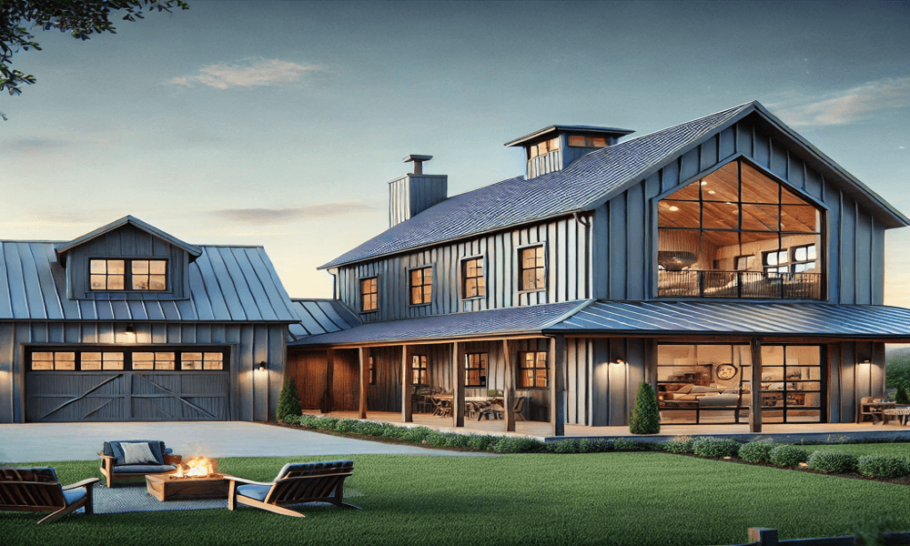
The rise of the barndominium has shifted the landscape of residential construction. Blending the rustic aesthetic of a barn with the functionality of a modern home, these structures are celebrated for their open floor plans and energy efficiency. However, beneath the attractive siding and spacious interiors lies a formidable engineering framework designed to handle the worst weather nature can offer.
Understanding why metal buildings outperform traditional stick-built homes during hurricanes, tornadoes, and straight-line wind events requires a look into structural physics. It is not magic; it is a calculated application of load paths, material science, and aerodynamic design.
The Physics of Wind Load
To understand why a barndominium stands firm, one must first understand what wind actually does to a building. Wind is not simply a pushing force. As air moves across a structure, it creates complex pressure differentials.
When wind hits the windward wall, it creates positive pressure, pushing against the structure. Simultaneously, as air flows over the roof and around the sides, it accelerates, creating negative pressure—or suction—on the leeward side and the roof. This suction attempts to lift the roof off the walls. In traditional construction, these opposing forces often find weak points at the connections, such as where the roof meets the wall or the wall meets the foundation.
Barndominiums counteract this through a principle known as continuous load path. This engineering concept ensures that the force of the wind is transferred continuously from the roof, through the walls, and into the foundation without interruption.
The Monolithic Strength of Steel
The primary differentiator between a barndominium and a conventional home is the skeletal structure. While traditional homes rely on wood framing—which can warp, crack, or rot—barndominiums utilize a steel frame or post-frame construction.
Steel possesses a high strength-to-weight ratio. This means it can withstand immense forces without adding excessive weight to the foundation. When high winds strike, the steel frame flexes slightly but returns to its original shape, rather than snapping like brittle wood or crumbling like masonry. The ductility of steel allows it to absorb energy from wind gusts, preventing the structural fatigue that leads to catastrophic failure.
Furthermore, the connections in a metal building are typically bolted or welded. In a wood-framed house, nails can pull out under stress. In a steel structure, the bolts act as rigid joints, keeping the frame square and intact even when the building is subjected to racking forces—the lateral movement that pushes the top of a wall one way and the bottom the other.
Diaphragm Action and Sheathing
A skeleton alone is not enough. The frame needs skin to provide shear strength. In a barndominium, the metal sheathing (roof and wall panels) acts as a structural diaphragm.
When attached correctly to the steel purlins and girts, the corrugated metal panels create a rigid shell. This shell distributes wind loads across the entire surface area of the building. Instead of a single window or wall segment taking the full brunt of a gust, the force is distributed through the sheathing to the surrounding framework. This is known as diaphragm action. The tighter the attachment pattern (the screws or fasteners), the stronger the diaphragm.
Aerodynamics and Roof Geometry
The shape of a barndominium often plays a role in its survival. Many designs feature a gable roof, which is generally more aerodynamic than complex, multi-hip roof designs found on some traditional homes.
However, the most critical factor regarding the roof is the overhang. While large overhangs provide shade and aesthetic appeal, they act like wings during high-wind events. If wind gets underneath an overhang, it creates uplift. Most engineered barndominiums for high-wind zones feature minimal overhangs or are designed with specific wind clips that tie the roof trusses directly to the wall framing, preventing the roof from peeling off like a lid.
Foundation and Anchoring
None of the superstructure’s strength matters if it is not anchored properly. Barndominiums typically utilize either a concrete slab foundation with embedded anchor bolts or a pier-and-beam foundation with helical piles.
In high-wind zones, the steel columns are anchored directly into the concrete with large, J-shaped bolts that are poured into the foundation while the concrete is wet. This creates a singular unit. The wind can lift, push, and pull, but the connection between the steel column and the concrete slab is designed to hold thousands of pounds of tension and shear force.
The Role of Engineering Standards
It is important to note that not all metal buildings are automatically storm-proof. The science behind wind resistance relies on adherence to local building codes and engineering standards. Modern barndominiums are often designed to meet specific wind speed requirements, such as 120 mph, 140 mph, or even higher in coastal regions.
This involves calculating the design wind pressure based on the location, exposure category, and height of the building. An engineer will specify the gauge of the steel, the spacing of the framing members, and the size of the bolts required to resist those specific forces. A structure built to withstand a 90 mph wind in a rural area is fundamentally different from one built to withstand a 150 mph hurricane on the coast.
Conclusion
The resilience of a barndominium is not a coincidence or a stroke of luck. It is the result of physics and engineering working in tandem. By utilizing a continuous load path, the ductility of steel, the rigidity of diaphragm action, and deep foundational anchoring, these structures turn the destructive energy of a storm back against itself. As weather patterns become more unpredictable, the barndominium stands as a testament to the power of modern metal building science.