
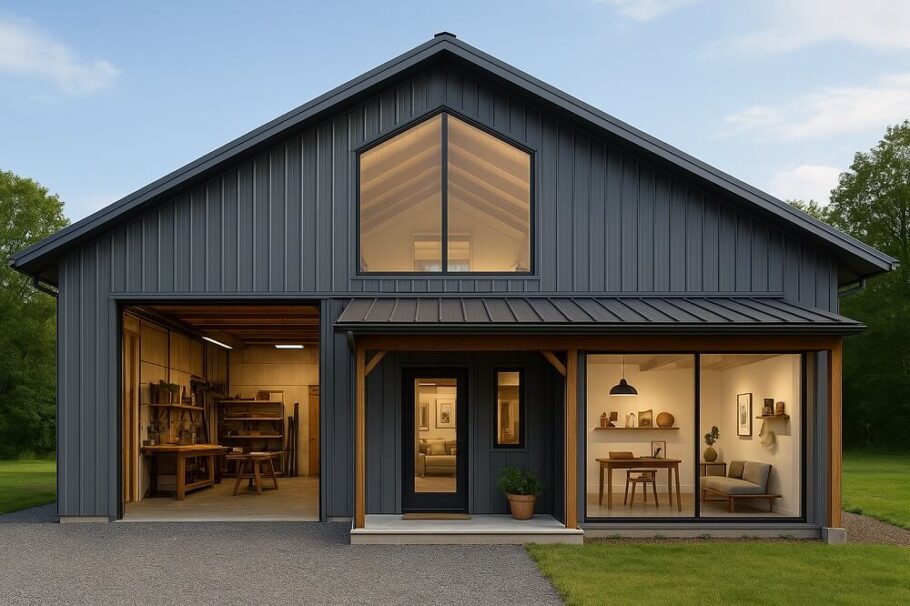
The barndominium trend has taken root deep in the soil of American self-reliance. Across rural and suburban landscapes, these steel-clad hybrids promise something rare: affordable, spacious living without the crushing weight of a traditional construction loan. But for the DIY crowd with a tight budget and a garage full of everyday tools, the question isn’t whether barndominiums are appealing. The question is whether a person can actually build one using nothing more than basic hand tools, a circular saw, and a stubborn refusal to quit.
The short answer is yes. The long answer requires a sober look at what “basic tools” really means, where the hard limits are, and how far determination can stretch before it snaps.
Defining “Basic Tools” for a Barndominium Build
Before hammering a single nail, get honest about the toolbox. Basic does not mean inadequate. A determined DIYer working on a barndominium needs a core set of reliable equipment: circular saw (corded, 15-amp minimum), cordless drill/driver set, hammer, tape measure, level (at least four feet), framing square, chalk line, reciprocating saw, and hand-operated post hole digger. For finishing work, add a miter saw (a used one counts), orbital sander, and a good set of chisels.
Missing from this list are the big-ticket rentals: skid steers, telehandlers, concrete pump trucks, and welding rigs for steel framing. Those get borrowed, hired out, or replaced with clever workarounds. The determined DIYer does not need a $50,000 shop full of professional gear. But ignoring the limits of human strength and time would be foolish.
The Foundation: Where Basic Tools Hit Their Limit
Every barndominium starts with a hole in the ground. For a post-frame building (the most common barndominium style), the foundation consists of concrete piers or a continuous perimeter footing. Digging holes by hand with a post hole digger works fine for a small shed. For a thirty-by-forty-foot living space with twenty or more piers, hand-digging becomes a season-long nightmare.
The realistic path here is compromise. A DIYer with basic tools can certainly dig the holes, set the forms, mix bagged concrete in a wheelbarrow, and pour each pier one at a time. People have done it. But the smarter move is renting a one-person auger for a weekend or paying a local operator with a mini-excavator to knock out the holes in an afternoon. That single rental keeps the project moving without violating the spirit of basic-tool construction. Mixing concrete by hand is miserable but possible. Ordering a ready-mix truck for the whole pour costs money but saves weeks of labor. Neither choice requires fancy tools. Both require honesty about physical limits.
Framing the Shell: Steel vs. Wood
Barndominiums typically use either a steel pole barn frame or a wood post-frame structure. For the basic-tool builder, wood framing wins every time. Steel requires welding, cutting with abrasive saws, heavy lifting with equipment, and specialized fasteners. Wood asks for a circular saw, a hammer, and a level. The choice is obvious.
A wood post-frame barndominium uses treated 6×6 posts set into concrete piers, with horizontal girts and purlins instead of traditional stud walls. This is where basic tools shine. A circular saw crosscuts dimensional lumber. A reciprocating saw handles notches and tricky angles. A hammer drives nails into pre-drilled holes (and yes, predrilling matters when hand-nailing into treated lumber). A ladder and a chalk line lay out the grid.
The challenge is not the tools but the geometry. Plumb posts, square corners, and level girts require constant checking. One post out of alignment throws off the entire wall. A determined DIYer can manage this by working slowly, checking every measurement twice, and using temporary braces cut from scrap lumber. No laser level or transit needed—a simple string line and a four-foot level get the job done.
Roofing and Siding: Working at Height with Simple Gear
Once the frame stands, the building needs skin. Steel roofing and siding panels are the barndominium standard. Installing them requires a few specialized items that still count as basic tools: tin snips (aviation shears), a drill with hex-head driver bits for self-tapping screws, and a chalk line for layout. A cheap siding brake for bending trim can be rented, but many suppliers offer pre-bent flashing.
The real obstacle is height. Working on a ladder with ten-foot sheets of metal panel is dangerous. Basic tools do not include a scissor lift or scaffolding, but renting rolling scaffold planks for a month costs far less than a hospital visit. A determined DIYer can install roofing by setting up pump jacks or building temporary plank staging from lumber. Neither requires advanced skills, just careful anchoring and respect for gravity.
Cutting metal panels with a circular saw fitted with a ferrous metal blade works fine, though it makes a mess of sharp shavings. Tin snips are slower but cleaner for small cuts. The drill drives hundreds of screws—keep extra batteries charged and carry a magnetic screw guide to prevent dropped fasteners.
Insulation and Interior Framing: A Return to Familiar Ground
After the shell is dried in, the build becomes much friendlier to basic tools. Insulating a barndominium means fiberglass batts between the girts and purlins, or rigid foam board for higher efficiency. A utility knife cuts both. No special equipment needed.
Interior walls traditionally use standard 2×4 stud framing. This is the domain of the humble circular saw, the hammer, and the level. A determined DIYer can frame an entire floor plan alone, though a helper makes standing walls much easier. Basic math lays out sixteen-inch centers. A chalk line snaps straight plates. Shims correct the inevitable floor or wall unevenness. Drywall or OSB sheathing goes up with screws—again, just a drill and a box of screws.
This part of the project rewards patience over speed. One person can frame a thousand square feet of interior partition walls in a few weeks of evenings and weekends. The tools do not limit progress. Physical endurance and attention to detail do.
Electrical and Plumbing: The Special Cases
Here is where the basic-tool builder must pause. Running electrical wire requires a few inexpensive items: wire strippers, lineman’s pliers, a voltage tester, and a fish tape for pulling through walls. These are basic tools by any definition. But electrical work demands knowledge more than gear. The DIYer can legally wire their own barndominium in most jurisdictions, but the work must pass inspection. That means learning the National Electrical Code, understanding load calculations, and installing panels and breakers correctly.
Plumbing is similar. Cutting and gluing PVC or PEX requires a hacksaw or PEX cutter—both cheap. But the layout of drains, vents, and water supply lines is a system that floods a building when done wrong. A determined person can learn these skills from books and videos. Many have. But a hybrid approach works better: the DIYer runs the low-skill labor (digging trenches, drilling holes through studs, hanging pipe straps) and hires a licensed pro for the final connections and pressure testing. That keeps the budget in check while ensuring the toilet flushes and the lights turn on.
Flooring, Cabinets, and Trim: Basic Tools Finish Strong
The finishing phase belongs entirely to the basic-tool DIYer. Luxury vinyl plank flooring snaps together with no glue and cuts with a utility knife. Laminate floors require a miter saw for crosscuts and a jigsaw for notches around door jambs. Both tools fall into the basic category. Cabinetry from a big-box store comes pre-assembled or flat-packed; a level, drill, and stud finder handle installation. Trim work uses a miter saw, nail punch, hammer, and coping saw for inside corners.
None of this demands professional skill. Patience and a willingness to redo a bad cut carry the day. A determined DIYer can achieve kitchen and bathroom finishes that rival mid-range contractor work. The secret is not the tool brand but the hours spent measuring, scribing, and fitting.
The Hidden Tool No One Talks About
Beyond saws and hammers, one resource matters more than any other: time. Building a barndominium with basic tools takes much, much longer than a professional crew with a full arsenal. A crew might frame a shell in a week. A solo DIYer should plan on two to three months for that same stage. Finishing another six months. Add weather delays, material shortages, and the inevitable mistakes that require tearing out and redoing.
This timeline does not mean failure. It means recalibrating expectations. A barndominium built with basic tools is not an emergency shelter or a quick flip. It is a long-term project, sometimes stretching across two or three years of weekends and vacation days. The DIYer who succeeds is the one who accepts this reality on day one.
What Absolutely Cannot Be Done with Basic Tools
Some tasks show up on every barndominium plan that no amount of determination can overcome without the right gear. Pouring a monolithic concrete slab foundation requires a power trowel and a bull float for a flat finish. Can it be done by hand? Technically yes, practically no—hand-floating a thirty-by-forty slab means crawling across wet concrete for hours, and the result will look like a frozen ocean. Better to hire that pour.
Lifting steel I-beams or heavy roof trusses into place cannot be done safely with muscle and a ladder. A DIYer without an engine hoist or a rented telehandler must either switch to lighter lumber trusses or find friends and a clever system of block-and-tackle. Lifting heavy objects overhead alone is how projects end in emergency rooms.
Welded steel frames fall into the same category. Stick to wood post-frame construction, which uses only bolts and nails. The dream of a all-steel barndominium built with a home-shop welder is a fantasy. Leave steel to the pros.
The Verdict: What’s Really Possible
A determined DIYer can build a livable, beautiful barndominium using nothing more than basic tools found in any homeowner’s garage plus a few affordable additions. The shell goes up with circular saws and hammers. The interior finishes with drills and levels. The electrical and plumbing get handled through a mix of self-education and targeted professional help. The only absolute requirements are time, patience, and a stubborn refusal to cut corners.
What makes this possible is the nature of post-frame construction itself. It forgives small errors. It uses common lumber dimensions. It relies on repetition and simple geometry. A person who can drive a nail straight, read a tape measure, and keep a chalk line taut has ninety percent of the skills needed.
The other ten percent is managing the weight of steel panels, the height of a roof edge, and the loneliness of working alone for months on end. Those challenges do not require better tools. They require better planning, safer practices, and the wisdom to know when to call in a rental or a helper.
For the DIYer staring at a bare piece of land with a low bank account and a well-used tool belt, the barndominium is not a dream too far. It is a long road, but the road has been walked before. Every cut, every screw, every leveled post adds up to something real. Basic tools do the job. Determination does the rest.