
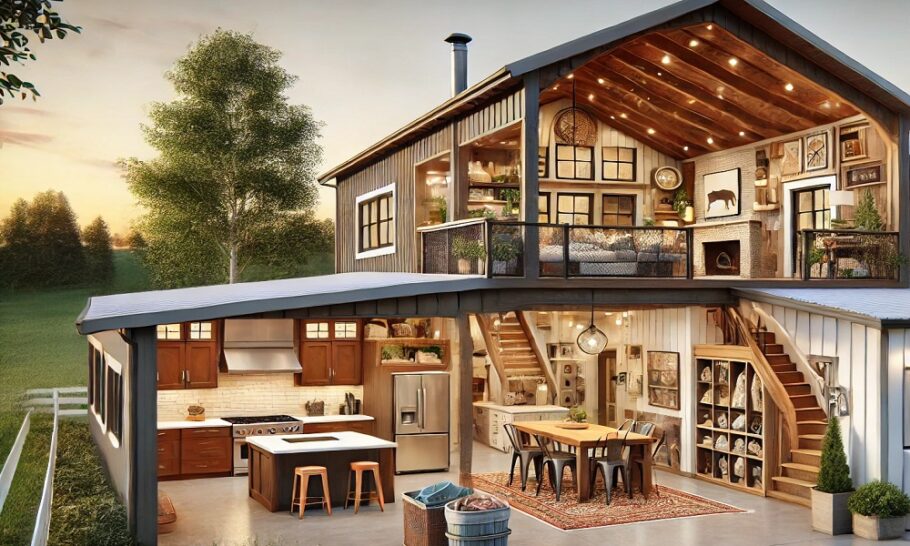
Most barndominiums get built with a fifty-year plan in mind. Pour the slab, raise the steel, screw down the roof panels, and call it done. But what happens in year fifteen when the kids move out and that open loft space needs to become a master suite? Or year twenty when a home-based business requires a separate entrance and a dedicated shipping bay? Traditional construction methods offer few answers beyond a Sawzall and a dumpster.
A quiet shift is happening in post-frame construction. Builders and homeowners are starting to ask a different question: not just how do we put this together, but how do we take it apart? The answer has a formal name—Design for Disassembly—and it is changing the way barndominiums get engineered from the footing up.
Why Permanent Connections Create Permanent Problems
Standard residential construction relies on adhesives, spray foam, nails, and construction adhesives that chemically bond materials into an inseparable mass. A wood-framed wall becomes a single composite object. Disassembly means destruction. Reuse means recycling at best, but more often landfill.
The barndominium, with its exposed structural frame and straightforward post-and-beam logic, actually offers a perfect laboratory for disassembly thinking. The bones are already visible. The connections happen at discrete points. The challenge is not reinventing the building type. The challenge is rethinking the hardware.
Threaded Rods and Bolted Moments
The most promising connection type for disassembly is also one of the oldest: the bolted joint. Instead of welding column splices or driving nails through shear plates, a disassembly-ready barndominium uses threaded rods, structural bolts, and custom brackets that can be loosened with common tools.
A bolted moment connection, for example, allows a steel column to transfer bending forces to a beam without permanent deformation. Weld a tab to the column, bolt through the beam flange, and the joint holds firm under snow loads and wind pressures. But when the floor plan needs to shift, those bolts turn. The beam drops. The column stays. No cutting torch required.
The hardware matters enormously. Grade 8 bolts with zinc plating resist corrosion while maintaining thread integrity over decades. Oversized washers distribute clamping force without crushing the steel. And crucially, every connection point gets detailed on a set of as-built drawings that live in a sealed tube mounted to the wall. Future owners should not have to guess which bolt does what.
Mechanical Fasteners Over Adhesives
Adhesives are the enemy of disassembly. Construction adhesive, expanding foam, and even certain weather sealing tapes create chemical bonds that cannot be reversed without destroying the substrate. A barndominium designed for future reconfiguration avoids these materials entirely.
Instead of gluing down subfloor panels, the builder uses screws every six inches along the joists. Instead of foaming around window rough openings, closed-cell gaskets and mechanical fasteners provide the air seal. Instead of adhesive-backed house wrap, a mechanically fastened fabric with taped seams that can be peeled and reapplied.
The difference shows up in the demolition phase. A screwed-down floor comes up in ten minutes without splintering a single panel. A glued floor becomes firewood. That reclaimed OSB can go right back down somewhere else in the same building, sometimes in the same afternoon.
The Role of Prefabricated Panel Systems
Some of the cleanest disassembly work happens off-site. Prefabricated wall and roof panels that bolt to the primary structure offer a level of reconfigurability that stick framing cannot touch.
A typical prefab panel might consist of 2×6 framing, rigid insulation, and an interior finish layer all assembled in a jig at a workshop. The panel arrives on a truck with predrilled holes at each corner. Four bolts secure it to the column. The next panel butts up against it. A spline or a gasket seals the joint.
To move a wall, unbolt the panel, lift it with a telehandler, and set it somewhere else. The openings come already framed. The electrical rough-in happens in the panel before the drywall goes on. It is modular construction taken seriously, not as a cost-cutting measure but as an investment in future flexibility.
Exposed Connections as Architectural Feature
There is an aesthetic case to be made here as well. Hiding every bolt and bracket behind drywall and trim defeats the purpose of disassembly. The best designs embrace the hardware. Steel gusset plates finished with clear lacquer. Exposed flange bolts with decorative caps. Threaded rod tensioners that look like they belong in a bridge, not a living room.
This industrial aesthetic suits the barndominium format perfectly. The building type already celebrates raw materials and structural honesty. Adding exposed, intentional connection hardware just continues that conversation. A visitor should be able to look at a column-to-beam joint and understand, without an explanation, that those bolts are meant to turn someday.
Foundation Details That Allow Movement
Disassembly does not stop at the floor line. A truly reconfigurable barndominium needs a foundation system that can accommodate changing loads and, in some cases, complete structural rearrangement.
Pier foundations with adjustable brackets offer one solution. Instead of pouring a continuous perimeter footing, the builder drives helical piles or casts concrete piers at regular intervals. Adjustable brackets sit on top of each pier. The primary columns bolt into these brackets. Shim packs allow for fine-tuning the column elevation, and the bolted connection means any column can be unbolted and moved.
Slab-on-grade presents more challenges, but creative solutions exist. Cast-in threaded inserts at regular grid points create anchor locations for future walls. A floating slab with no integral footings can be saw-cut and removed in sections if the floor plan changes drastically. Neither option is cheap, but both are cheaper than demolishing a thirty-year-old building and starting over.
Mechanical, Electrical, and Plumbing as Separate Systems
Disassembly thinking applies to the guts of the building too. A reconfigurable barndominium treats MEP systems as independent layers that can be accessed, modified, or removed without disturbing the structure.
Electrical runs through surface-mounted conduit rather than inside walls. Plumbing stacks cluster in removable chaseways rather than buried in insulation. HVAC ductwork hangs from hangers that unclip rather than straps that require cutting. None of these choices look unusual. Commercial buildings have used exposed conduit and accessible chases for a century. The only difference is applying the same logic to a residence.
When a wall moves, the conduit unclips from the surface, the chaseway opens, and the mechanicals adjust. No fishing wires through studs. No breaking into finished ceilings. The building becomes a kit of parts that includes the plumbing and wiring as much as the steel and lumber.
The Cost Question Up Front Versus Later
Disassembly-ready connections cost more on day one. Bolts cost more than nails. Threaded inserts cost more than anchor cement. Prefabricated panels cost more than stick framing. The hardware alone might add ten to fifteen percent to the structural budget.
But those upfront costs start looking different when measured against the cost of future reconfiguration. Retrofitting a traditionally built barndominium often means opening walls, cutting structural members, and disposing of mountains of demolition debris. A single reconfiguration can easily run twenty thousand dollars. A second one runs another twenty thousand. The disassembly-ready building might cost an extra fifteen thousand upfront but pays for itself after the first major layout change.
Then there is the salvage value. A building designed for disassembly has a materials bank at the end of its life. The steel columns go to another project. The panelized walls go to an addition. The copper pipe gets sold. Traditional demolition sends everything to a grinder.
Code Considerations and Engineering Approval
Building departments do not always know what to do with bolted moment connections and removable wall panels. The International Residential Code assumes nails, glue, and permanent assembly. A design for disassembly requires engineering stamps, sometimes peer reviews, and a lot of conversations with plan examiners.
The path forward usually involves working with a structural engineer who understands post-frame construction and alternative connection methods. That engineer will specify bolt sizes, edge distances, and torque requirements. They will also write a letter explaining why a bolted connection meets or exceeds the strength of a nailed one. Most building departments accept this approach once the engineering makes the case.
Documentation becomes critical. Every connection type, bolt specification, and disassembly sequence should live in a permanent building manual. Future owners, builders, and even building inspectors need to know what holds the building together and how to take it apart safely.
A Building That Learns and Changes
The disassembly-ready barndominium rejects the idea that a building is a finished object. Instead, the building becomes a platform—a durable, engineered frame that supports a constantly evolving set of interior conditions. The steel stays. The panels shift. The family grows, contracts, and grows again in different configurations.
This approach demands more from the initial design. It requires thinking about load paths that might change. It requires detailing connections that might cycle through tension and release over decades. It requires accepting that the perfect layout does not exist, only the current one.
But that honesty feels like freedom. A barndominium that can unbolt and rearrange itself over time stops being a building and starts being a tool. And a good tool adapts to the hand that holds it.