
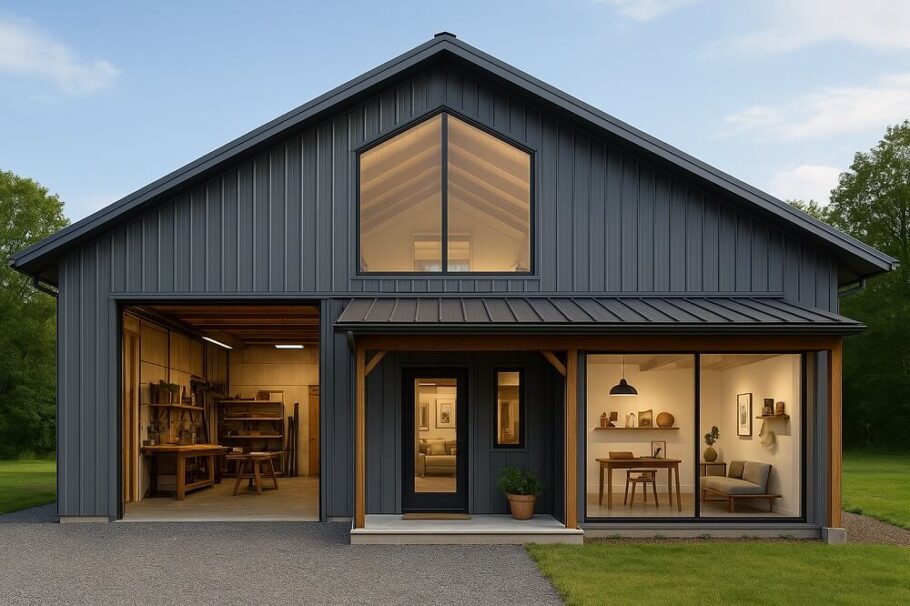
Barndominiums have exploded in popularity over the last decade, and for good reason. These hybrid structures—part workshop, part living quarters, all steel and timber—offer affordability, durability, and that wide-open rural aesthetic city folk can’t seem to get enough of. But most barndos today are still built using conventional methods borrowed from agricultural sheds and suburban stick framing. That’s fine, but it’s not exactly groundbreaking. What happens when you stop treating a barndominium like a metal box with drywall and start treating it like a living ecosystem? That’s where biomimetic engineering enters the picture.
Biomimetics, or biomimicry, is the practice of drawing inspiration from nature’s time-tested patterns and strategies to solve human engineering problems. Think lotus leaves repelling water, termite mounds maintaining steady temperatures in the African savanna, or honeycomb structures achieving maximum strength with minimal material. Now apply those lessons to a barndominium. The result isn’t just a quirky conversation starter—it’s a smarter, more resilient, and profoundly efficient building.
The Honeycomb Skeleton: Structural Efficiency Reimagined
A conventional barndominium relies on heavy-gauge steel framing or laminated posts spaced every eight or ten feet. It works, but it’s brute force engineering. Look inside a beehive, and you’ll see something different. Hexagonal cells pack together with no wasted space, distributing loads evenly across every wall. That geometry handles compression and shear forces far better than squares or rectangles.
Translating this into building design means rethinking the frame itself. A honeycomb-inspired barndominium might use hexagonal floor cassettes instead of rectangular joists. The walls could incorporate a grid of hexagonal shear panels—thin steel or engineered wood stamped into a cellular pattern. These panels weigh less than solid sheathing but resist buckling and racking like something twice as thick. For tornado-prone regions where many barndos are built, that’s not a minor upgrade. It’s a potential life-saver that also cuts material costs by thirty percent or more.
Even the roof benefits. Standard barndominium roofs use corrugated metal panels laid over purlins. A biomimetic approach borrows from the cellular structure of bird bones—hollow but reinforced with internal struts. That translates to a standing-seam metal roof with an integrated truss system that follows a branching, trabecular pattern. The load spreads out along natural force paths instead of just dropping straight down onto load-bearing walls. Less steel, fewer internal columns, and more open floor space for that shop or living area.
Breathing Like a Termite Mound: Passive Climate Control
Here’s where biomimetic engineering gets really interesting. Termite mounds in Namibia and Zimbabwe maintain a near-constant temperature of about 87°F (30°C) while the outside air swings from near-freezing at night to over 100°F during the day. They do this without a single HVAC duct or thermostat. The secret lies in a network of tunnels and chimneys that harness wind pressure and thermal buoyancy to circulate air continuously.
A barndominium designed this way doesn’t need a giant heat pump guzzling electricity. Instead, the building becomes a breathing organism. Start with orientation—long axis aligned to prevailing summer breezes. Then add an underground air intake, often called an earth tube, buried four to six feet below the frost line. Air passing through these tubes gets pre-cooled by the stable ground temperature before entering the living space. From there, it rises through a central masonry core—a thermal mass wall made of rammed earth or concrete block—picking up or shedding heat as needed. Hot air exhausts through ridge vents or solar chimneys on the south-facing roof.
The barndominium’s classic high ceilings and open mezzanines work perfectly for this strategy. Warm air collects at the peak, and operable windows near the floor draw in cooler air. Add a few whisper-quiet DC fans to assist during still days, and the whole system runs on less power than a single light bulb. For owners in Kansas, Texas, or Oklahoma where summer heat can turn a metal building into an oven, that’s a game-changer.
The Lotus Effect: Self-Cleaning Exteriors and Water Management
Anyone who owns a barndominium knows the struggle of keeping that metal siding looking decent. Dust, pollen, bird droppings, and mud splatter from farm equipment accumulate fast. Power washing a two-story steel barn isn’t anyone’s idea of a good weekend. Enter the lotus leaf.
Lotus leaves have a microscopic double-textured surface—bumps on bumps—that traps air underneath water droplets. Dirt particles adhere more strongly to the water droplet than to the leaf surface, so as the droplet rolls off, it takes the grime with it. This self-cleaning property, called ultrahydrophobicity, has already inspired commercial coatings. But applying it to barndominium design means thinking beyond a spray-on product.
Imagine standing-seam metal panels embossed with a microscopic hierarchical pattern during the roll-forming process. No coating to wear off, no reapplication every few years. Rainwater beads up and sheets off, carrying away nearly everything that lands on the surface. Gutters and downspouts stay cleaner longer. The roof sheds snow more easily. Even the walls resist graffiti and mildew. For a rural building surrounded by dust and agricultural residue, that cuts maintenance time dramatically.
The same principle applies to water collection. Many barndominium owners rely on rainwater catchment because they’re outside municipal water service. A lotus-inspired roof sheds water so efficiently that collection yields increase by fifteen to twenty percent compared to a standard metal roof. Combine that with a self-cleaning surface, and the water stays cleaner entering the storage tank—less filtration, less sediment, less hassle.
Shark Skin and Fractals: Moving Air and Light Where It’s Needed
Shark skin isn’t smooth. Under a microscope, it’s covered in tiny tooth-like scales called denticles that reduce drag and prevent microbial buildup. Engineers have copied this for ship hulls and wind turbine blades. For a barndominium, the application shows up in the ductwork and ventilation pathways. Traditional rectangular ducts create turbulence and resistance. A shark-skin-inspired lining or a set of small riblets inside circular ducts reduces friction, meaning smaller fans can move the same volume of air. That’s quieter and more efficient.
Then there’s light. Barndominiums often struggle with uneven natural lighting—blazing sun on one side, gloomy shadows on the other. Fractals offer a solution. Trees and ferns branch in fractal patterns to capture sunlight efficiently across different angles and times of day. A fractal-inspired window layout or light shelf breaks up direct glare while bouncing soft, diffuse light deep into the interior. Laser-cut fractal patterns on interior partition panels or stair railings throw speckled light patterns that change with the sun’s position, reducing the need for artificial lighting during daylight hours.
For the south-facing wall, consider a branching array of fiber-optic cables or small light tubes that terminate in ceiling diffusers. Like the veins in a leaf, they distribute light evenly rather than concentrating it in a few bright spots. Photographers and artists who use barndominiums as studios would appreciate the soft, shadowless illumination. So would anyone tired of flicking on overhead LEDs at two in the afternoon.
Owl Feathers and Quiet Barns
Barndominiums aren’t exactly known for acoustic comfort. Metal roofs amplify rain into a deafening drum solo. Steel siding transmits highway noise and barking dogs. Open floor plans let every sound echo off every surface. Nature has an answer for that too, hiding in plain sight on an owl’s wing.
Owls fly silently because the leading edges of their primary feathers have a comb-like fringe that breaks up turbulence into microscopic eddies. The trailing edge has a porous, frayed structure that further dissipates sound energy. Recreate that geometry on building surfaces, and suddenly the noise problem shrinks dramatically.
Acoustic panels stamped with a fringe pattern—milled into wood, pressed into metal, or molded into recycled foam—can line the ceiling of a barndominium. The effect isn’t just absorption; it’s active disruption of sound waves before they even form. Combine that with a corrugated metal roof that has a micro-fringed lower surface, and rain noise drops from irritating clatter to a soft whisper. Workshop equipment becomes tolerable without hearing protection for brief exposure. Conversations in the living area don’t compete with the air compressor kicking on in the shop bay.
Even the foundation benefits. Borrow from the structure of a seashell’s nacre—mother of pearl—which alternates layers of soft protein with hard aragonite to stop cracks from propagating. A barndominium slab-on-grade with alternating layers of compacted gravel, sand, and a geotextile membrane mimics this, dampening vibration from heavy machinery or passing trucks before it reaches the living quarters.
Practical Realities: What This Actually Costs and How to Start
Nobody’s claiming that a fully biomimetic barndominium is as cheap as a standard kit home. The engineering and custom fabrication add costs upfront. But the payoff comes in operational savings, reduced maintenance, and durability that outlasts conventional construction by decades. A lotus-effect metal panel might cost twenty percent more than standard galvalume, but eliminating power washing and repainting over a thirty-year lifespan makes that back several times over. Passive termite-inspired ventilation can downsize or eliminate an HVAC system, shaving ten to fifteen thousand dollars off mechanical costs.
For someone actually planning to build, the smart approach is layering. Pick one or two biomimetic strategies that address the biggest pain points for the specific site. In a hot, humid climate, start with termite-mound ventilation and lotus-effect siding. In a windy, dusty area, prioritize self-cleaning surfaces and owl-feather acoustic treatments. In a place with brutal winters, focus on honeycomb structural efficiency to allow deeper insulation without thicker walls.
Several metal building manufacturers have started offering embossed panel patterns that accidentally create hydrophobic surfaces. A few custom fabricators will mill fractal light shelves from a CNC file. Earth tubes have become almost standard in passive house construction, and there’s no reason they can’t be specced for a barndominium. The pieces exist. They just haven’t been assembled under one roof very often.
Where This Goes Next
The barndominium community has always been about pragmatism with personality. Folks choose these buildings because they want something that works hard, lasts long, and doesn’t look like every suburban tract house. Biomimetic engineering aligns perfectly with that mindset. It’s not about making a building look like a giant bug or a flower. It’s about borrowing 3.8 billion years of design iteration to build something that performs better using less.
Imagine walking into a barndominium in August. No AC running, but the air feels fresh and cool, drawn from underground tubes and rising gently through a central masonry spine. Rain starts hammering the metal roof, but inside it sounds like static on an old radio—present but not piercing. The south-facing windows throw fractal shadows across a workshop table while the north side stays bright but glare-free. And the siding, last cleaned by a thunderstorm three months ago, still looks freshly washed.
That’s not science fiction. That’s biomimetic engineering applied to a steel barn with a living room. Nature figured out these solutions long before humans started drawing blueprints. All the barndominium builder has to do is pay attention, adapt, and build something that breathes, sheds water, and stands strong—just like the rest of the living world.