
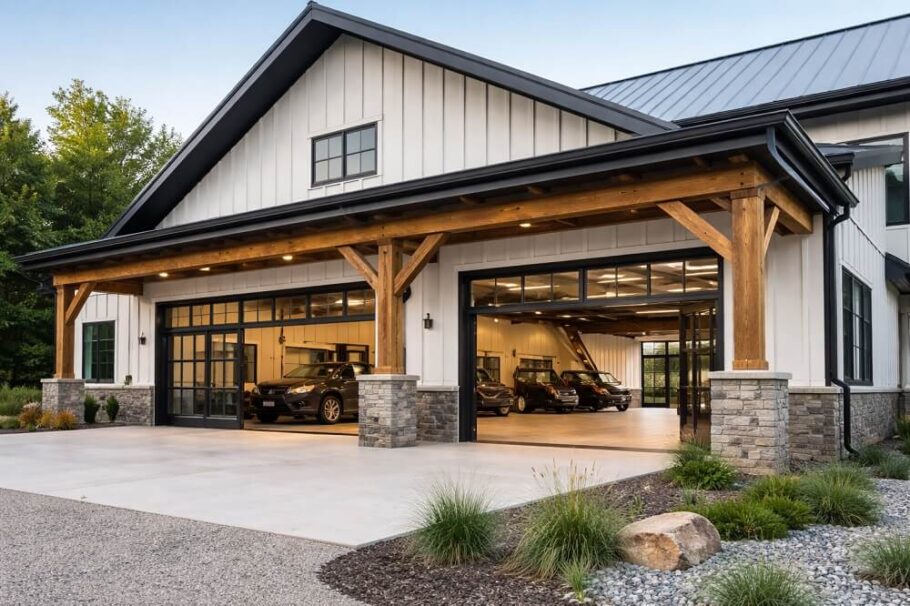
Barndominiums are already known for their efficiency, durability, and flexible layouts—but the next evolution in barndominium design may come from an unexpected place: termite mounds.
Across Africa, Australia, and parts of Asia, towering termite mounds stand in harsh climates where temperatures swing wildly between day and night. Despite these extreme conditions, termites maintain nearly constant interior temperatures and humidity levels without air conditioners, furnaces, or electricity. They do it through nature-engineered passive ventilation systems that outperform many modern buildings.
This is where biomimetic engineering comes in.
By studying and applying the principles found in termite mounds, architects and builders are discovering new ways to design barndominiums that stay cooler in summer, warmer in winter, and healthier year-round—while using far less energy. In this article, we’ll explore how termite mounds work, why their ventilation systems are so effective, and how those same principles can be applied to modern barndominium design.
What Is Biomimetic Engineering?
Biomimetic engineering, also known as biomimicry, is the practice of designing systems inspired by nature’s proven solutions. Instead of forcing buildings to fight the environment using mechanical systems, biomimetic design works with natural forces like airflow, temperature gradients, and solar exposure.
Nature has had millions of years to refine efficient structures. Spider webs optimize strength with minimal material. Bird wings maximize lift with minimal energy. Termite mounds master climate control without a single moving part.
When applied to barndominiums, biomimetic engineering offers a path toward buildings that are:
- More energy efficient
- More resilient to extreme temperatures
- Healthier for occupants
- Less dependent on HVAC systems
- Better suited for off-grid or rural living
The Genius of Termite Mound Ventilation
To understand how termite mounds inspire barndominium ventilation, we first need to understand how these structures function.
A Climate-Controlled Ecosystem
Certain termite species, especially Macrotermes, farm fungus inside their mounds. This fungus requires a very narrow range of temperature and humidity to survive. The challenge is that these mounds exist in environments where outside temperatures can exceed 100°F during the day and drop dramatically at night.
The termites solve this problem with a sophisticated passive ventilation system built entirely from soil, saliva, and instinct.
How Termite Mounds Regulate Airflow
Termite mounds function like living lungs. Their design uses a combination of:
- Vertical shafts
- Internal chambers
- Porous walls
- Temperature differentials
During the day, the sun heats the exterior of the mound, warming the air inside. Warm air rises and escapes through upper vents. As it exits, cooler air is drawn in through lower openings and porous walls.
At night, the process reverses. The mound releases stored heat slowly, preventing rapid temperature drops inside. This continuous cycle creates steady airflow without fans or ducts.
Key Takeaway for Builders
The brilliance of termite mounds lies in their passive stack effect—a natural movement of air driven by temperature differences and height. This same principle can be scaled and applied to barndominiums with remarkable results.
Why Passive Ventilation Matters in Barndominiums
Barndominiums often feature large open interiors, high ceilings, and metal exteriors. While these characteristics offer flexibility and strength, they can also create challenges when it comes to temperature control.
The HVAC Problem
Traditional HVAC systems:
- Consume large amounts of energy
- Require ongoing maintenance
- Can struggle with large-volume spaces
- Often distribute air unevenly
In rural or off-grid barndominiums, these systems may be expensive or impractical.
Passive ventilation reduces reliance on mechanical systems by designing airflow into the structure itself. This not only cuts energy costs but improves comfort and indoor air quality.
Applying Termite Mound Principles to Barndominium Design
Let’s explore how the core ideas behind termite mounds translate into practical barndominium design strategies.
Designing for the Stack Effect
The stack effect is the backbone of termite-inspired ventilation.
How the Stack Effect Works
Warm air is lighter than cool air. As air inside a building heats up, it naturally rises. If there is an outlet at the top and an inlet at the bottom, air will move continuously without mechanical assistance.
Barndominium Design Strategies
- Tall interior spaces with high ceilings
- Vertical ventilation shafts or cupolas
- Clerestory windows or ridge vents
- Lower-level intake vents or operable windows
By encouraging warm air to exit at the highest point of the structure, fresh air is constantly pulled in at lower levels.
Central Ventilation Cores
Termite mounds often have a central core that acts as a thermal and airflow regulator.
Translating This to Barndominiums
A barndominium can incorporate a central ventilation spine that runs vertically through the building. This might be:
- A stairwell with operable vents
- A central atrium
- A chimney-like air shaft
This core becomes the primary exhaust path for warm air while also stabilizing internal temperatures.
Porous and Breathable Building Envelopes
Termite mound walls are not airtight. They allow slow, controlled air exchange through microscopic pores.
Modern Building Adaptations
While modern buildings must remain weather-tight, they can still “breathe” using:
- Ventilated rain screen walls
- Permeable insulation assemblies
- Continuous but breathable air barriers
This helps manage humidity, reduces condensation, and improves indoor air quality.
Thermal Mass for Temperature Stability
Termite mounds store heat during the day and release it slowly at night.
Using Thermal Mass in Barndominiums
Thermal mass helps smooth out temperature swings. Common materials include:
- Concrete slabs
- Masonry walls
- Rammed earth accents
- Stone flooring
When paired with passive ventilation, thermal mass reduces peak heat loads and improves comfort without mechanical systems.
Roof Design Inspired by Nature
The shape and orientation of termite mounds are not accidental. They maximize airflow and minimize heat gain.
Barndominium Roof Strategies
- Steep roof pitches to enhance airflow
- Ridge vents combined with soffit intakes
- Extended overhangs for solar control
- Ventilated attic spaces
A well-designed roof becomes an active participant in passive ventilation rather than a thermal liability.
Zoning and Interior Layout for Natural Airflow
Termite mounds are compartmentalized, allowing precise airflow control.
Applying This Concept Indoors
Barndominium interiors can be zoned to support airflow by:
- Placing heat-producing spaces near exhaust points
- Keeping living areas along airflow paths
- Using transom windows or interior vents
- Avoiding dead-end air pockets
Good layout design reduces the need for fans and improves comfort throughout the structure.
Real-World Benefits of Termite-Inspired Barndominiums
When biomimetic ventilation principles are applied correctly, the benefits are substantial.
Energy Efficiency
Passive ventilation can reduce cooling energy use by 30–60%, especially in warm or mixed climates.
Improved Indoor Air Quality
Continuous fresh air exchange helps remove:
- Moisture
- Odors
- Volatile organic compounds
- Indoor pollutants
This creates healthier living environments with fewer respiratory issues.
Resilience and Reliability
Passive systems don’t fail during power outages. This makes them ideal for rural, remote, or off-grid barndominiums.
Lower Lifetime Costs
Fewer mechanical systems mean:
- Lower installation costs
- Reduced maintenance
- Longer building lifespan
Climate Considerations and Limitations
While termite-inspired ventilation is powerful, it must be adapted to local climate conditions.
Hot and Dry Climates
Passive ventilation works exceptionally well, especially when combined with night flushing and thermal mass.
Hot and Humid Climates
Careful humidity control is required. Passive ventilation should be paired with moisture management strategies and limited mechanical assistance.
Cold Climates
Passive ventilation still works but must be carefully controlled to prevent heat loss. Heat recovery ventilators can complement biomimetic airflow designs.
The Future of Biomimetic Barndominium Design
As energy codes tighten and homeowners demand more sustainable living solutions, biomimetic engineering is moving from theory to mainstream practice.
Advanced modeling tools now allow designers to simulate airflow, temperature movement, and pressure differentials—making termite-inspired ventilation systems more precise than ever.
Barndominiums, with their flexible layouts and structural simplicity, are especially well-suited for this design philosophy. They offer the perfect canvas for merging natural intelligence with modern construction.
Final Thoughts
Termite mounds remind us that efficient, resilient design doesn’t always require advanced technology—sometimes it just requires paying attention to what nature already does best.
By embracing biomimetic engineering principles, barndominium designers can create homes that breathe naturally, regulate temperature passively, and remain comfortable with minimal energy input. These structures don’t just shelter us—they work in harmony with their environment.
In the future, the most advanced barndominiums may not be defined by smart thermostats or high-powered HVAC systems, but by quietly moving air the same way termites have done for millions of years—effortlessly, efficiently, and intelligently.