
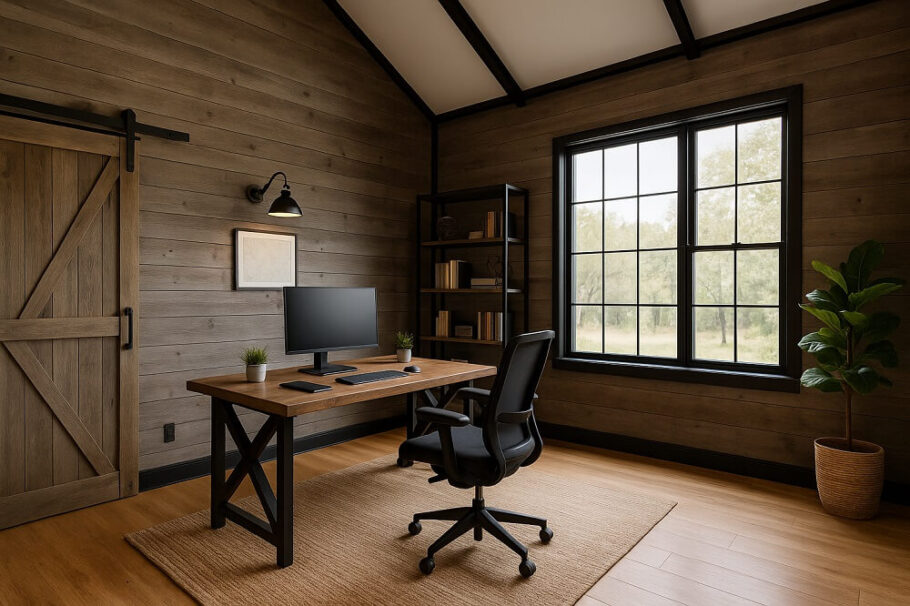
For decades, the dream of a dedicated workspace was often an exercise in compromise. The home office meant commandeering the formal dining room, your back to the family chaos, fighting for bandwidth with the kids’ tablets. The dream workshop was a leaky, single-car garage where you had to shuffle the car out just to saw a piece of wood.
Then came the barndominium.
What started as a regional curiosity in the rural South and Midwest has exploded into a full-blown architectural movement. And for anyone who has ever craved a space that is truly theirs—whether for creative pursuits, heavy-duty tinkering, or focused professional work—the barndominium offers something a traditional suburban home never can: a blank canvas of cubic volume.
Designing a workspace within a barndominium isn’t just about throwing a desk in the corner of a big metal building. It’s about leveraging the unique bones of the structure to create a zone that is more efficient, more inspiring, and more functional than any standard room could ever be. Whether you are planning to build from scratch or converting an existing shell, here is how to master the art of the barndominium workspace.
The Psychology of the High Ceiling
Before we talk about tool chests and ethernet cables, we have to talk about volume. The most immediate difference between a barndominium and a stick-built home is the vertical space. With ceiling heights often soaring to sixteen, twenty, or even thirty feet, the sense of spaciousness is palpable.
For a home office, this volume translates to a lack of visual clutter. In a standard eight-foot ceiling room, bookshelves and cabinets loom over you, closing in the space. In a barndominium, you can breathe. The airiness fosters a clarity of thought that is hard to replicate. If you work in a creative field—writing, graphic design, architecture—the ability to look up and see space rather than drywall can unlock a different level of mental freedom.
For the workshop side of the equation, volume isn’t a luxury; it is a necessity. That vertical space allows for the storage of lumber, the erection of a boat on a lift, or the safe operation of heavy machinery without feeling like you are in a cave. The psychological shift of moving from a cramped, dark garage to a bright, airy workshop is profound. It turns a chore into a craft.
Zoning: The Art of the “Big Room”
The open floor plan is the signature of the barndominium. While beautiful, it presents a unique challenge: how do you keep the dust from the workshop off the keyboard in the office?
The key is thoughtful zoning. You are essentially designing a “big room” with distinct neighborhoods.
The Clean Room (The Office)
This zone needs to be thermally and physically separated from the dirty work. While you might not want full drywalled walls to block the view, consider a “half-wall” or a glass partition wall. Using commercial storefront glass or large sliding barn doors (ironic, given the setting) allows you to seal off the office environment for climate control while maintaining the visual connection to the rest of the space.
When designing the office, focus on the floor plan. Because the barndominium shell is often a rectangle, you have the luxury of arranging your desk to face the activity of the workshop (if you like to keep an eye on projects) or to face a massive roll-up door that opens to the landscape. In-floor radiant heat is a popular choice in barndominiums, and running it under the office slab ensures you aren’t wasting energy heating the entire workshop bay when you are just sitting at a computer.
The Dirty Room (The Workshop)
This zone is where the barndominium truly flexes its muscles. But “workshop” can mean different things. Are you restoring classic cars? Woodworking? Welding? Pottery?
Your hobby dictates your infrastructure.
- For the Woodworker: You need dust collection. This means designing a ductwork system that runs through the ceiling trusses or under the floor before the concrete is poured. You also need dedicated 220V outlets for table saws and planers.
- For the Mechanic: You need a floor drain and a robust ventilation system to handle exhaust fumes if you plan to run vehicles inside. Consider a recessed lift area in the concrete slab.
- For the Maker/Artist: You need natural north-facing light. If possible, position the workshop portion of the barndominium to have large clerestory windows or vertical panel doors to let in consistent, indirect light.
The Mezzanine: Your Secret Weapon
If there is one design feature that separates a good barndominium workspace from a great one, it is the mezzanine. Because of the high ceilings, building a second-floor loft area is often structurally and financially feasible.
Do not waste this space on storage you’ll never access. Think of the mezzanine as the “command center” or the “library.”
Looking down onto the workshop floor from a mezzanine office provides a sense of oversight and control. It allows you to have a quiet, separate office space that is still physically in the building. You can have your video calls in the loft, then walk down a short flight of stairs to get your hands dirty on the engine or the canvas below.
Alternatively, the mezzanine can serve as a design studio or a lounge area for the workshop. If you have employees or collaborators, it becomes a space for blueprints, brainstorming, and taking a break away from the noise of the machinery below.
The Light: Industrial vs. Ambient
Lighting in a standard home is an afterthought—a few can lights and a ceiling fan. In a barndominium, lighting is architecture.
You have the opportunity to mix two types of lighting effectively.
First, there is the industrial lighting required for the workshop: high-bay LED shop lights that hang down to bathe the workspace in a crisp, white light. These are essential for safety and precision.
But for the office zone, you need warmth. This is where you can get creative. Use the steel beams or the bar joists as mounting points for track lighting or decorative pendants. Because the ceiling is so high, you can use larger fixtures that would dwarf a normal room.
Don’t underestimate the power of the garage doors themselves. If you install glass panels in the top sections of your roll-up doors, you can flood the interior with natural light during the day, reducing your electricity bill and boosting your mood. Polycarbonate panels can also be used to diffuse light, preventing harsh shadows on your workbench.
The Floor: Where the Rubber Meets the Road
You cannot have a single flooring type in a hybrid space. You need transition points.
In the workshop, a sealed concrete floor is king. It handles dropped tools, oil spills, and the weight of machinery. You can even have it stamped or stained to give it a bit of personality, or epoxy-coated for a high-gloss, easy-clean finish.
As you move toward the office zone, the flooring should change to delineate the space. Large format tile or luxury vinyl plank (LVP) laid at the threshold of the office creates a psychological barrier. It tells your brain, “I am now entering the professional zone.” This transition is also practical; it prevents you from tracking grinding dust and metal shavings from the workshop into your paperwork.
Insulation and Acoustics: The Silent Partner
Metal buildings are noisy. Rain can sound like a drum solo, and a table saw can create a deafening echo.
To make the space usable for both focused work and noisy hobbies, you have to address the acoustics in the wall cavities and the roof deck. Spray foam insulation is the gold standard here. It seals the building envelope completely, stopping thermal loss and dramatically dampening sound.
Inside the workshop, acoustic panels can be mounted high on the walls or suspended from the ceiling to break up sound waves and prevent that “echo chamber” effect. In the office, thicker carpet or rugs over the tile floor will absorb sound, making phone calls clearer and the space feel more intimate.
Connectivity and Power
In a standard home, finding enough outlets is a game of strategic power strips. In a barndominium, you are starting from scratch, which is a huge advantage.
Run empty conduit (smurf tube) from the office area to the workshop area. Technology changes. Today you need Cat6 ethernet; tomorrow you might need fiber optic for a CNC machine. Having empty conduits in the walls allows you to pull new wires without tearing open the drywall.
In the workshop, put outlets every four feet along the walls, and consider installing ceiling-mounted retractable extension cords. There is nothing worse than tripping over a cord while carrying a sheet of plywood.
For the office, treat it like a commercial space. Install a dedicated circuit for computers and networking equipment to protect against surges from the welder or compressor kicking on in the next zone.
The Human Element
Finally, remember that this space is for you. The barndominium lifestyle is about merging the rustic with the refined, the industrial with the comfortable.
Add a small kitchenette with a refrigerator and a coffee bar. If you are pulling an all-nighter on a project, you don’t want to have to walk through the house and risk tracking debris everywhere. A small bathroom with a utility sink (often called a “dirty bathroom”) off the workshop zone is also a game-changer.
Install a ceiling fan so large it looks ridiculous. In a high-volume space, a massive fan moving air slowly will keep you cool in the summer without creating a draft that scatters your papers or sawdust.
Conclusion
The barndominium offers a rare opportunity to build a workspace that isn’t a compromise. It can be a sanctuary of focus and a cathedral of creation all under one roof. By thoughtfully zoning the space, leveraging the vertical volume, and investing in the infrastructure of light, power, and climate, you can design a home for your work that actually enhances your abilities.
Whether you are drafting legal briefs or fabricating steel, your environment matters. In a barndominium, you have the shell. Now go build the dream.