
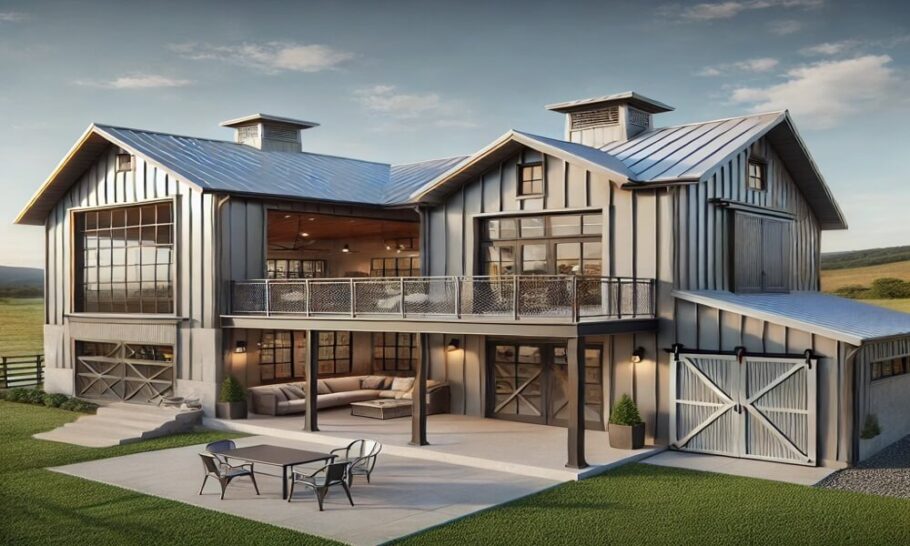
So, you’re building a barndominium. You’ve got the shell picked out, the floor plan is roughed in, and you can already see yourself sipping coffee on that massive covered porch. But before you get too lost in the daydream, we need to talk about the stuff you can’t see: the utilities.
Planning the plumbing, electrical, and HVAC for a barndominium isn’t the same as planning for a traditional stick-built home. You’re essentially merging the infrastructure of a residential house with the bones of a large metal building. If you get these systems wrong, you end up with frozen pipes, rooms that are always too hot or too cold, and extension cords running everywhere because you forgot to put outlets in the right spots.
To help you avoid those headaches, let’s break down how to approach the big three utilities during your planning phase.
The Golden Rule: Plan Before the Slab is Poured
If you take one thing away from this article, let it be this: All utility planning must be finalized before the concrete slab is poured.
In a traditional home with a basement or crawlspace, you can often retrofit plumbing and wiring with relative ease. In a barndominium, you are likely building on a monolithic slab. Once that concrete is down, the ground underneath becomes a vault. Moving a toilet drain by even six inches becomes a jackhammer situation. So, every decision we discuss here needs to be mapped out and approved before the trucks show up with the ready-mix.
Part 1: Plumbing – Working with the Slab
Plumbing in a barndominium is all about “rough-ins.” These are the pipes that will be embedded in the concrete. If you miss a rough-in for a utility sink in the workshop area, you will never have water there without running ugly pipes on the surface.
The Layout is Everything
You need to decide exactly where your “wet walls” are. A wet wall is a wall that contains the plumbing supply lines and drain pipes. In an efficient design, you want to stack your bathrooms back-to-back, and ideally place the kitchen on the other side of the same wall. This consolidates the plumbing runs, which saves you money on materials and labor.
If you have a massive shop area on the other side of the building, and you think you might want a sink there someday, rough it in now. Even if you cap it off under the slab, it’s infinitely cheaper to bury a stub-out than to cut concrete later.
Water Heater Considerations
Where is your water heater going? In a traditional home, it’s often hidden in a basement corner. In a barndominium, you have options:
- Standard Tank Water Heater: This will likely live in a mechanical room or a utility closet. You need to run cold water to it, and hot water lines from it to the various fixtures. The longer the run, the longer you wait for hot water.
- Tankless (On-Demand) Water Heaters: These are incredibly popular in barndominiums because they save floor space. However, they require a different type of utility planning. They need a dedicated gas line (usually larger diameter than standard) and sometimes upgraded electrical for ignition. You also have to consider the venting requirements through your metal roof or wall.
- Point-of-Use Heaters: If your barndo is massive, you might consider small tankless units under the bathroom sinks or near the workshop sink to avoid the “waiting for hot water” issue across a long building.
Don’t Forget the Freeze Factor
This is the biggest mistake new barndominium owners make. In a house, pipes run through the basement or insulated crawlspace. In a barndo, water lines come up through the slab. That’s fine. But where does the water enter the building?
Your main water line will come up from the ground into the building somewhere. That point of entry needs to be sealed and insulated. If you are in a cold climate, the water line must come up inside a conditioned space or be buried below the frost line and then insulated heavily as it transitions into the floor.
Septic and Greywater
If you are in a rural area, you’re likely dealing with a septic system. The location of your septic tank and drain field dictates where the main sewer line leaves the building. You want the shortest, straightest path possible from your main stack to the tank. This will dictate where you place your bathrooms to keep the sewage lines efficient and prevent clogs.
Part 2: Electrical – More Than Just Lights and Plugs
Electrical planning in a barndominium is where the “shop” meets the “home.” The electrical load of a house is fairly predictable: lights, TVs, fridges, and maybe a hair dryer. But if you are combining that with a workshop, you are introducing machinery that draws serious amperage.
The Service Size
First, talk to your power company and electrician about the service drop. A typical modern home might have a 200-amp service. A barndominium with a hobbyist workshop and standard living quarters should likely be looking at 400-amp service.
Why? Because you don’t want to be welding a project in the shop only to trip the main breaker because your spouse turned on the microwave and the AC kicked on. A 400-amp service is often split into two 200-amp panels: one for the living quarters and one for the shop. This isolates your “house” loads from your “shop” loads.
The Panel Placement
You need to decide if you want one central panel or sub-panels.
- Living Quarters Panel: Usually located in a pantry, a hallway closet, or the mechanical room.
- Shop Sub-Panel: This should be located near where you will be working. If you are running a lathe, a welder, and a dust collector, you want the breakers right there, not on the other side of the barndo.
Outlets, Outlets, Outlets
This is the most common regret: not enough outlets. In a metal building, adding an outlet after the fact is a nightmare because of the steel framing and finished walls.
- In the Shop: Plan for outlets every 6 to 8 feet along the walls. Also, consider installing flush-mount floor boxes in the middle of the shop floor if you plan to have equipment that can’t sit against the wall. Install dedicated 220V outlets for welders, compressors, or large saws, even if you don’t own them yet. It’s cheaper to buy the wire and cap it now than to rip into the ceiling later.
- In the Living Area: Follow standard residential code, but think about furniture placement. If you plan to have a large sectional sofa, don’t put an outlet directly behind where the middle of it will sit.
Lighting Strategy
You have high ceilings. In the living quarters, you might want recessed lighting or stylish pendants. In the shop, you need utility.
- Shop Lighting: LED high-bay lights are the standard. They are bright and energy-efficient. Plan your layout so you don’t cast shadows on your workpieces. Think about task lighting over workbenches.
- Exterior Lighting: A barndominium often sits on a larger plot of land. Plan for dusk-to-dawn lights on the corners or near the main entrance. You also need to think about lighting the path from the house to the shop if they are separate structures.
Data and “Smart” Rough-Ins
We live in a connected world. Metal buildings are essentially Faraday cages. They block cell signals and Wi-Fi. If you want to stream Netflix in the bedroom or get a signal in the shop, you cannot rely solely on a standard router in the living room.
Plan for Ethernet (Cat6) runs. Run cables to locations where you can install Wi-Fi access points on the ceiling (like in the main hallway and in the center of the shop). This is also the time to run speaker wire for a sound system or low-voltage wiring for security cameras.
Part 3: HVAC – Conditioning a Metal Box
Heating and cooling a barndominium presents a unique challenge. You are trying to climate control a structure that was originally designed to house tractors. Metal conducts heat and cold far more efficiently than wood. If the sun hits that metal roof or wall, the heat is coming inside unless you stop it.
The Insulation Connection
You cannot plan your HVAC without planning your insulation. The two go hand-in-hand.
- Spray Foam: This is the gold standard for barndominiums. Closed-cell spray foam adheres to the metal panels and provides a thermal break and an air seal. It stops the condensation (sweating) that can occur on metal in humid climates. Because it seals the building so tightly, you don’t need as massive an HVAC system to condition the air.
- Fiberglass Batts: These are cheaper but harder to install in a metal building because of the curved roof and purlins. They also leave room for air leakage, which makes your HVAC system work harder.
Zoning is Your Friend
A wide-open barndominium floor plan might sound nice, but it’s a nightmare for a single thermostat. The heat from the shop tools will make the living area stuffy. The bedroom at the far end of the building will always be a different temperature than the kitchen.
Consider a zoned HVAC system. This uses multiple thermostats and motorized dampers in the ductwork to direct cold or hot air only where it is needed. You can keep the shop cool while the bedrooms are warm, or vice versa.
System Types
- Forced Air (Ductwork): This is the most common. If you have a conditioned attic space or soffits, you can run ducts to each room. The challenge is the ductwork layout. You need to plan the runs so they don’t interfere with the structural steel.
- Radiant Floor Heating: This is a luxury option, but it is amazing in a barndo with polished concrete floors. It involves running PEX tubing in the slab before it’s poured. Hot water runs through the tubes, heating the concrete, which radiates heat upward. It is silent, efficient, and doesn’t blow dust around—great for a workshop. However, you usually need a separate system for air conditioning (like mini-splits).
- Mini-Split Systems (Ductless): These are great for barndominiums that are divided into distinct zones. You mount an air handler on the wall or ceiling in the living room, one in the master, and one in the shop. They are efficient and easy to install, but some people don’t like the look of the units on the walls.
The Mechanical Room
You need a place for the furnace/air handler and the water heater to live. In a barndo, this is often a small, enclosed room. This is smart because it isolates the noise of the HVAC kicking on from the living space. Make sure this room has a return air path (like a louvered door or a transfer grille) so the unit can breathe properly.
Final Thoughts
Planning utilities for a barndominium is a juggling act. The plumbing has to go in before the floor. The electrical has to handle both your quiet evenings and your noisy hobbies. The HVAC has to fight against the nature of the metal box you live in.
The best advice is to gather your team early. Sit down with your builder, your plumber, your electrician, and your HVAC contractor at the same table. Go over the floor plan inch by inch. Ask the “what if” questions. If you do the heavy lifting on the planning side now, the construction phase will go smoothly, and you’ll move into a space that’s not just beautiful, but functional and comfortable for the long haul.