
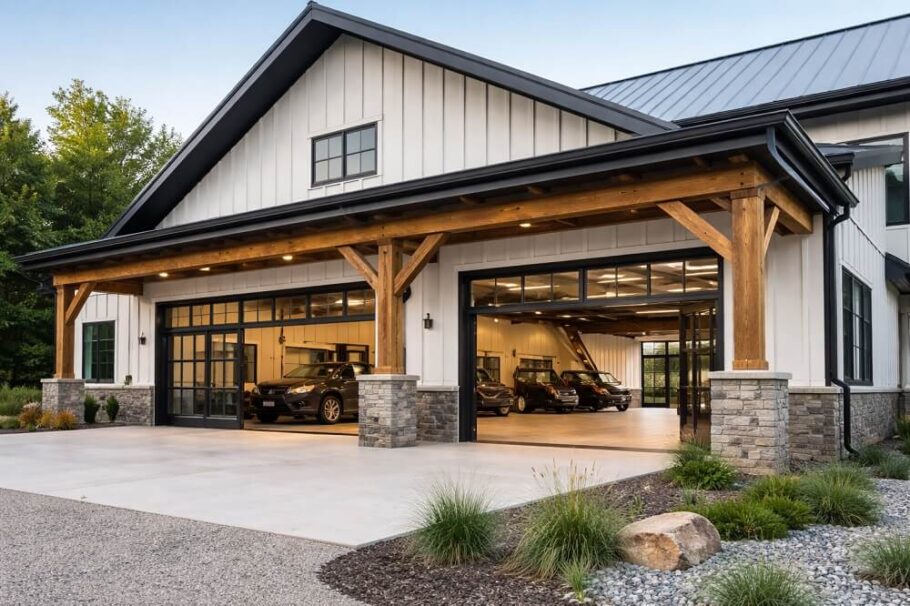
The barndominium has shed its humble agricultural skin and emerged as a genuine force in residential architecture. These steel-framed hybrids offer wide-open floor plans, soaring ceilings, and an industrial-meets-rustic soul that conventional homes simply cannot replicate. But every barndo faces the same vertical challenge: how to connect the main living level to a loft, second story, or basement workshop without killing the vibe.
Staircases in a barndominium are not merely functional necessities. They become sculptural anchors, sightline definers, and conversation starters. Choose poorly, and the stairs eat square footage or clash with every exposed beam and corrugated panel. Choose wisely, and they elevate the entire structure. Three distinct approaches dominate the barndo world right now—spiral, floating, and classic—and each brings something entirely different to the table.
The Spiral Staircase: Compact Drama
Spiral stairs have earned a complicated reputation. Some see them as carnival attractions or boat-ladder compromises. But in the right barndominium, a well-executed spiral staircase becomes the most memorable feature in the entire build.
The obvious advantage is footprint. A spiral staircase occupies as little as a five-foot diameter circle, sometimes even less with custom fabrication. For barndominiums with tight loft access or secondary living quarters above a garage bay, that compactness proves invaluable. No wasted floor space. No awkward triangular corners left behind by traditional stair landings. Just a clean, circular ascent that frees up the rest of the open floor plan.
But the real magic happens when material choices align with the barndo aesthetic. Industrial black steel spirals with open risers look right at home against weathered barn wood and concrete floors. Powder-coated metal in matte charcoal or raw iron develops a patina that ages beautifully. For a warmer approach, consider a spiral with wooden treads—hickory, white oak, or reclaimed pine—paired with a central steel column and cable railings. That mix of textures feels intentional, not like a hardware store afterthought.
The drawbacks deserve honest attention. Spiral stairs are not friendly to everyone. Moving furniture upstairs becomes a genuine puzzle, sometimes an impossible one. The tapered treads mean the inside edge offers barely enough room for a full foot, and anyone carrying a hot mug of coffee up to the loft learns quickly to watch their step. Building codes also impose restrictions. Most jurisdictions require a minimum tread depth at the center walking line, and spiral stairs often push those limits. Check local requirements before falling in love with a design.
For barndominiums used as weekend retreats or single-person dwellings, the spiral makes perfect sense. For a busy family home with kids, elderly parents, or frequent guests, think twice.
Floating Staircases: The Modern Statement
Nothing says contemporary barndominium quite like a floating staircase. Also called cantilevered stairs, these designs create the illusion that each tread hovers in midair, attached to the wall with no visible support underneath. The effect is stunning. Light pours through the open risers. The visual mass of traditional stairs disappears. And in a structure defined by wide-open spaces and high ceilings, removing that visual obstruction transforms how the entire room feels.
The engineering behind floating stairs is serious business. Each tread must anchor into the wall structure with steel stringers or reinforced brackets hidden inside the framing. For barndominiums with standard wood stud walls, this requires additional blocking, laminated veneer lumber, or even a custom steel subframe welded into place before drywall goes up. Concrete or masonry walls make the job easier, but most barndos are steel and wood. Plan accordingly, and expect the cost to run significantly higher than conventional stairs.
Material choices for floating stairs lean toward the refined end of the barndo spectrum. Solid oak treads with a natural oil finish bring warmth without hiding the floating effect. Walnut adds richness. For a more industrial look, consider steel plate treads with a clear coat or powder coat—heavy, yes, but visually weightless when cantilevered correctly. Glass railings keep the openness intact, though cable railings in stainless steel offer a similar transparency with a bit more rugged character.
The catch with floating stairs is the wall requirement. They need a solid structural wall running the entire length of the staircase. Open floor plans with partial walls, railings, or loft overlooks may not provide enough anchoring surface. And floating stairs rarely work well in retrofits. This is a design choice that needs to happen during the framing phase, not as an afterthought once the barndo shell is standing.
Comfort matters too. Floating stairs typically have open risers, meaning no vertical backing between treads. That openness looks fantastic but feels unsettling to some people, especially those unaccustomed to seeing the floor below through the stairs. Children and pets also require supervision—a small dog can slip right through an open riser if the spacing exceeds four inches.
Classic Staircases: The Reliable Workhorse
The classic staircase gets dismissed as boring far too often. In the rush to create something unique and Instagram-worthy, many barndominium owners overlook the straightforward L-shaped, U-shaped, or straight-run staircases that have worked for centuries. There is a reason these designs persist. They are comfortable, safe, and infinitely adaptable.
A classic staircase in a barndominium does not have to feel ordinary. The materials make all the difference. Heavy timber treads with visible mortise and tenon joinery bring a barn-like authenticity that matches the structure’s agricultural roots. Steel stringers with wood treads combine industrial bones with natural warmth. Even a fully enclosed staircase with drywall and trim can work beautifully if the railing gets the right treatment—black metal balusters, cable infill, or horizontal rod railings keep the industrial vibe alive while the stairs themselves fade into the background.
The L-shaped staircase, which turns ninety degrees at a landing, deserves special attention for barndominiums. That landing can tuck neatly under a loft overhang or fit into a corner that otherwise goes unused. The turn also breaks up the run, making the ascent feel less daunting and providing a natural stopping point. U-shaped stairs, with two landings and a one-hundred-eighty-degree turn, consume more square footage but offer even greater comfort and the potential to use the space underneath for storage, a reading nook, or a pet den.
Straight-run stairs are the most efficient for circulation but the most demanding on floor space. They need a clear shot from bottom to top, typically twelve to fourteen feet of linear run for a standard ceiling height. In a barndominium with a twenty-foot wall, that straight run stretches even longer. The visual effect can be dramatic—a long, uninterrupted line of treads leading up to a loft railing—but the space underneath often becomes wasted or awkward to furnish.
Code compliance matters most with classic stairs because they have the most rules. Risers cannot exceed seven and three-quarters inches in most places. Treads need at least ten inches of depth. Handrails must be graspable and continuous. Open risers, if desired, cannot exceed four inches between treads. These rules exist for good reason. A staircase used daily needs to feel natural underfoot, and classic designs meet that standard without compromise.
Making the Final Call
No single staircase design fits every barndominium. The right choice depends on floor space, budget, household composition, and personal tolerance for maintenance and inconvenience.
Spiral stairs work best for small footprints, secondary lofts, and homes without regular furniture-moving needs. They excel in vacation barndos, tiny barndominiums, and any situation where stairs serve one person most of the time.
Floating stairs shine in barndominiums designed around sightlines and natural light. They require a committed budget and careful structural planning but deliver a payoff in pure visual impact that neither spiral nor classic can match.
Classic stairs remain the default for a reason. They work for everyone. They move furniture without drama. They meet code without loopholes. And with thoughtful material choices, they belong in the same room as reclaimed barn siding and concrete floors.
The best approach often involves mixing types. A floating main staircase for daily use and guest admiration. A spiral staircase to a bonus loft or roof deck. A classic utility staircase in the shop area where looks matter less than function. Barndominiums embrace that kind of honest, practical design. The staircase should do the same.