
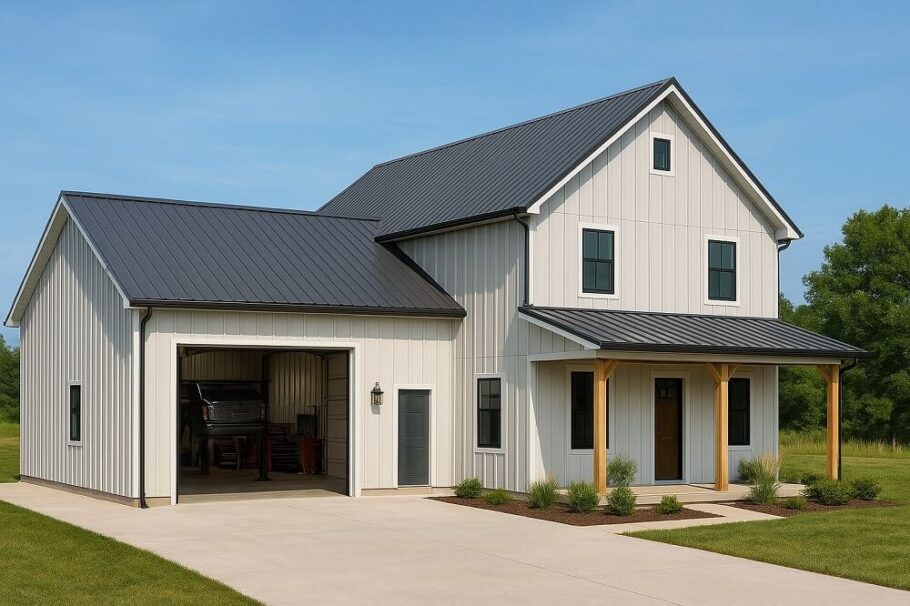
Barndominiums have surged in popularity over the last decade, moving far beyond their agricultural roots to become full-time residences, mixed-use live–work spaces, and even luxury homes. Despite this growth, a surprising number of engineering myths continue to circulate about barndominiums. These misconceptions can mislead homeowners, designers, and builders, sometimes resulting in poor decisions, unnecessary expenses, or missed opportunities.
Engineering a barndominium is not a shortcut or a compromise—it is simply a different structural approach. Like any building, its performance depends on sound engineering principles, proper material selection, climate considerations, and adherence to codes. In this article, we will break down the most common barndominium engineering myths and explain the reality behind them, helping you make informed decisions when planning or evaluating a barndominium project.
Myth 1: Barndominiums Are Just Metal Sheds with Living Space
One of the most persistent myths is that barndominiums are little more than metal sheds converted into homes. This misconception often stems from early agricultural pole barns or storage buildings that lacked insulation, proper foundations, or residential-grade systems.
The reality is that a properly engineered barndominium is a fully designed structural system. It includes engineered foundations, primary and secondary framing, load paths, insulation assemblies, and mechanical systems just like a conventional home. The difference lies in the framing method—steel or post-frame systems replace traditional stick framing—but the engineering rigor remains the same.
Modern barndominiums are designed using structural calculations that account for live loads, dead loads, wind uplift, seismic forces, and snow loads where applicable. Calling them “just metal sheds” ignores the extensive engineering behind a well-designed barndominium.
Myth 2: Barndominiums Are Not Structurally Safe
Some people believe barndominiums are inherently weaker than conventional homes. This myth often arises from unfamiliarity with steel structures or post-frame engineering.
In truth, steel-framed barndominiums are often stronger than wood-framed homes in key ways. Steel does not rot, warp, or suffer from termite damage. Engineered steel frames can span large distances without interior load-bearing walls, distributing loads efficiently across the structure.
When designed correctly, barndominiums can meet or exceed the structural safety requirements of residential building codes. They are commonly engineered to withstand high wind zones, heavy snow loads, and seismic activity. Structural safety is not determined by the building style but by the quality of engineering and construction.
Myth 3: Barndominiums Cannot Handle Extreme Weather
Another common misconception is that barndominiums perform poorly in extreme weather conditions such as hurricanes, tornadoes, heavy snow, or earthquakes.
In reality, barndominiums can be engineered specifically for extreme climates. Steel framing performs exceptionally well under wind loads when properly anchored and braced. Roof systems can be designed with appropriate slopes, purlin spacing, and load ratings to handle snow accumulation. In seismic regions, engineered connections and moment frames can improve performance during earthquakes.
Problems arise only when a building is under-engineered or not designed for the local environment. A barndominium built to Florida hurricane standards or Midwest tornado zones will look very different structurally than one designed for a mild climate—but that is true for any type of home.
Myth 4: Barndominiums Do Not Need a Real Foundation
Some believe that because barndominiums originated from agricultural structures, they can sit on minimal or non-engineered foundations. This myth can be costly and dangerous if followed.
Every residential barndominium requires a properly engineered foundation. This may be a slab-on-grade, pier-and-beam system, or a combination of footings and slabs depending on soil conditions and design loads. Foundation engineering accounts for soil bearing capacity, frost depth, drainage, and structural loads from the frame above.
Skipping proper foundation design can lead to settlement, cracking, water intrusion, and structural failure. A barndominium foundation is not optional or simplified—it is a critical part of the engineering system.
Myth 5: Engineering a Barndominium Is Cheaper Because It Is Simpler
It is often assumed that barndominium engineering costs less because the structure is “simpler” than a traditional home. While barndominiums can be cost-effective, the engineering process itself is not necessarily cheaper or easier.
Structural engineers must still perform detailed calculations, produce stamped drawings, and coordinate with architectural and mechanical plans. In some cases, barndominiums require additional engineering due to large clear spans, mixed-use loads, mezzanines, or heavy equipment storage.
The cost savings associated with barndominiums usually come from construction efficiency, reduced labor time, and material optimization—not from cutting corners on engineering.
Myth 6: Barndominiums Cannot Support Multiple Stories
Many people assume barndominiums are limited to single-story layouts. This myth persists despite the growing number of multi-level barndominiums across the country.
Steel and post-frame systems can easily support second floors, lofts, and mezzanines when designed correctly. Engineers account for additional live loads, vibration control, and deflection limits when designing upper levels. The framing system may include steel joists, composite decks, or engineered wood components integrated into the steel frame.
Multi-story barndominiums are not only possible—they are increasingly common, especially in residential designs that combine open living areas with private upper-level spaces.
Myth 7: Barndominiums Are Hard to Insulate Properly
Insulation myths often arise from early metal buildings that suffered from condensation and thermal bridging. While these issues can occur, they are not inherent flaws of barndominiums.
Modern barndominium engineering incorporates advanced insulation strategies such as spray foam, rigid board insulation, thermal breaks, and properly designed vapor barriers. Wall assemblies can be engineered to meet or exceed energy code requirements, and roof systems can be designed to prevent condensation buildup.
Insulation performance depends on design choices, not the presence of steel. With proper engineering, barndominiums can achieve excellent energy efficiency in both hot and cold climates.
Myth 8: Barndominiums Cannot Meet Residential Building Codes
Some believe barndominiums exist in a regulatory gray area and cannot meet residential building codes. This myth often causes confusion during permitting and inspections.
In reality, barndominiums must comply with the same residential codes as any other home when used as a dwelling. Structural design, fire safety, egress, energy efficiency, plumbing, and electrical systems are all subject to code review.
Engineers and designers who understand local code requirements can ensure that barndominium plans are fully compliant. The structure type does not exempt the building from regulations—it simply requires the correct documentation and engineering approach.
Myth 9: Steel Barndominiums Are Too Rigid and Will Crack
A common concern is that steel structures are too rigid, leading to cracking in finishes or discomfort during high winds or seismic events.
In truth, steel structures are designed to flex within safe limits. Engineers calculate allowable deflection and drift to ensure structural integrity and occupant comfort. Connections are designed to absorb and redistribute forces rather than resist them rigidly.
Cracking issues typically result from improper detailing, poor foundation design, or low-quality interior finishes—not from the steel structure itself.
Myth 10: Barndominiums Are Only for Rural Areas
Because barndominiums originated in rural settings, many assume they cannot be engineered for suburban or urban environments.
While zoning restrictions may vary, from an engineering standpoint, barndominiums can be designed for virtually any setting. Urban barndominiums may incorporate fire-rated assemblies, noise control measures, and architectural finishes that blend with surrounding structures.
Engineering adapts to context. The same principles that allow barndominiums to thrive on farmland also allow them to function in denser environments when properly designed.
Myth 11: Barndominium Engineering Is One-Size-Fits-All
Some kit providers and online plans promote the idea that one engineered design works everywhere. This is one of the most dangerous myths.
Engineering must be site-specific. Wind speeds, snow loads, seismic zones, soil conditions, and local codes all influence structural design. A barndominium engineered for Texas may be completely inadequate in Colorado or Florida.
Responsible engineering always considers location. Custom or region-specific engineering is not a luxury—it is a necessity for safety and performance.
Myth 12: Barndominiums Cannot Be Customized Structurally
There is a belief that barndominiums are limited to boxy shapes and fixed layouts due to structural constraints.
In reality, steel and post-frame systems are highly adaptable. Engineers can design cantilevers, vaulted ceilings, large window openings, curved rooflines, and complex floor plans. The structural system often allows more freedom than traditional framing because loads can be carried over longer distances.
Customization is limited only by budget, engineering creativity, and code requirements—not by the barndominium concept itself.
The Real Truth About Barndominium Engineering
Barndominiums are not shortcuts, compromises, or experimental structures. They are engineered buildings that rely on the same principles of physics, materials science, and safety as any other home. The myths surrounding them often arise from outdated examples, poorly designed projects, or misunderstandings about steel and post-frame construction.
When engineered correctly, barndominiums can be strong, durable, energy-efficient, and highly customizable. They can withstand extreme weather, support multiple stories, meet strict building codes, and provide long-term performance equal to—or better than—traditional homes.
The key takeaway is simple: the success of a barndominium depends on proper engineering, not on myths or assumptions. By working with qualified designers and engineers who understand barndominium systems, homeowners can enjoy all the benefits of this versatile building style without falling victim to misinformation.
As barndominiums continue to evolve, the engineering behind them will only become more refined. Separating myth from reality is the first step toward building a barndominium that is safe, efficient, and built to last.