
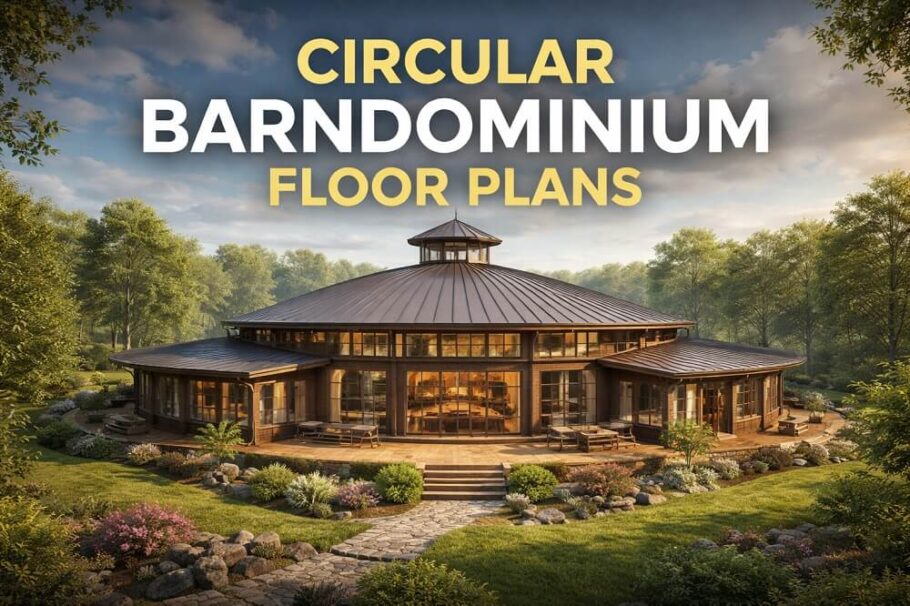
When most people imagine a barndominium, they picture rectangular steel buildings with open interiors, clean lines, and straightforward layouts. While that approach remains popular for good reasons—cost efficiency, simplicity, and ease of construction—design innovation is steadily pushing barndominium architecture in new directions. One of the most intriguing and unconventional concepts gaining attention is the circular floor plan.
Circular barndominium floor plans challenge traditional thinking about space organization, structural efficiency, and daily movement within a home. Rather than relying on straight corridors and right angles, these designs embrace curves, radial symmetry, and continuous flow. The result is a living environment that feels organic, visually striking, and surprisingly functional when executed properly.
In this article, we’ll explore what circular barndominium floor plans are, why they’re appealing, how they function structurally, and what homeowners should consider before committing to this bold design choice.
What Is a Circular Barndominium Floor Plan?
A circular barndominium floor plan is exactly what it sounds like: a home designed around a round or near-round footprint instead of a rectangular one. The structure may be a perfect circle, an oval, or a segmented radial form that approximates circular geometry.
At the core of many circular designs is a central hub, often used as a living room, great room, or atrium. From this center point, spaces radiate outward like spokes on a wheel. Bedrooms, kitchens, bathrooms, and utility rooms are arranged along the perimeter or in curved segments that follow the building’s shape.
In barndominiums, circular plans are often paired with steel framing or hybrid steel-and-wood systems, allowing for large spans, minimal interior load-bearing walls, and flexible interior layouts.
Why Consider a Circular Floor Plan for a Barndominium?
Circular homes may seem unconventional, but they offer several compelling advantages that align well with barndominium living.
One major benefit is flow. Circular layouts naturally eliminate dead ends and long hallways. Movement through the home feels intuitive, continuous, and efficient. This can be especially appealing in open-plan barndominiums where the goal is to create a sense of connection between spaces rather than separation.
Another advantage is visual interest. Curved walls, panoramic views, and radial layouts create a living experience that feels custom and architectural rather than standardized. For homeowners who want their barndominium to stand out, circular floor plans make a strong design statement.
Circular designs also support equal access to natural light. When windows are placed along the perimeter, daylight enters from multiple directions throughout the day, reducing reliance on artificial lighting and enhancing indoor comfort.
Structural Logic Behind Circular Barndominiums
From an engineering perspective, circular structures are inherently strong. This principle has been used for centuries in silos, domes, and towers. Loads are distributed evenly around the structure, reducing stress points and improving overall stability.
In barndominium construction, steel framing can be curved or segmented to form a circular perimeter. Roof systems are often designed as conical, domed, or radial truss arrangements that transfer loads efficiently to the exterior walls.
This structural efficiency can improve resistance to high winds, especially when compared to flat vertical walls that catch gusts directly. While proper engineering is essential, circular barndominiums can perform exceptionally well in regions prone to strong storms.
Centralized Living Spaces and Radial Layouts
One of the defining features of circular floor plans is the central space. In barndominiums, this area often becomes the heart of the home.
A central great room can function as a living room, dining area, or combined gathering space. With high ceilings and exposed steel trusses, this area feels expansive and dramatic. From here, homeowners can visually connect with nearly every part of the house.
Bedrooms and private areas are usually positioned along the outer ring, providing separation from noise while maintaining proximity. Kitchens are often placed adjacent to the central area, allowing for easy circulation during daily routines and entertaining.
This radial organization promotes balance. No single room feels isolated, and every space benefits from thoughtful placement and access.
Kitchen Design in Circular Barndominiums
Designing a kitchen within a circular floor plan requires creativity, but the results can be highly functional and visually striking.
Instead of straight runs of cabinetry, kitchens often use curved counters, angled islands, or segmented cabinet layouts. The cooking zone may face inward toward the central living space, making it ideal for social interaction.
Pantry and utility areas are typically tucked into wedge-shaped spaces or secondary rings behind the kitchen. With careful planning, these areas can be highly efficient despite their unconventional geometry.
Modern cabinetry manufacturers increasingly offer flexible solutions that accommodate curves, making circular kitchens more practical than ever before.
Bedrooms and Private Zones Along the Perimeter
Placing bedrooms along the outer edge of a circular barndominium offers several advantages. Each room can have access to exterior windows, improving ventilation and natural light.
The curved exterior walls can create a cozy, enveloping feeling that many homeowners find comforting. While furniture placement may require extra planning, custom-built storage and integrated furniture solutions often solve these challenges elegantly.
Bathrooms are typically positioned between bedrooms or inboard of the exterior wall, using curved partitions or angled walls to maintain efficient plumbing layouts.
Energy Efficiency and Environmental Performance
Circular barndominiums can be surprisingly energy efficient when designed correctly.
The reduced exterior surface area relative to enclosed volume helps limit heat loss in colder climates and heat gain in warmer ones. Continuous insulation around the perimeter further enhances thermal performance.
Additionally, circular homes naturally encourage passive solar strategies. Windows placed evenly around the structure allow homeowners to take advantage of changing sun angles throughout the day. Overhangs and roof extensions can be designed to shade windows during summer while allowing winter sunlight to penetrate.
Ventilation can also be improved through central skylights, cupolas, or vented roof peaks that promote stack effect airflow.
Challenges of Circular Floor Plans
Despite their advantages, circular barndominium floor plans are not without challenges.
One of the most common concerns is furniture compatibility. Most furniture is designed for rectangular rooms, and fitting it into curved spaces can require custom solutions or careful selection.
Construction costs can also be higher if the builder lacks experience with curved framing or radial layouts. Precision is critical, and not all contractors are comfortable working outside traditional rectangular designs.
Permitting and appraisal processes may take longer as well, since circular homes are less common and may require additional documentation or explanation for lenders and inspectors.
However, for homeowners willing to plan carefully and work with experienced professionals, these challenges are manageable.
Customization and Flexibility
One of the biggest advantages of circular barndominium floor plans is their adaptability.
The design can be scaled up or down easily, making it suitable for compact homes or expansive luxury residences. Additional rings or partial arcs can be added to create garages, workshops, or guest suites without disrupting the main structure.
Interior walls are often non-load-bearing, allowing future modifications as needs change. This flexibility aligns perfectly with the barndominium philosophy of long-term adaptability.
Circular Barndominiums as Lifestyle Statements
Choosing a circular floor plan is about more than aesthetics. It reflects a lifestyle preference for openness, connection, and intentional living.
Circular homes encourage interaction. There’s no “end of the house” where activity disappears. Families remain visually and physically connected, even when engaging in different activities.
For homeowners who value creativity, sustainability, and architectural uniqueness, circular barndominiums offer a powerful alternative to conventional layouts.
Is a Circular Barndominium Right for You?
Circular floor plans are not for everyone, but they can be ideal for those who value design innovation and spatial harmony.
They work particularly well for:
- Homeowners seeking a distinctive architectural identity
- Open-plan living enthusiasts
- Properties with panoramic views
- Clients interested in energy efficiency and airflow optimization
If you’re considering a circular barndominium, early collaboration with designers, engineers, and builders is essential. Proper planning ensures the design delivers both visual impact and everyday practicality.
Final Thoughts
Barndominium circular floor plans represent a bold departure from traditional residential design. By embracing curves, radial layouts, and centralized living spaces, these homes redefine how space can function and feel.
While they require thoughtful planning and experienced execution, the rewards are substantial: improved flow, architectural distinction, strong structural performance, and a living environment that feels truly unique.
As barndominium design continues to evolve, circular floor plans stand out as a powerful example of how creativity and engineering can work together to create homes that are both beautiful and deeply functional.
If you’re ready to move beyond straight lines and right angles, a circular barndominium may be the perfect way to reimagine modern rural living.