
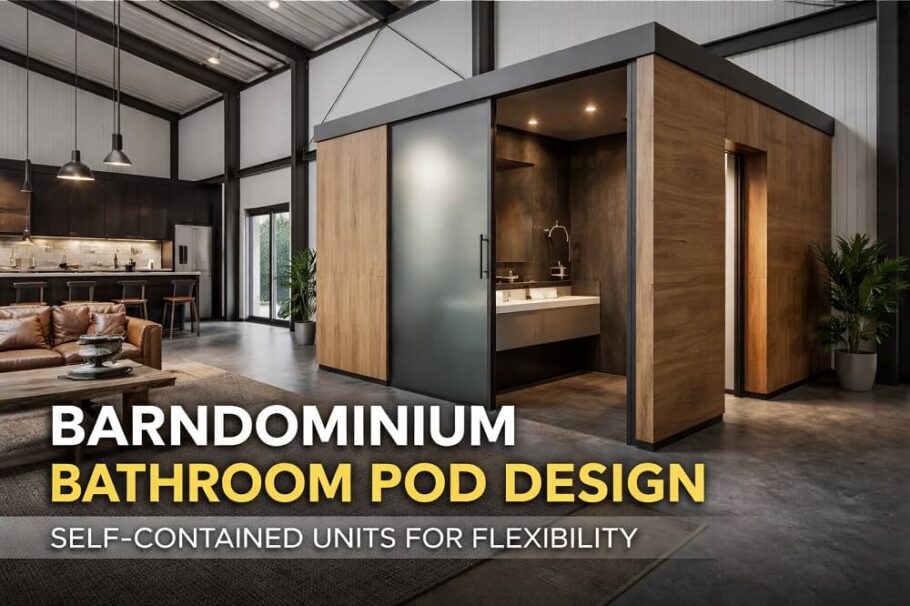
Barndominium Bathroom “Pod” Design: Self-Contained Units for Flexibility in an Open Plan
Barndominiums are celebrated for their openness, adaptability, and industrial-meets-residential appeal. High ceilings, wide spans, and minimal interior load-bearing walls create incredible freedom in layout—but that same openness can complicate one essential function: bathrooms. Plumbing, privacy, acoustics, and moisture control don’t always cooperate with vast open plans.
That’s where the bathroom “pod” concept comes in.
Bathroom pods are self-contained units that consolidate all wet functions—plumbing, ventilation, waterproofing, and utilities—into a compact, modular zone. In a barndominium, these pods act as functional anchors inside an otherwise fluid interior. They allow designers and homeowners to preserve openness while gaining flexibility, efficiency, and future adaptability.
This article explores what bathroom pods are, why they make sense in barndominiums, and how to design them successfully for both performance and aesthetics.
Understanding the Bathroom Pod Concept
A bathroom pod is a fully enclosed or semi-enclosed bathroom module that functions almost like a room within a room. Instead of distributing plumbing lines across the slab or framing bathrooms into exterior walls, the pod centralizes all bathroom components into a compact footprint.
In traditional construction, bathrooms are often tied to perimeter walls or stacked vertically in multi-story homes to simplify plumbing. Barndominiums break that convention with their clear spans and flexible interiors. Bathroom pods restore order by creating a single, predictable “wet core” that can be placed almost anywhere.
Bathroom pods can be:
- Fully prefabricated and installed as a unit
- Site-built but designed as a unified system
- Permanent or semi-modular for future relocation
The defining feature is not how they’re built, but how they function: as a self-contained service hub.
Why Bathroom Pods Work So Well in Barndominiums
Barndominiums are uniquely suited to pod-style bathrooms due to their structural and spatial characteristics. Post-frame or steel-frame construction allows large uninterrupted floor areas, making it easier to position pods strategically without structural compromise.
One of the biggest advantages is plumbing efficiency. Running water supply, drainage, and venting to a single core reduces material costs and simplifies maintenance. This is especially valuable in slab-on-grade barndominiums, where cutting concrete later can be costly and disruptive.
Bathroom pods also support phased construction. Homeowners who plan to finish interiors over time can install a primary bathroom pod early and add additional pods later as budgets or needs change.
Flexibility in Open-Plan Living
Open-plan barndominiums thrive on adaptability. Rooms shift functions, walls are minimized, and furniture often defines space more than framing does. Bathroom pods complement this philosophy by acting as movable boundaries.
A centrally located pod can subtly divide living, sleeping, and working zones without closing off sightlines. Instead of walls stretching from floor to ceiling, the pod becomes a visual and functional divider that preserves spatial flow.
In live-work barndominiums, bathroom pods can separate residential areas from workshops or studios. In multi-generational layouts, they allow private bathroom access without duplicating plumbing across the structure.
Because pods are compact, they also allow for future reconfiguration. A guest suite can become a rental unit. A home office can become a bedroom. As long as the pod remains accessible, the surrounding space can evolve.
Design Approaches to Bathroom Pods
Bathroom pods can be designed to either blend into the barndominium interior or stand out as architectural features. The choice depends on the aesthetic direction of the home.
Some pods are treated like solid volumes—wrapped in wood slats, corrugated metal, plaster, or concrete finishes that echo the building’s exterior. Others are visually lighter, using partial-height walls, glass panels, or integrated shelving to maintain openness.
Shape also matters. Rectangular pods are efficient and easy to frame, but curved or chamfered corners can soften the pod’s presence and improve circulation in open spaces.
The key design principle is intentionality. A bathroom pod should feel like it belongs in the space, not like an afterthought dropped into the middle of the floor plan.
Plumbing and Mechanical Advantages
From an engineering standpoint, bathroom pods offer major advantages.
All supply lines, drains, vents, and mechanical systems are concentrated in one zone. This reduces the total length of piping, minimizes pressure loss, and lowers the risk of leaks. For slab foundations, pods allow plumbing to be planned precisely before the pour, avoiding unnecessary trenching.
Ventilation is also easier to manage. A dedicated vertical chase within the pod can handle exhaust ducts, ensuring proper moisture control without complex routing through roof trusses or long horizontal runs.
In climates with extreme temperature swings, pods can be insulated as a unit, protecting plumbing from freezing or overheating more effectively than scattered lines throughout the structure.
Acoustic and Privacy Benefits
Bathrooms are noisy. Water flow, flushing, ventilation fans, and echoing surfaces can disrupt the calm of an open-plan home. Bathroom pods help control these issues by concentrating noise within a defined envelope.
Properly designed pods incorporate sound-insulating materials, resilient mounts for plumbing, and layered wall assemblies that reduce sound transmission. This is especially important in barndominiums where metal framing can amplify vibrations if not handled correctly.
Privacy is another benefit. In an open interior, traditional bathroom placement can feel exposed or awkward. Pods create a clear boundary, allowing bathrooms to exist closer to living spaces without sacrificing comfort or dignity.
Material Selection for Bathroom Pods
Material choice is critical in pod design because all wet functions are contained in a small area.
Walls and floors must handle moisture, heat, and cleaning without degrading. Common materials include:
- Cement board or magnesium oxide panels for walls
- Waterproof membranes and sealed concrete or tile floors
- Moisture-resistant framing or light-gauge steel
- Integrated floor drains for added leak protection
Because the pod is self-contained, it’s also an opportunity to use bolder finishes. Dark tile, textured concrete, or industrial metals can create a dramatic contrast with the lighter, more open areas of the barndominium.
Durability should always outweigh trendiness. Pods are functional cores, and their materials should be chosen for long-term performance.
Accessibility and Aging-in-Place Considerations
Bathroom pods can be designed with accessibility in mind from the start. Because everything is centralized, it’s easier to plan for wider doorways, curbless showers, reinforced walls for grab bars, and clear circulation space.
In barndominiums intended as forever homes, pods allow homeowners to future-proof their layout. Even if accessibility isn’t needed immediately, designing the pod to accommodate it later avoids expensive renovations down the road.
Pods can also be duplicated. A standard accessible pod design can be reused in different locations within the same structure, ensuring consistency and reducing design costs.
Prefabricated vs. Site-Built Pods
Some homeowners opt for prefabricated bathroom pods, which are built off-site and installed as complete units. These are common in hotels and multi-family construction and are becoming more accessible for residential projects.
Prefabricated pods offer quality control, faster installation, and predictable costs. However, they may be limited in size, finish options, or customization.
Site-built pods, on the other hand, allow full design flexibility and better integration with the barndominium’s structure. They can be tailored to unusual footprints, ceiling heights, or aesthetic goals.
The choice often comes down to budget, timeline, and how customized the design needs to be.
Pods in Multi-Bathroom Barndominiums
In larger barndominiums, multiple bathroom pods can be arranged around a shared plumbing spine. This is especially effective in homes with guest wings, rental units, or mixed-use spaces.
Stacking pods vertically in two-story barndominiums is also efficient. Aligning bathrooms reduces structural complexity and simplifies mechanical routing.
Even powder rooms can benefit from the pod approach. A compact half-bath pod near a living or entertainment area keeps plumbing centralized while maintaining privacy.
Cost Considerations and Long-Term Value
At first glance, bathroom pods may seem more expensive than traditional bathrooms. In reality, they often reduce overall costs by simplifying construction, reducing errors, and minimizing future maintenance.
Shorter plumbing runs, fewer penetrations, and clearer coordination between trades all translate to savings. Pods also reduce the risk of moisture damage spreading through the building, protecting the long-term value of the barndominium.
From a resale perspective, flexible layouts and efficient infrastructure are attractive to buyers. A well-designed bathroom pod signals thoughtful planning and adaptability.
Conclusion: A Smart Core for a Flexible Home
Bathroom pod design aligns perfectly with the philosophy behind barndominiums. It embraces efficiency without sacrificing openness, and structure without rigidity.
By consolidating wet functions into self-contained units, homeowners gain flexibility in layout, ease in construction, and confidence in long-term performance. Pods allow barndominiums to evolve over time—supporting changing lifestyles, new uses, and future upgrades without major disruption.
In an open-plan home where almost anything is possible, bathroom pods provide the one thing every great design needs: a reliable, well-designed core that makes everything else work better.