
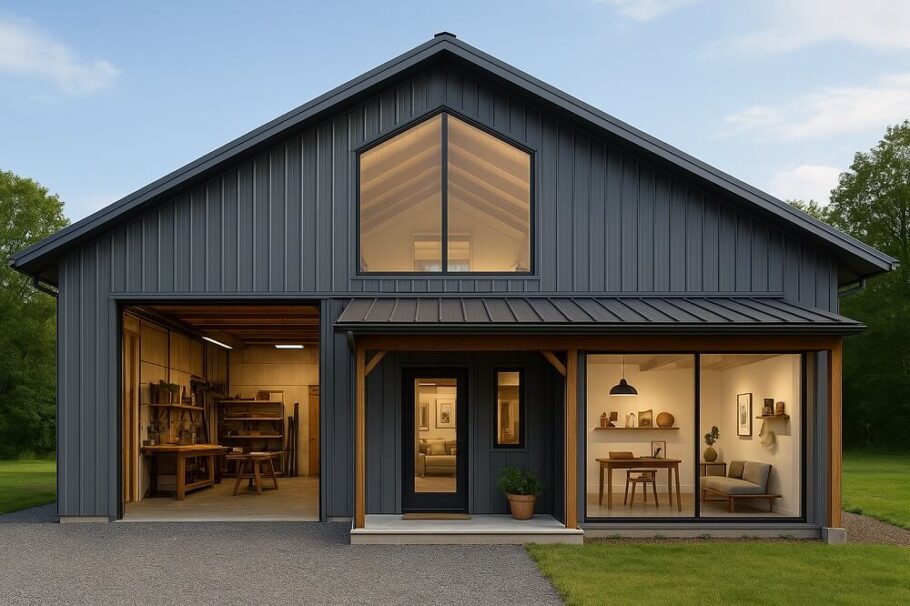
Let’s be honest—most people don’t buy a barndominium for its cutting-edge aerodynamics. They want the wide-open spaces, the rustic-industrial vibe, and the cost-effective square footage. But here’s the thing every barndo owner eventually learns: that beautiful, high-profile roof can turn into a giant sail when the wind really gets going.
Wind doesn’t care about barn charm. It sees a big, boxy structure with a steep roof and treats it like an invitation. The good news? A few smart design choices can keep that iconic barndominium silhouette intact while making sure the roof stays on when Mother Nature throws a tantrum.
Why Wind Behavior Matters for Barndominiums
Most barndominiums share a common architectural DNA. They’re long, rectangular, and feature a prominent roof—often a gambrel, a steep gable, or a modified A-frame. That shape works wonders for loft space and rain runoff, but it also creates serious wind exposure problems.
Unlike a low-profile suburban home, a barndo’s roof rises high and fast. Wind hitting the building doesn’t just push sideways. It accelerates up the wall, curls over the ridge, and tries to peel the roof off from the top down. This is called uplift, and it’s the number one reason metal roofs fail in high winds.
The second issue is corner vortices—those swirling funnels of air that form at the upwind corners of a building. On a barndominium with large, flat wall surfaces, these vortices hit the roof edge with tremendous force. Without proper detailing, that’s where panels start lifting first.
Aerodynamic roof design isn’t about making the building look like a spaceship. It’s about understanding these wind forces and working with them, not against them.
The Science of Aerodynamic Roof Profiles
Get comfortable with a few basic wind physics principles. When air hits a vertical wall, it has to go somewhere. Most of it goes up. As it climbs, it speeds up and loses pressure. Lower pressure above the roof means higher pressure inside the building—and that pressure difference creates lift.
Think of an airplane wing. That’s exactly what a poorly designed roof edge becomes in a storm.
Now add the wind moving across the roof surface itself. Once air clears the ridge, it creates a suction zone on the leeward side. So the roof is being pulled up from the windward edge, sucked up from the leeward side, and pushed from underneath if any air gets into the attic space.
The most aerodynamic roofs manage two things: they reduce the speed of air moving over the surface, and they eliminate sharp edges where vortices can form. Rounded eaves help. So do certain pitch angles. But the biggest factor is simply keeping the roof low and tight to the building—which runs directly counter to the tall, dramatic roofs barndominiums are known for.
That’s the balancing act. And there’s a sweet spot.
Choosing the Right Roof Pitch and Shape
A gambrel roof—the classic barn shape with two different slopes on each side—looks fantastic, but aerodynamically it’s a mixed bag. The lower slope acts like a ramp, accelerating wind up toward the steeper upper slope. Then the sharp break between slopes creates turbulence. In moderate winds, that’s fine. In hurricane-force conditions, it’s asking for trouble.
A simpler gable roof with a consistent pitch performs better, hands down. No sudden changes in angle means no sudden pressure changes. The wind still accelerates, but it does so predictably.
What’s the ideal pitch? Research on low-rise buildings points to a range between 4:12 and 6:12 for the best balance of wind performance and usable interior space. Pitches steeper than 8:12 catch significantly more wind force. Flatter than 3:12 allows pressure to build up over a larger surface area, which creates different but equally serious uplift problems.
For barndominiums in high-wind zones (coastal areas, the Midwest tornado belt, or open plains), sticking to a 5:12 or 6:12 pitch with no secondary breaks or dormers is the safest bet. That still looks like a barn. It still sheds rain and snow. But it doesn’t beg the wind to take a swing.
Asymmetrical roofs? Gorgeous for modern farmhouse barndos. Aerodynamically complicated. The long slope catches wind differently than the short slope, creating torque. Unless a structural engineer signs off on it, skip the asymmetry in exposed locations.
Critical Details That Make or Break Wind Performance
Pitch is just the beginning. The real aerodynamic magic happens at the edges and connections.
Overhangs are a classic barndo feature—deep eaves that provide shade and keep rain off the walls. From a wind perspective, long overhangs are dangerous. Every foot of overhang past the wall line acts as a lever. Wind gets underneath, pries up, and transfers huge forces into the roof-to-wall connection. In high-wind zones, keep overhangs to 12 inches or less. Better yet, use a closed eave design where the soffit is fully enclosed and vented properly, eliminating the gap where wind can grab.
The ridge detail matters more than most realize. A simple ridge cap screwed down every few feet creates weak points. Wind can work under the cap between fasteners. A continuous ridge vent with a pressure-equalized design—something that allows air to move in and out without catching—performs far better. Look for ridge products specifically rated for high-wind uplift.
Roof-to-wall connections aren’t aerodynamic in the strict sense, but without them, aerodynamics mean nothing. Standard construction often uses toe-nailed rafters into a top plate. That’s insufficient. Hurricane ties or Simpson-style clips at every rafter or truss create a continuous load path from the roof deck down to the foundation. On a barndominium, where the metal panels themselves provide some diaphragm strength, those connections become even more critical.
Eave trim and flashing needs special attention. Many barndo builders use light-gauge trim that flutters in moderate winds. Once that trim starts vibrating, it works fasteners loose. The next storm catches the edge, and the whole panel starts peeling. Heavy-gauge, mechanically seamed trim with fasteners on 6-inch centers solves this.
Material Selection and Structural Reinforcements
Not all metal roofing handles wind the same way. Standing seam panels—the ones with raised, interlocking vertical seams—blow away screw-down corrugated panels in wind resistance. The hidden clips allow the panels to expand and contract while holding tight. No exposed fasteners means no weak points where wind can start a tear.
For screw-down panels (R-panels or similar), the fastener pattern dictates survival. Standard patterns might put screws every 24 inches along the panel. For high wind, that drops to every 12 inches at eaves and ridges, and every 18 inches in the field. Every screw needs a neoprene washer, and every screw needs to hit a solid structural member—not just the steel girt, but the wood or metal purlin beneath.
Panel gauge matters too. 26-gauge steel is common but light. 24-gauge adds significant strength without breaking the bank. In extreme wind zones, some builders go to 22-gauge on the first two panels from each eave and ridge—the highest stress areas.
Underlayment doesn’t get enough credit. A self-adhering membrane (ice and water shield type) under the metal panels provides a secondary water barrier if panels lift. More importantly, it creates a more continuous surface that distributes wind pressure more evenly than open purlins alone.
Truss bracing is non-negotiable. Barndominium roof trusses—whether wood or steel—need diagonal bracing in both directions. Lateral bracing between trusses prevents racking. Without it, wind can twist the entire roof assembly, and no amount of aerodynamic shaping will save a structure that wants to parallelogram itself into rubble.
Beyond the Roof – Integrating Aerodynamics with the Whole Structure
The roof doesn’t exist in isolation. What happens at the walls and ground level affects wind loads dramatically.
A barndominium with large sliding doors or roll-up garage doors on the windward side creates a pressure disaster if those doors fail. Wind blows in, builds pressure, and the roof pops off from inside. The fix isn’t complicated: keep large openings on the leeward side relative to prevailing winds, or use impact-rated doors with strong framing.
Site grading and landscaping matter too. A barndo sitting on a bare hilltop catches every bit of wind available. Earth berms, shelterbelts of trees, or even carefully placed outbuildings can break the wind before it hits the roof. That’s not cheating—that’s using the landscape as an aerodynamic tool.
Even the color of the roof, believe it or not, has a tiny aerodynamic effect? No, that’s a joke. But orientation does. On a rectangular barndominium, aligning the ridge perpendicular to prevailing winds reduces uplift compared to aligning it parallel. The wind has a shorter distance to travel over the roof, which reduces the acceleration effect.
Practical Compromises for Real-World Barndos
Let’s face it—most barndominium owners aren’t building in a wind tunnel. They’re building on a budget, on a timeline, with a Pinterest board full of gambrel roofs and cupolas and other wind-catching nonsense.
The compromise approach works like this: keep the aesthetic features that matter, but reinforce the hell out of the connections. Want a 10:12 pitch because it looks like a real barn? Fine. But double up the hurricane ties. Use standing seam instead of screw-down. Add a continuous ridge vent and close off those deep overhangs. The roof can look dramatic as long as it’s attached like a fighter jet canopy.
Skip the cupolas. Seriously. Those little louvered towers act like scoops, funneling wind into the roof assembly. Same goes for multiple dormers and decorative rake edges with exposed lookout blocks. Every protrusion is a place where smooth airflow turns turbulent and pressure spikes.
For barndominiums in wind zones requiring engineered designs (check local codes—many areas now follow ASCE 7-22 standards), hire an engineer who understands metal buildings. Not every residential engineer knows how post-frame construction behaves under wind loads. Find someone with pole barn or agricultural building experience.
The Bottom Line on Wind and Barndo Roofs
Aerodynamic roof design for a barndominium isn’t about making the building weird or ugly. It’s about making small, smart choices that add up to a huge difference in storm performance. A 5:12 pitch instead of 8:12. Heavy-gauge standing seam instead of light corrugated. Short overhangs, reinforced trusses, and enough clips and ties to make a framer’s arm sore.
The wind will come. That’s not pessimism—that’s reality for anyone building in open country or coastal zones. But a barndominium built with aerodynamic principles in mind doesn’t just survive. It stands there, solid and quiet, while the storm takes the path of least resistance somewhere else.
And that’s exactly what a barndo should do. Look good, work hard, and make the wind find another problem to solve.