
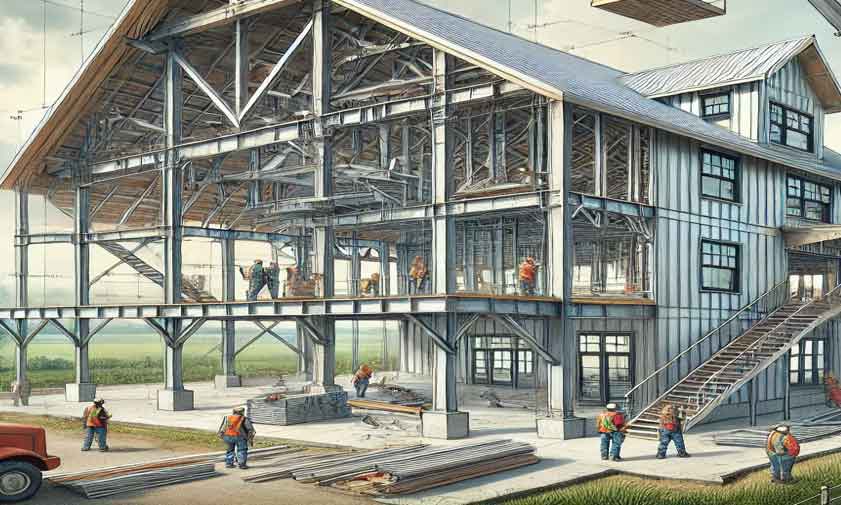
The barndominium has captured the American imagination as the ultimate expression of practical living. Steel frames, wide-open spaces, and the flexibility to use every square foot exactly as needed. But there is a quiet revolution happening within this already-flexible building type, one that looks past the initial construction and toward the decades of use that follow.
Design for Disassembly, or DfD, represents a fundamental shift in how barndominiums are engineered. Instead of welding steel members into permanent, unchangeable configurations, these structures use mechanical connections that allow components to be separated, moved, or entirely repurposed. The implications extend far beyond simple convenience.
Rethinking the Steel Frame
Traditional barndominium construction relies heavily on welded connections. Steel columns get permanently attached to beams, roof trusses become fixed elements, and the entire structural system hardens into a single, unalterable mass. This approach offers excellent strength and relatively straightforward construction, but it creates a permanent building that resists change.
The DfD approach replaces welding with bolted connections, pinned joints, and specially engineered brackets that transfer loads while remaining completely reversible. These connections must meet the same rigorous structural requirements as their welded counterparts, but they add a layer of future flexibility that transforms the building from a static object into an adaptable system.
Engineers working in this space have developed connection details that handle the full range of structural demands. Moment connections that resist rotation use high-strength bolts with specialized friction grip assemblies. Shear connections transfer vertical loads through precisely machined plates that can be unbolted and repositioned. Even the foundation connections allow for future adjustments, with anchor bolts designed for repeated tensioning and loosening without compromising their holding capacity.
The Practical Benefits of Disassembly
The immediate advantage of mechanical connections becomes apparent during the first reconfiguration. A family that started with an open workshop space might need partitioned rooms as children arrive or aging parents move in. With welded construction, this change requires cutting steel, welding new members, and potentially compromising the original structural integrity. With bolted connections, the process involves unbolting existing members, repositioning them, and adding new ones using the same connection points.
The savings in time, money, and material waste are substantial. One barndominium owner calculated that reconfiguring their welded frame cost nearly seventy percent more than a comparable change would have cost in a bolted structure. Beyond the immediate financial impact, the ability to make changes without generating scrap steel or sending materials to landfills aligns with growing environmental consciousness in the building industry.
Maintenance becomes significantly more straightforward as well. A damaged beam in a welded structure requires cutting out the affected section and welding in a replacement, often with temporary shoring and extensive safety precautions. The same repair in a DfD barndominium involves unbolting the damaged member, installing a replacement, and torquing the connections to specification. The building remains occupied and functional throughout the process.
Material Efficiency and the Circular Economy
The long-term implications of DfD extend into what happens when the building eventually reaches the end of its useful life. Standard construction practices essentially guarantee that most materials will end up in landfills, their embodied energy wasted and their raw materials lost to future use. The DfD approach keeps materials in circulation.
Steel members can be unbolted, cleaned, inspected, and either reused in their original form or melted down for recycling with minimal contamination. The mechanical connections themselves become valuable components that can be removed and reused on other projects. Insulation panels maintain their integrity during removal, allowing for reuse in new applications.
The economic case for this approach grows stronger as materials become more expensive and supply chains more uncertain. A barndominium built with disassembly in mind effectively functions as a material bank, storing valuable resources that can be accessed when needed. The initial premium for DfD connections typically pays for itself within a few years through reduced renovation costs and increased material value.
Engineering the Connections
The hardware that makes disassembly possible requires careful attention to detail. Bolted connections must be designed for repeated tightening and loosening cycles, which means specifying fasteners with sufficient strength and durability. Corrosion protection becomes critical since mechanical connections need to remain accessible and functional for decades.
Engineers specify galvanized or stainless steel fasteners in most applications, with specialized coatings for particularly demanding environments. The connection plates themselves use thicker material than typical welded connections, accounting for the stress concentrations that develop around bolt holes. Proper torque specifications ensure that connections transfer loads effectively while remaining removable.
The design process must also account for the slightly different load paths that develop in bolted versus welded connections. Welded steel behaves as a continuous material, distributing stress evenly across the joint. Bolted connections create discrete load transfer points that require additional engineering analysis. The resulting designs often use larger connection plates and more fasteners than a welded alternative, but the material premium remains modest compared to the long-term benefits.
Modular Systems and Prefabrication
The DfD approach aligns naturally with prefabricated construction methods. Manufacturers can produce standardized connection components in controlled factory environments, ensuring consistent quality and precise tolerances. The same connection hardware that enables future reconfiguration also simplifies initial assembly, reducing on-site labor requirements and accelerating construction timelines.
Several companies now offer complete barndominium systems based on DfD principles, with pre-engineered connection points at regular intervals throughout the structural grid. These systems allow owners to reconfigure their spaces without requiring engineering input for every change, since the connection points have already been designed to accommodate multiple configurations. The result approaches the flexibility of a modular building system while maintaining the open spans and aesthetic appeal that make barndominiums so attractive.
Challenges and Considerations
The shift toward DfD construction requires changes throughout the building industry. Contractors must learn proper bolting techniques and understand the importance of torque specifications. Inspectors need training to evaluate mechanical connections effectively. Building codes must adapt to accommodate the different failure modes and performance characteristics of bolted versus welded structures.
The initial cost premium for DfD connections remains a barrier for some owners, particularly when the long-term benefits seem distant or uncertain. However, the growing availability of standardized components and the increasing acceptance of DfD principles in commercial construction have driven costs down substantially. Many owners find that the premium amounts to less than five percent of total construction cost, a small price for decades of flexibility.
The Future of Adaptable Construction
Design for Disassembly represents more than just a technical innovation in barndominium construction. It embodies a philosophical shift toward buildings that adapt to changing needs rather than forcing owners to adapt to fixed spaces. The same mechanical connections that enable future reconfiguration also create buildings that perform better over their entire lifecycle, consuming fewer resources and generating less waste.
The barndominium, with its simple structural systems and open floor plans, provides the ideal platform for DfD principles. The large clear spans and straightforward load paths simplify the engineering challenges, while the typical owner’s appreciation for practical efficiency makes them receptive to the long-term benefits. As the building industry continues to embrace sustainability and adaptability, the DfD barndominium points the way toward a more flexible future.
The next time someone describes a barndominium as a simple building type, consider what happens when that simplicity gets paired with connections designed for change. The result transforms a permanent structure into a living system, capable of evolving alongside the people who call it home.