
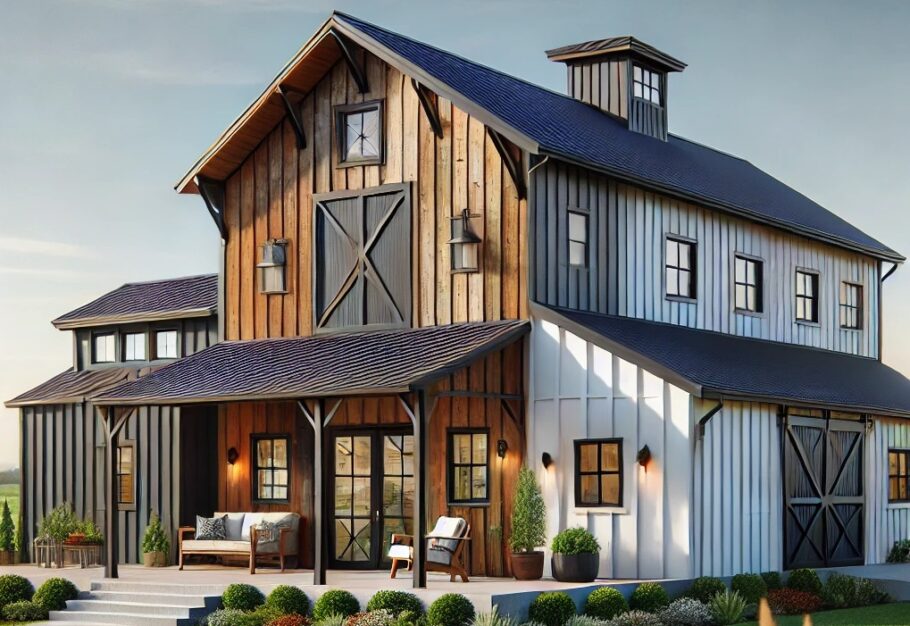
For decades, the barndominium has stood as a testament to pragmatic American architecture—a structure born from the simple need to convert agricultural space into livable quarters. What began as a niche solution for rural property owners has exploded into a mainstream housing movement, offering an aesthetic that blends rustic charm with modern open-concept living. Yet for all their appeal, barndominiums have long faced a singular, persistent challenge: the timeline to get them dried in.
Traditional stick-framing methods, while familiar and flexible, are notoriously time-consuming. Each stud must be cut, each header assembled, and each wall plate aligned by hand, often in unpredictable weather conditions. This is where the panelized barndominium is rewriting the rules of construction.
Beyond the Pole Barn: Defining the Panelized Approach
The term “barndominium” often conjures images of massive post-frame structures with metal siding. While that aesthetic remains popular, the construction methodology has undergone a significant evolution. The panelized approach doesn’t abandon the core concept of the barndominium; rather, it refines the process of building its shell.
Pre-fabricated wall sections—or panels—are manufactured off-site in a controlled factory environment. These are not simple, flat assemblies but precisely engineered components that arrive on the job site ready for installation. A typical panelized wall system for a barndominium might include the structural framing, insulated cavities, windows, doors, and even exterior sheathing and weather-resistant barriers pre-installed. In more advanced systems, the exterior finish, whether it’s metal siding, stone veneer, or fiber cement, is also applied in the factory.
This shift from on-site assembly to factory production represents a fundamental change in the construction workflow. The framing crew no longer cuts lumber or nails studs on the concrete slab. Instead, a crane or lifting system positions complete wall sections onto the foundation, and a smaller crew bolts them into place.
The Anatomy of a Speedier Enclosure
The term “enclosure” in construction refers to the point at which the building’s interior is protected from the elements. Achieving a weather-tight shell is the single most critical milestone in any construction project. It allows interior trades—electricians, plumbers, HVAC installers—to begin their work without the constant disruption of rain delays or temperature extremes.
Panelization accelerates this process through several key mechanisms. First, there is the sheer volume of work completed concurrently. While the foundation is being poured and cured on-site, the wall and roof panels are already being fabricated hundreds of miles away. This parallel processing eliminates the downtime that plagues traditional builds, where construction often halts while waiting for materials or favorable weather.
Second, the precision of factory fabrication cannot be overstated. In a controlled environment, lumber is straight, cuts are exact to the millimeter, and squareness is guaranteed. This level of precision means that when a panel arrives on site, it fits. There is no time wasted shimming walls, forcing out-of-square corners, or adjusting for warped lumber. The panels marry to the foundation and to each other with a speed that makes traditional framing look archaic by comparison.
Consider a typical 40×60 barndominium shell. A skilled stick-framing crew might take several weeks to frame the walls alone, given the need for precise layout, cutting, and assembly. A panelized system can have the same walls standing and braced in a matter of days, sometimes even hours, depending on the complexity of the design. This does not merely shave days off the schedule; it compresses the timeline by weeks.
Rethinking the Labor Equation
Perhaps the most profound advantage of the panelized barndominium is its impact on the skilled labor shortage that plagues the construction industry. Finding qualified framers is increasingly difficult, and their wages reflect their scarcity.
Panelized construction reduces the reliance on highly skilled carpenters at the job site. The complex framing, the tricky angled cuts, and the precise header installations are handled in the factory by a dedicated workforce. The crew on-site needs to be proficient in lifting, placing, and fastening panels—tasks that are more about coordination and safety than intricate carpentry.
This shift allows for a smaller, more efficient crew. A barndominium that might have required a team of eight framers for six weeks can often be enclosed by a team of four in a single week. The savings in labor costs are substantial, but the real win is in the reduced risk of delays. A smaller, less specialized crew is easier to manage, easier to schedule, and less susceptible to the disruptions that cause projects to go over budget.
The Economics of Factory Precision
While the upfront cost of panelized components can be slightly higher than raw lumber, the overall economic picture often favors the factory-built approach. The hard cost of the materials is just one factor in a complex equation.
Waste reduction is a significant contributor to cost savings. In traditional stick framing, a certain percentage of lumber ends up as scrap—off-cuts from studs, odd angles, and damaged materials. In a factory setting, waste is minimized. Materials are used efficiently, and scrap is often recycled. This reduction in material waste translates directly to lower costs for the builder.
Furthermore, the predictability of the panelized system eliminates the “soft costs” that plague traditional builds. There are no weather delays that force the crew to idle on a rainy Monday. There are no material shortages caused by a supplier miscalculating an order. The schedule is tighter, the timeline is predictable, and the builder can commit to a finish date with greater confidence. In the world of construction, time is literally money, and panelization is a powerful hedge against time-based cost overruns.
Engineering the Components: A Modern Building System
The modern panelized barndominium is not a simple kit home; it is an engineered building system. Every panel is designed using advanced software that accounts for local building codes, seismic loads, wind pressures, and snow loads. The components are not assembled on a whim; they are engineered to perform.
This engineering extends to the connections between panels. Manufacturers have developed sophisticated fastening systems and hardware that ensure the structural integrity of the assembled building. These connections are stronger and more consistent than traditional field-fabricated nailing patterns. When the panels are bolted and fastened together, the result is a building that is tighter, stronger, and more resilient than a traditionally framed structure.
The structural diaphragm of a panelized building is also more consistent. The sheathing is factory-attached with consistent nailing schedules, creating a rigid box that resists racking forces effectively. For barndominiums, which often feature large open spaces and expansive windows, this structural integrity is paramount. The engineered panels ensure that the large openings are properly supported without the need for excessive on-site engineering adjustments.
The Insulation Envelope: Performance from the Start
One of the most frequently overlooked advantages of panelized construction is the quality of the insulation envelope. In a traditional build, insulation is installed after the framing and exterior finish are complete, often in less-than-ideal conditions. Gaps are common, and thermal bridging through studs is a constant source of energy loss.
In a panelized system, the insulation is installed in the factory. This ensures that the insulation fits perfectly within the cavities, with no gaps, compressions, or misalignments. Many panel manufacturers also incorporate integrated thermal breaks to reduce heat transfer through the studs. This attention to detail creates a far superior thermal envelope.
This is particularly critical for barndominiums, which often feature expansive metal roofs and large glass windows. A tight building envelope is essential for energy efficiency and comfort. The panelized approach ensures that the building’s “skin” is as efficient as possible from the moment it is assembled.
The Roof System: An Integrated Component
While wall panels are the primary focus of panelized construction, the roof system is equally critical to achieving a quick enclosure. Roof trusses and panels are also manufactured off-site and delivered with the wall components. In many cases, the roof panels are designed to span the entire width of the barndominium, incorporating structural insulation and roof decking.
The installation of these roof panels is as efficient as the wall panels. Once the walls are standing, the roof panels are craned into place and fastened to the wall plates. In a single day, a building can go from being an open structure to a fully enclosed, weather-tight shell. This is a significant leap forward from traditional roof framing, which requires crews to work at height, installing rafters, decking, and insulation piecemeal.
Navigating the Logistics: The Delivery Day
The logistics of a panelized build are distinct from a traditional stick-frame project. Delivery day is a carefully orchestrated event. A flatbed truck carries the entire shell of the building—walls, roof panels, and associated hardware—to the site. The panels are stacked in a specific order, designed to streamline the erection process.
A crane is typically required to lift the panels into place. This requires adequate site access and a clear understanding of the lift plan. However, the efficiency gains of this approach far outweigh the logistical challenges. Once the panels are unloaded and staged, the assembly process is remarkably fast.
The Challenges and Considerations
While the advantages of panelized construction are compelling, it is not a one-size-fits-all solution. The most significant challenge is the design phase. Panelized systems require a high degree of detail and precision before the manufacturing process begins. All electrical and plumbing locations must be determined upfront, as the panels are fabricated with pre-cut holes for these services. Changes after the panels are manufactured are costly and difficult.
Site conditions also play a role. The foundation must be perfectly level and square. A mismatch of a quarter-inch between the foundation and the panels can create significant issues during assembly. However, this is not a disadvantage of the system but rather a requirement that forces a higher standard of workmanship from the concrete contractor.
Long-Term Durability and Maintenance
A panelized barndominium is not just built faster; it is built better. The factory-controlled environment ensures that the lumber is dry and straight, reducing the risk of warping and settling. The fasteners are installed with consistent torque, and the structural connections are engineered to exacting standards.
This translates to a building that requires less maintenance over its lifespan. The walls are straight, the corners are true, and the insulation is consistent. For owners looking for a home that is both low-maintenance and energy-efficient, the panelized approach offers a distinct advantage over traditional framing.
Conclusion: The Future of the Barndominium
The barndominium is no longer a niche interest for rural property owners; it is a serious contender in the broader housing market. As the demand for these unique structures grows, the industry is evolving to meet that demand with more efficient, cost-effective, and sustainable methods.
The panelized barndominium represents the future of this movement. By shifting the construction of the shell to a controlled factory setting, builders can achieve faster enclosure times, reduce labor costs, eliminate weather delays, and deliver a superior product. For anyone considering a barndominium project, the decision to panelize is not merely a construction choice; it is a strategic decision that impacts every aspect of the building process from the foundation pour to the final move-in.
The speed of the enclosure is the single most critical factor in a successful build, and the panelized system delivers on that promise with precision, efficiency, and a quality that traditional methods struggle to match.