
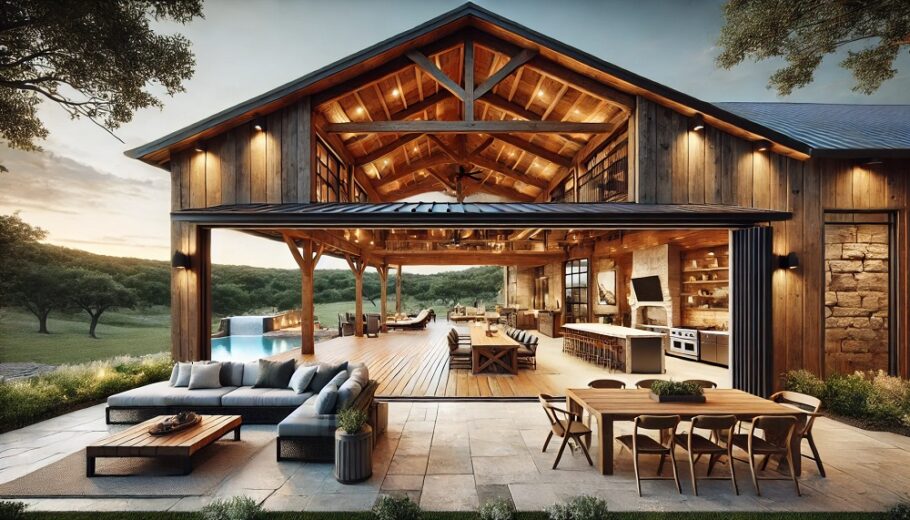
Walk into most barndominiums, and there it is—the long, narrow hallway stretching from one end of the structure to the other, lined with doors like a budget hotel. White walls, maybe some builder-grade beige, recessed lights every eight feet, and a runner rug that does little more than collect dust. People rush through these spaces with their heads down, eager to reach the living room or the kitchen or the bedroom. The corridor is punishment. A necessary evil. A tax on square footage.
What a waste.
The central corridor in a barndominium has more potential than almost any other space in the building. Think about it—this is the artery of the entire home. Every room branches off from it. Every family member passes through it dozens of times each day. In a well-designed barndominium, the main hallway can span sixty, eighty, even a hundred feet from end to end. That’s not just a hallway. That’s real estate. That’s opportunity.
The barndominium spine deserves better.
Rethinking the Long Hall
The shift starts with a simple question—what happens if the corridor becomes a place to be rather than a place to pass through? What if the journey between rooms offers something worth pausing for?
Barndominiums naturally lend themselves to this kind of thinking. The open spans of post-frame construction mean fewer load-bearing walls interrupting the interior layout. A long central corridor doesn’t have to feel like a bowling alley. It can breathe. It can change width. It can incorporate natural light, display space, seating, work zones, and moments of unexpected delight.
The key is to stop treating the hallway as leftover space. Most floor plans develop the corridor last—whatever is left after placing the kitchen, the bathrooms, the bedrooms, the shop. That guarantees a mediocre result. The spine should drive the floor plan, not emerge from it.
Width Matters More Than You Think
Standard residential hallways run thirty-six to forty-two inches wide. That’s barely enough for two people to pass without the awkward shoulder-dance. For a barndominium spine, thirty-six inches feels like a crawlspace. Go wider. Much wider.
A sixty-inch corridor transforms the experience immediately. Two people can walk side by side comfortably. A wheelchair turns without a three-point maneuver. A piece of furniture moves from one room to another without scraping drywall. But the real benefit shows up in how the space feels. A wide corridor doesn’t constrict. It invites.
Some of the best barndominium designs push the spine to eight or ten feet wide in certain sections. The hallway becomes a gallery. A reading nook can tuck into an alcove. A narrow desk fits against one wall without blocking traffic. Children play board games on the floor without getting stepped over. The corridor stops being a passage and starts being a room—a long, linear room, yes, but a room nonetheless.
Light as a Design Element
Dark hallways feel oppressive. Endless artificial light from recessed cans creates a tunnel effect that makes people move faster. Natural light changes everything.
Steel-framed barndominiums have an advantage here. The structure can accommodate larger windows than traditional stick framing. Punched openings along the corridor walls bring in morning light from the east, afternoon sun from the west. Better yet, terminate the spine with a large window at one or both ends. A twelve-foot sliding glass door at the far end of the corridor pulls the eye outward and makes the entire length feel like a procession toward something meaningful.
Consider clerestory windows high on the corridor walls. These admit light without sacrificing privacy from adjacent rooms. The light washes down the walls and creates a sense of volume without opening sightlines into bedrooms or bathrooms. For a truly dramatic effect, a strip of translucent polycarbonate paneling along the roofline above the spine turns the entire ceiling into a light diffuser.
Flooring That Directs the Journey
The material underfoot shapes how people move through a space. Carpet softens footsteps but deadens the sense of progression. Hard surfaces—concrete, tile, wide-plank wood—create a resonant quality that announces motion.
Polished concrete makes particular sense for a barndominium spine. The material connects to the building’s agricultural roots while providing durability that laughs at muddy boots and rolling tool chests. A scoring pattern or integral pigment can break up the visual length without breaking the physical continuity. Diamond-polished concrete reflects light back upward, brightening the entire corridor without adding fixtures.
For those wanting warmth underfoot, a transition works beautifully. The spine might start with stained concrete near the entry, shift to tile through a central gallery section, and end with wood planks in the private wing. Each material change signals a different zone and breaks the corridor into digestible segments.
Zones Within the Spine
A hundred-foot hallway functions better when it reads as a series of connected spaces rather than one endless run. Strategic zoning accomplishes this without walls or doors.
The entry zone occupies the first fifteen to twenty feet nearest the main entrance. This area handles boots, coats, keys, and bags. A built-in bench with cubbies below keeps the floor clear. Hooks on the wall at two heights accommodate both adults and children. A narrow console table holds a bowl for loose change and a tray for outgoing mail. This zone serves a purpose, and that purpose is transitional—from outside to inside, from public to private.
The gallery zone follows. Here, the corridor widens to seven or eight feet. Track lighting on a dimmer highlights artwork along both walls. A mix of family photographs, original paintings, and sculptural objects turns the walk into an experience. A shallow display shelf runs the length of the zone at eye level, deep enough for small ceramics or framed snapshots but not so deep that it encroaches on walking space. The gallery zone makes the daily commute through the house feel curated rather than cluttered.
The library zone transforms a section of the spine into a place for lingering. A floor-to-ceiling bookshelf covers one wall. Below it, a continuous bench with cushions invites sitting. A reading light on a swing arm mounts to the shelf above. This is not a full living room, but it does not need to be. It is a pause—a place to sit for ninety seconds with a passage from a novel or to tie shoes before heading out the door.
The work niche serves the household’s command center needs. A desk surface folds down from the wall when needed and disappears when not. Above it, a magnetic board holds schedules and reminders. A single electrical outlet and a USB port keep devices charged without cord clutter. This zone handles the business of daily life without dedicating an entire room to paperwork and calendars.
The conservatory zone brings the outside in. This section of the spine features a glass wall facing a courtyard or garden. A line of planters sits below the windows, filled with herbs or trailing vines. Drip irrigation keeps maintenance minimal. In winter, the passive solar gain warms the corridor. In summer, operable windows create cross-ventilation that pulls air through the entire building.
Doors That Disappear
Pocket doors and barn doors eliminate the swing clearance that traditional hinged doors require. When every bedroom, bathroom, and closet opens off a central spine, the cumulative effect of door swings eats up the corridor’s effective width. Pocket doors slide into wall cavities and disappear entirely. Barn doors ride along exposed tracks above the opening, becoming architectural features rather than obstacles.
For rooms that need sound privacy—bedrooms, home offices, media rooms—solid-core pocket doors with perimeter seals perform nearly as well as hinged alternatives. The hardware must be commercial grade. Cheap pocket door hardware fails within a few years of daily use, and repair means opening the wall. Quality costs more upfront but saves misery later.
The Destination End
The end of a long corridor needs resolution. A blank wall with a single picture creates an anticlimax. A door slamming the space shut feels worse. The terminus of the spine should reward the journey.
An interior garden makes a powerful destination. A corner of the corridor walled in glass contains a small fountain, a chair, and several large plants. The sound of moving water travels back up the spine and masks noise from other parts of the house. The green view from the far end gives the entire corridor a sense of purpose.
Alternatively, a fireplace anchors the end of the spine. A double-sided unit serves both the corridor and the primary suite or living area beyond. Even unlit, the firebox and surround provide a focal point that draws the eye and organizes the space.
A window seat at the corridor’s end offers a practical destination. The bench below a large window provides a place to read, to wait, to watch children playing in the backyard. Cushions and pillows make it comfortable. Storage below holds blankets or board games. The window seat turns the end of the hallway into a destination worth reaching.
Materials That Tell a Story
The barndominium aesthetic—exposed steel, wood, concrete—should extend into the spine rather than stopping at its walls. Corrugated metal wainscoting protects the lower portion of the walls from scuffs while reinforcing the agricultural character. Reclaimed barn wood on one accent wall brings texture and history. A steel beam left exposed above the corridor reminds everyone walking beneath it that this building started as something else.
These materials wear well. Scratches in the metal wainscoting add character rather than demanding repair. Dings in the reclaimed wood tell stories. The spine does not need to look pristine. It needs to look honest.
Acoustics in a Long Space
A long, hard-surfaced corridor becomes an echo chamber. Footsteps multiply. Conversations travel. Closing a door sounds like a gunshot. Without acoustic treatment, the spine becomes the noisiest part of the house.
Textiles solve this problem without sacrificing the material palette. A runner carpet in the heaviest-traffic zone absorbs footfall noise. Fabric-wrapped acoustic panels painted to match the walls disappear visually while killing reflections. A line of curtains at one end of the corridor—drawn back during the day, closed at night—adds softness and can hide storage or mechanical access.
The ceiling offers the biggest opportunity for acoustic control. Acoustic tile in a grid pattern reads as intentional rather than institutional when chosen carefully. Wood slats with acoustic felt backing create a warm, rhythmic ceiling that tames sound while looking nothing like an office building. Sprayed acoustic texture on drywall costs little and performs adequately for most homes.
The Spine as Organizing Principle
When the central corridor becomes a destination, everything else in the barndominium benefits. Rooms no longer need to contain every function. A small bedroom feels less cramped when a desk niche in the spine handles homework. A compact kitchen breathes easier when pantry storage lines the nearby corridor wall. The spine absorbs the overflow, the transition, the daily clutter that otherwise overwhelms individual rooms.
This is not open floor planning. The spine offers a middle path between the closed-off warren of traditional rooms and the chaotic noise of the everything-in-one-room great hall. Privacy remains—bedrooms and bathrooms still close their doors. But the spaces between those doors serve a purpose beyond circulation.
The barndominium spine, done right, becomes the most used room in the house. Not because anyone lives there, but because everyone passes through there on the way to everywhere else. And when passing through feels as good as arriving, the entire home works better. The hallway stops being a necessary evil and starts being what it always should have been—the backbone of the house.