
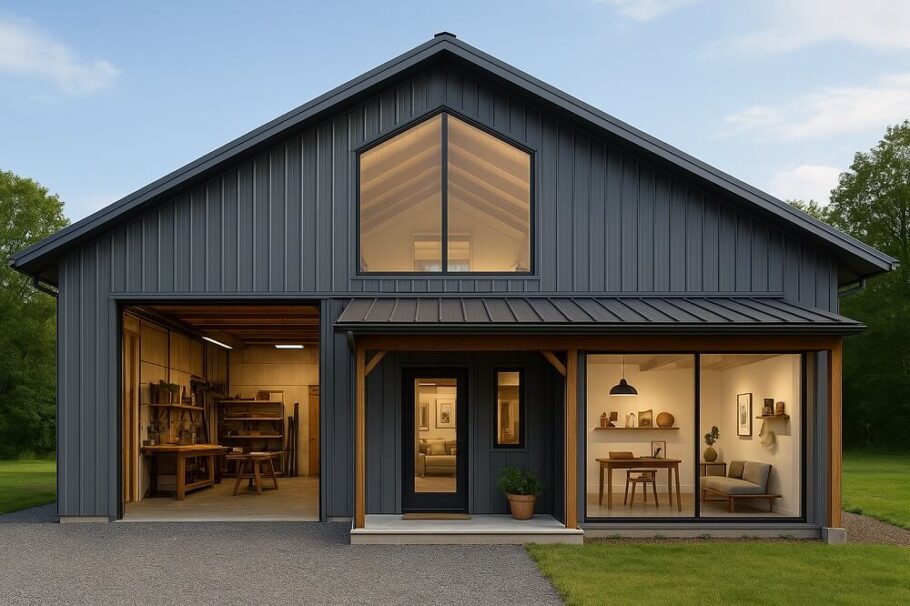
Barndominiums have exploded in popularity over the last decade. The appeal is obvious: open floor plans, lower construction costs per square foot, and that rustic-meets-modern aesthetic that sells like crazy on social media. But here’s the reality check that too many first-time builders learn the hard way – getting a barndo through a standard building inspection can be an absolute nightmare. Municipal inspectors weren’t trained on post-frame construction with living quarters. They know stick-built homes, and when something looks different, they look harder.
After watching countless barndominium projects stall out at the inspection stage, certain failure patterns keep showing up. These aren’t obscure technicalities either. These are legitimate safety and code issues that catch builders off guard because conventional home construction doesn’t deal with them the same way. Let’s break down the top five reasons barndominiums fail inspection, and more importantly, what actually needs to happen to get that green tag.
1. Frost Line Violations with Post-Frame Foundations
This one tops the list because it’s so fundamental and so frequently missed. Traditional homes sit on continuous poured concrete foundations that extend below the frost line – that’s the depth where the ground stops freezing in winter. But barndominiums typically use post-frame construction. That means large wooden posts (or laminated columns) set directly into the ground or embedded in concrete piers.
Here’s where the trouble starts. Building codes require that any foundation supporting a structure must be protected from frost heave. Frost heave happens when water in the soil freezes and expands, literally lifting whatever is sitting above it. A few inches of movement cracks drywall, jams doors, and can rupture plumbing lines. Most inspectors enforce the International Residential Code (IRC) section R403.3, which mandates that footings extend below frost line unless the structure is specifically designed to tolerate movement.
But barndominium builders often argue that their embedded posts don’t need to go that deep because the building is “just a pole barn.” That argument fails inspection every single time once living space is involved. The moment sleeping rooms and bathrooms exist, the structure becomes a dwelling. Dwellings need frost-protected foundations. Period.
The fix isn’t complicated, but it adds cost. Posts need to either extend below frost line (typically 36 to 48 inches in most climates) or sit on properly designed concrete piers that do. Some barndo plans use a “floating slab” approach with insulation to prevent frost penetration, but that requires engineered drawings and specific approval from the local building department before anyone breaks ground. Showing up to inspection without that approval guarantees a failed sticker.
2. Inadequate Emergency Escape and Rescue Openings (EEROs)
Walk into almost any barndominium floor plan and you’ll notice something right away – windows are often placed high on the walls. That’s not an accident. Metal buildings don’t have conventional stud framing, so window placement gets dictated by the metal panel layout and structural girts. Plus, that high window look has become a signature design feature. Looks great for Instagram. Fails inspection nearly every time.
The IRC requires every sleeping room to have at least one emergency escape and rescue opening. That means a window or door with specific minimum dimensions: at least 5.7 square feet of net clear opening (5.0 square feet for ground floor), at least 24 inches high, and at least 20 inches wide. The bottom of that opening can’t be more than 44 inches above the finished floor. That last part is what kills most barndo designs.
Those high windows that sit six feet off the ground? Completely useless for escape. A sleeping person can’t reach them, and even with a chair or ladder, by the time someone climbs up to that window during a fire, smoke has already become deadly. Inspectors enforce this strictly, and rightfully so. House fires double in size every minute. Wasting thirty seconds trying to reach a window is thirty seconds too many.
The solution requires planning from day one. Sleeping rooms need low, accessible windows that meet the size requirements. That often means reconfiguring the metal panel layout or adding window openings in places that weren’t originally designed for them. Some barndo builders try to cheat by putting an exterior door in each bedroom, but that creates security issues and usually wrecks the floor plan. Better to just design proper egress windows from the start and save the high windows for living areas where egress doesn’t apply.
3. Improper Electrical Wiring Through Metal Framing
Stick-built homes have wood studs. Drilling through wood to run electrical wire is easy, and Romex (non-metallic sheathed cable) can be stapled right to the wood framing without much fuss. Barndominiums are different. The structural skeleton is steel – steel beams, steel girts, steel purlins. And steel hates Romex.
Here’s what happens. An electrician runs standard Romex cable through holes drilled in steel framing members. The sharp edges of the drilled steel eventually cut through the cable’s plastic sheath from vibration or thermal expansion. That exposes live wires to grounded metal, which creates a short circuit or worse – an arc fault that can start a fire inside the wall cavity. Inspectors catch this constantly because they see the wrong type of cable for the application.
The code requires that any cable passing through metal framing must be protected from abrasion. That usually means using metal-clad cable (MC cable) instead of Romex. MC cable has its own flexible metal armor that withstands contact with steel framing. Some inspectors will allow Romex if the electrician uses plastic bushings or grommets at every penetration point, but that’s tedious and easy to miss. One missed grommet, one sharp edge, and the inspection fails.
Then there’s the bonding issue. The entire steel structure needs to be bonded to the electrical grounding system. That means a dedicated grounding conductor connected to the steel frame at multiple points. Miss this, and any electrical fault could energize the entire building frame. Touching a steel column during a fault means taking a shock. Inspectors test for this with continuity checks, and when they find an unbonded frame, that’s an immediate red tag.
The smart play here is hiring an electrician who has worked on post-frame or metal buildings before. Residential electricians who only do wood framing will make these mistakes every single time. Commercial electricians who work with steel studs and metal decking understand the requirements, but they often charge more. That extra cost beats redoing half the electrical system after a failed inspection.
4. Missing or Improper Vapor Retarders and Condensation Control
This one sends more barndominium owners into a spiral than almost anything else. Metal buildings sweat. It’s not a defect – it’s physics. When warm, moist indoor air hits a cold metal surface, condensation forms. In a conventional home, that moisture gets absorbed by wood framing and drywall, eventually drying out without major damage. In a barndominium, that moisture runs down the inside of the metal panels, pools at the bottom of walls, and creates a perfect environment for mold, rot in any wood components, and corrosion of fasteners.
Inspectors have gotten wise to this problem because they’ve seen the aftermath. A barndominium that looks perfect on the outside can have hidden condensation damage six months after occupancy. The code addresses this in the building envelope requirements, specifically the need for a continuous vapor retarder on the warm side of the insulation.
But here’s where barndo builders mess up. They think steel building insulation with a vinyl facing counts as a vapor retarder. Sometimes it does, but the facing must be installed with all seams sealed, all penetrations taped, and no gaps anywhere. In practice, that’s nearly impossible to achieve with the way metal building insulation comes in rolls that get stretched between purlins. There are always gaps, always tears, always unsealed seams.
The other mistake is putting the vapor retarder on the wrong side. In most climates, the vapor retarder goes on the interior face of the wall assembly (the warm side in winter). But some barndo plans use insulation with reflective foil facing on the exterior side to reflect heat. That foil acts as a vapor barrier too, but on the wrong side for cold climates, trapping moisture inside the wall cavity.
Failed inspections happen when the building official can’t verify a continuous vapor retarder. They’ll look for seams, tape, and proper placement. If they see exposed fiberglass batts without a facing, or facing that’s torn or misaligned, that’s a fail. The solution usually means either switching to closed-cell spray foam (which acts as its own vapor retarder) or using rigid foam board with taped seams on the interior before adding drywall. Neither option is cheap, but condensation damage costs even more to fix after the fact.
5. Structural Issues with Loft Floors and Mezzanines
Barndominiums love lofts. The high ceilings of a metal building practically beg for a mezzanine level – a bedroom up top, a home office, maybe just a hangout space overlooking the main living area. They look fantastic. And they fail structural inspection constantly.
The problem starts with the assumption that the existing steel frame can support a loft. Those steel columns and roof trusses were designed for snow loads and wind loads, not for an extra floor of live load with furniture and people walking around. Adding a loft means adding concentrated loads that the original frame never accounted for. Inspectors ask for engineering calculations stamped by a licensed structural engineer. Without those calculations, no pass.
Even when the frame can handle the load, the connection details fail. How does the loft floor attach to the steel columns? Bolted connections need proper bolt sizes, spacing, and torque. Welded connections need certified welders and inspection of weld quality. Most barndo builders aren’t structural steel fabricators. They’ll throw up some wooden joists, rest them on a ledger bolted to the columns, and call it good. Then the inspector shows up, sees lag bolts into thin steel tube columns, and rejects the whole thing because lag bolts have no business carrying floor loads in steel construction.
Then there’s the railing issue. Any loft floor more than 30 inches above the lower floor needs guardrails that meet code – minimum 36 inches high for residential, with balusters spaced so a 4-inch sphere can’t pass through. Seems simple, but the attachment of those railings to the steel frame matters. Railings bolted only to drywall or wood trim fail immediately. Railings need solid connection back to the primary structure.
The way to pass this inspection is to involve an engineer before building the loft. Get actual stamped drawings showing live load capacity (minimum 40 pounds per square foot for sleeping areas, 30 for storage), connection details, and railing attachments. Some barndominium owners skip the permit for the loft entirely, treating it like furniture rather than a structure. That strategy works until someone gets hurt or the house goes up for sale. A buyer’s inspector will spot an unpermitted loft from across the room, and suddenly the sale falls apart or the price drops by tens of thousands.
The Bottom Line on Barndominium Inspections
None of these problems are impossible to solve. They’re not even that expensive to address during the planning phase. The real issue is that barndominiums sit in a weird regulatory space – they’re agricultural buildings converted to residential use, and building codes weren’t written with that conversion in mind. Inspectors aren’t being difficult when they flag these problems. They’re just doing their jobs, enforcing codes that exist for legitimate safety reasons.
The builders who sail through inspection are the ones who treat their barndominium like what it actually is – a house that happens to have a metal shell. They hire tradespeople who understand steel framing. They pay for engineering drawings. They skip the shortcuts on vapor control and egress windows. And they budget for the extra costs upfront instead of getting blindsided by rework after a failed inspection.
If a barndominium is still the goal after reading all this, go for it. The finished product really is something special. Just go into it with eyes open, a good set of plans, and a building department that knows what’s coming. The failures happen to people who think codes don’t apply to pole barns. They always apply. And they always catch up.