
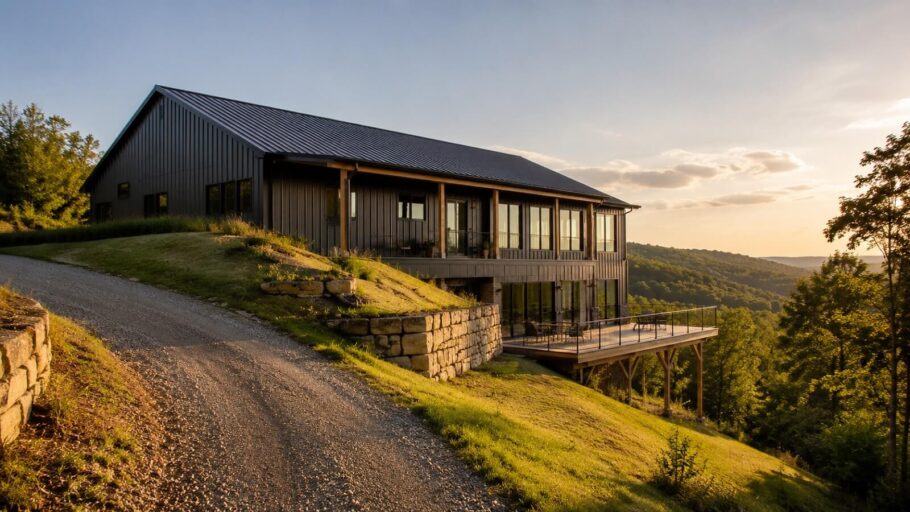
There’s something undeniably striking about a barndominium perched on a hillside. The way the metal roof cuts across a sloping backdrop, the layered views from every window, the natural drainage that keeps the foundation high and dry. But anyone who has looked at a steep piece of land and thought, that’s where the barn home belongs knows the reality: building on a slope introduces a whole different set of rules.
Flat land is easy. Sloped land is character – and character comes with engineering, excavation bills, and some hard decisions about foundations. The good news? With the right approach, a sloped barndominium can actually outperform a flat-site build in terms of drainage, natural cooling, and living space efficiency. The key is understanding how post-frame construction interacts with grade changes, and where to invest money early to avoid nightmares later.
Reading the Land Before Breaking Ground
Before a single post goes into the ground, the slope itself needs a thorough evaluation. Not all slopes are created equal. A gentle 5% grade (about a three-foot drop over sixty feet) offers a different set of options than a steep 15% grade where the dirt falls away sharply from the proposed building site.
Soil composition matters enormously on a slope. Sandy or gravelly soils drain fast but can erode during excavation. Clay-heavy slopes hold water and become slick, unstable messes when cut into. Bedrock close to the surface means blasting or specialty equipment, adding cost and complexity. A proper geotechnical evaluation – soil borings, percolation tests, slope stability analysis – isn’t an upsell from a nervous engineer. It’s the difference between a barndominium that settles gracefully over decades and one that starts cracking foundation walls after the first heavy rain season.
Local building departments often have stricter requirements for sloped sites. Erosion control plans, stormwater management permits, and engineered grading plans become mandatory once the slope exceeds a certain percentage. Some jurisdictions outright prohibit post-frame construction on slopes steeper than 4:1 without additional engineering. Checking these requirements before buying the land saves a world of frustration.
Foundation Strategies That Work With Gravity
The classic barndominium foundation – a concrete slab on grade with embedded post brackets – works beautifully on flat ground. On a slope, that same approach becomes either impossible or ruinously expensive. The solution lies in adapting post-frame logic to uneven terrain.
Stepped foundations offer the most straightforward path for moderate slopes. The slab is poured in sections, each level stepping down the hill like an oversized set of stairs. Individual post placements align with each step, and reinforcing steel ties the stepped sections together. This approach keeps excavation relatively contained and works well for slopes up to about eight feet of total drop across the building footprint. The downside? Those steps create interior floor level changes. A split-level barndominium isn’t everyone’s dream, though some owners embrace the chance to separate public and private spaces with a few stairs.
Pier and beam construction shines on steeper ground. Instead of cutting and filling to create a level pad, the building rests on concrete piers drilled deep into stable soil or bedrock. The posts then attach to these piers, and the floor deck spans between them. This approach disturbs the slope minimally, preserves natural drainage patterns, and allows the building to essentially float above the hillside. Crawl space height varies from a few feet on the uphill side to eight feet or more downhill, which creates incredible storage or mechanical room opportunities.
Post-frame on grade with a graded pad works for slopes under about six feet of total drop. This means bringing in fill dirt to create a level building pad on the downhill side while cutting into the uphill side. It requires careful compaction and usually a retaining wall on the downhill edge. Many barndominium builders prefer this method because it delivers a conventional slab-on-grade floor – no steps, no piers, no complicated framing. But the fill volume adds cost, and retaining walls aren’t cheap. For slopes over ten feet of drop, the fill volume becomes astronomical, pushing most projects toward pier and beam.
Managing Water When Every Drop Wants to Visit
Water is the quiet enemy of every foundation, but on a slope, it moves with purpose. Rain hitting the uphill side of a barndominium doesn’t just sit there – it flows under, around, and through any gap it can find. Poor drainage turns a dream barn home into a muddy, mildewed mess within a few seasons.
Perimeter drainage starts with a proper swale or diversion ditch uphill from the building. This intercepts surface water before it ever reaches the foundation. French drains at the uphill foundation line capture subsurface flow, directing it around the building through perforated pipe wrapped in filter fabric. The downhill side needs positive drainage too – water that collects against the foundation on the low side has nowhere to go without a well-designed outlet.
Grading the immediate building perimeter requires special attention on slopes. The finished grade should slope away from the structure on all four sides, even if that means building up the downhill side slightly. A common mistake involves letting the natural slope fall directly against the foundation on the downhill elevation, turning that wall into a dam. Splash blocks, downspout extensions, and gutters become non-negotiable on a sloped barndominium – no skipping these to save a few dollars.
Crawl space or basement drainage deserves its own line item. For pier and beam construction on a steep slope, the area beneath the building often becomes a wind tunnel and water pathway. Installing a vapor barrier over the ground, adding perimeter drains at the lowest points, and ensuring cross-ventilation prevents moisture problems. Some owners opt to enclose part of the under-story space as a garage or shop, which requires even more careful waterproofing of the downhill foundation wall.
Access and Driveways: Getting to the Front Door
A barndominium on a slope means a driveway that climbs, switchbacks, or cuts across the hillside. This seems obvious, but many owners underestimate how much driveway impacts the total project budget. A long, steep driveway on unstable soil can cost as much as the building foundation.
Cut and fill driveways work well for moderate slopes but require a bulldozer and compactor. The driveway is carved into the hillside, with the excavated dirt used to build up the downhill edge. Retaining walls often become necessary on the downhill side to prevent the fill from slumping away. Every foot of driveway width requires more cut and fill than most people guess – a twelve-foot-wide driveway actually needs a twenty-foot-wide disturbance zone after accounting for ditches and shoulders.
Switchbacks solve steep grades but eat up space and add turning radius requirements. A barndominium on a very steep slope might need a driveway that zigzags up the hill, with level sections between turns. This works, but snow removal becomes interesting, and delivery trucks need room to maneuver. Concrete or asphalt paving on switchbacks beats gravel every time – gravel migrates downhill relentlessly on any slope over 8%.
Parking and turnaround areas need to be level. Building a flat parking pad near the barndominium entrance often requires independent grading and retaining walls separate from the building foundation. Some designs integrate the parking pad as part of the downhill under-story, creating a drive-under garage or carport. This works exceptionally well for steep slopes where the building’s downhill side stands tall enough to accommodate vehicle clearance.
Floor Plans That Embrace the Grade
One of the best arguments for a sloped barndominium lies in the floor plan possibilities. Instead of a single-level barn shape, the slope naturally creates two distinct elevations. This opens up designs that flat-land builders envy.
Walkout basements become standard with a moderate slope. The uphill side of the barndominium sits at or near grade, while the downhill side stands two or three stories tall. That downhill face can hold full-height windows, sliding glass doors, and a patio or deck that feels suspended in the trees. Interior stairs connect the upper living level to a lower level that might contain bedrooms, a media room, or a workshop. No dark, damp basement here – just a light-filled lower floor with its own entrance.
Split-level entries eliminate the need for long staircases at the front door. Placing the main entry on the uphill side means stepping directly into the upper living level. From there, a short half-flight of stairs goes down to the lower level. This arrangement keeps daily living spaces (kitchen, living room, primary bedroom) on one level and secondary spaces downstairs. It works particularly well for retirees or anyone who wants to minimize stairs in the core living areas.
Two-story barndominiums on steep slopes can almost hide their lower level entirely. From the uphill approach, the building looks like a single-story barn. The roofline stays low and agricultural. Then guests walk around to the downhill side and discover a second full story of windows and deck space. This design trick preserves the classic barndominium aesthetic while doubling square footage without increasing the building’s visual bulk from the road.
Retaining Walls and Structural Considerations
Cutting into a slope destabilizes the ground. Filling over a slope adds weight that wants to slide downhill. Retaining walls manage these forces, but they need to be designed correctly – not as an afterthought.
Gravity walls made of large interlocking concrete blocks or gabion baskets work for walls up to about four feet tall. They rely on their own weight to hold back the hillside. For taller walls, reinforced concrete or mechanically stabilized earth (MSE) walls with geogrid fabric become necessary. A six-foot retaining wall done wrong fails slowly at first – a little tilt, a few cracks – then catastrophically in a heavy rain.
Tiered walls break a tall slope into multiple shorter walls with terraces between them. This looks more natural, costs less than one massive engineered wall, and provides flat planting areas or patios at each terrace level. Many sloped barndominium properties use tiered walls to transition from the building pad down to a lower lawn or driveway.
The building as retaining wall – some designs just let the barndominium structure act as the retaining element. Post-frame construction handles lateral soil pressure poorly unless specifically engineered for it. A better approach keeps the building separate from major retaining structures. The house sits behind its own foundation, and the retaining wall handles the hillside independently. This separation prevents soil pressure from ever loading the building frame.
Cost Realities That Surprise Owners
Nobody builds on a slope to save money. The numbers tell a clear story: sloped sites add 20-40% to foundation and site work costs compared to a flat, accessible lot. But those numbers vary wildly based on specifics.
Excavation and grading eats the biggest chunk of the slope premium. Moving dirt on a hillside takes longer, requires more equipment, and produces less predictable results than flatland earthwork. Rock excavation doubles or triples costs. Hauling fill onto a site (imported dirt) costs more than using on-site material, but sometimes the native soil doesn’t compact well enough for building pads.
Engineering fees jump for sloped barndominiums. Standard post-frame engineered plans assume level ground with uniform soil conditions. A slope requires site-specific foundation engineering, retaining wall design, and often a geotechnical report. Adding
3,000to
3,000to8,000 for engineering is realistic – money well spent to avoid a structural failure.
Access costs for construction equipment add up. Concrete trucks need to reach the foundation pour location. Steel beams and lumber packages need delivery. If the slope prevents standard truck access, smaller delivery vehicles or even telehandler forklifts moving material in stages increase labor hours. Remote or very steep sites sometimes require temporary access roads that get removed after construction – an added line item many forget to budget.
Long-Term Advantages Worth the Extra Effort
For all the challenges, a well-built sloped barndominium offers genuine advantages that flat-site owners miss. The elevated views alone justify the foundation complexity. But beyond scenery, consider these operational benefits.
Natural drainage means no ponding water around the foundation, no sump pump running constantly, no wet crawl space. Gravity works in the building’s favor rather than against it. As long as drainage details are done right, a sloped barndominium stays drier than any flat-land slab.
Energy performance improves with a walkout lower level. Earth contact on the uphill side provides natural insulation, stabilizing temperatures in both summer and winter. The lower level stays cool without air conditioning in many climates. Cross-ventilation from the downhill windows draws air through the building.
Resale value on unique properties tends to reward good design. A barndominium that uses its slope intelligently – with views, walkout access, and functional lower-level space – stands out from cookie-cutter builds. Buyers pay premiums for hillside properties with finished walkout basements. They avoid poorly executed slope builds with drainage problems. The difference comes down to whether the original owner invested in proper engineering or tried to cut corners.
Final Thoughts on Hillside Barn Homes
Building a barndominium on a slope isn’t for the faint of heart or the shallow of pocket. It requires more planning, more professional input, and more money upfront. But the result – a home that rises naturally from the land, captures sweeping views, and stays bone-dry through every storm – rewards that investment for decades.
The contractors who specialize in post-frame construction on difficult sites are worth finding. A builder who says “we do slopes all the time” without asking about soil reports or drainage plans is probably not the right choice. The right builder asks hard questions about grade percentages, water flow paths, and retaining wall engineering before quoting a price.
Start with the land itself. Walk the slope in different weather conditions. Watch where water runs and pools. Dig a few test holes to see what sits beneath the grass. Then design the barndominium to work with that specific hillside, not against it. That approach turns a construction challenge into a home that feels like it always belonged there.