The barndominium market has exploded over the past decade, but most people still imagine two distinct ways to build one. The first is the traditional post-frame method—sinking treated wood columns into the ground, throwing up trusses, and calling it a day. The second is the fully custom steel building, designed by an engineer, fabricated off-site, and assembled with a crane and a crew that knows how to read heavy structural drawings.
But there is a third way. One that sits right in the sweet spot between agricultural simplicity and industrial precision. It is the kit-of-parts approach, and it is quietly changing how people think about barndominium design.
What Exactly Is a Kit of Parts?
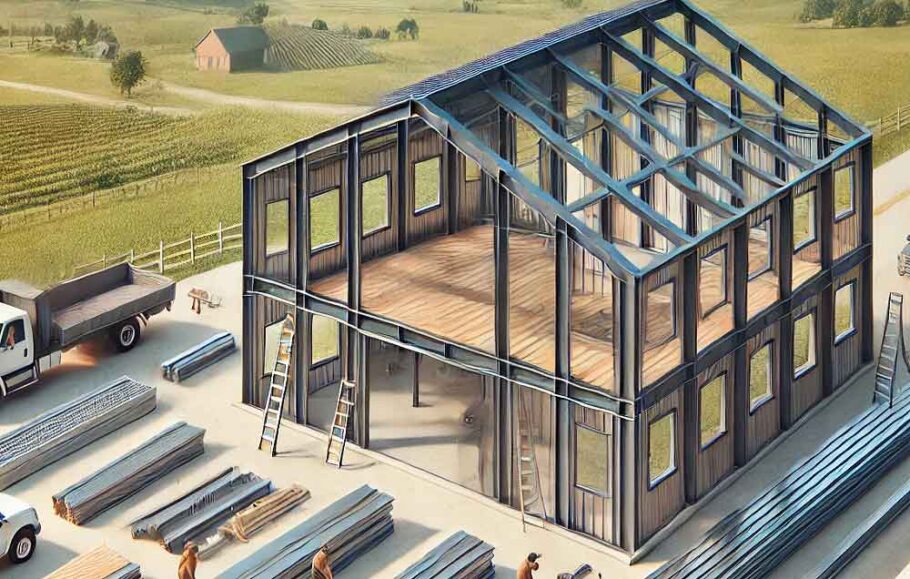
A kit of parts is exactly what it sounds like. A manufacturer pre-engineers every structural component—columns, rafters, girts, purlins, bracing, and connectors—then cuts, drills, and labels each piece before shipping it to the site. The entire frame bolts together. No welding. No cutting steel on-site with a torch. No guesswork about whether a beam is actually square.
This approach borrows heavily from the world of pre-engineered metal buildings (PEMBs), but with a critical difference. PEMBs have traditionally been designed for warehouses, airplane hangars, and agricultural sheds. The kit-of-parts barndominium takes that same engineering logic and adapts it for living spaces—with attention to insulation continuity, interior finishability, and the kind of flexibility that residential construction rarely offers.
The Three Core Component Groups
Any bolt-together barndominium frame breaks down into three families of parts. Understanding each one makes the whole system click into place.
Primary framing handles the heavy lifting. These are the rigid steel columns and tapered rafters that create the building’s skeleton. In a typical kit, columns bolt to a concrete foundation using embedded anchor rods. Rafters bolt to the columns at the eave line. The ridge connection—where two rafters meet at the peak—uses a bolted splice plate. Every bolted joint uses oversized holes that allow for minor field adjustments, which matters more than most people realize. Concrete foundations are never perfectly flat. Anchor rods never land exactly where the drawing says they should. Slotted holes and bolted splices absorb those real-world imperfections without forcing anyone to drill new holes in the field.
Secondary framing includes the cold-formed C-purlins on the roof and Z-girts on the walls. These lighter members bolt perpendicular to the primary framing, creating a grid that supports the roof and wall panels. The magic here is spacing. A typical kit uses purlins spaced five feet apart, which matches standard metal roofing panel lengths without waste. That same spacing also creates convenient cavities for insulation—something the old post-frame buildings did poorly.
Connectors and bracing form the third group, and this is where most kits either succeed or fail. A good kit includes pre-drilled flange braces, cable or rod cross-bracing for the endwalls, and moment connections at every corner where wind or seismic loads demand extra strength. Cheap kits skimp here. The difference shows up the first time a heavy storm rolls through.
Why Bolt-Together Becomes a Superpower for Flexibility
Site-welded steel buildings lock the owner into a permanent configuration. Once those columns are welded to their rafters, moving a wall or adding a lean-to becomes a major fabrication project. Bolt-together construction flips that logic entirely.
Every connection can be unbolted. That does not mean reconfiguring the structure every other weekend, but it does mean the building can grow and change in ways welded frames cannot match. Need a taller garage door five years from now? Unbolt the girts in that bay, cut the wall panel, and install a new frame. Want to add a covered patio off the back? Bolt a new set of rafters to the existing eave strut. Deciding to convert half the shop space into a home gym? Move the non-structural partition walls without touching the primary frame.
This flexibility extends to interior finishes as well. Because the frame uses standard bolt patterns, running electrical conduit, plumbing lines, or low-voltage wiring becomes predictable. Every bay between columns is the same width. Every purlin sits at the same height. Anyone with a tape measure and a basic understanding of the system knows exactly where to drill, cut, or mount something.
The Thermal and Moisture Advantage Nobody Talks About
Conventional barndominium construction has a dirty secret. Those beautiful exposed steel columns act as thermal superhighways. Heat travels straight down the column from the roof, through the insulation gap, and into the living space. In winter, that means condensation forming on the interior steel. In summer, it means air conditioning dollars leaking out through the frame.
The kit-of-parts approach offers a fix that welded buildings cannot replicate. Because the frame bolts together, manufacturers can include thermal break details at every column-to-foundation connection and every rafter-to-column joint. Some kits use injected-foam isolator pads between bolted surfaces. Others rely on engineered plastic shims that compress under bolt torque while blocking conductive heat transfer. Either way, the bolted joint itself becomes the place where thermal breaks live.
Moisture management improves too. A welded steel building often traps condensation inside closed cavities where it cannot dry. Bolt-together frames leave small gaps at every connection—not enough to leak air, but enough to allow vapor pressure to equalize. Combined with properly detailed insulation and vapor retarders, this approach produces walls and roofs that actually breathe in the way building scientists recommend.
Assembly Logistics and Labor
Anyone who has watched a traditional steel building go up knows the drill. A crew shows up with a lift, a welder, and a stack of drawings that seem to contradict the material that actually arrived. Days are lost to field fabrication, burned electrodes, and arguments about who cut which beam too short.
The kit-of-parts process looks completely different. Every piece arrives numbered. The drawings show exactly which bolt goes through which hole in which order. A crew of four people with basic tools—spud wrenches, impact guns, levels, and a scissor lift—can set the primary frame in two or three days. Secondary framing adds another two days. By the end of the first week, the building is standing, squared, and ready for roof and wall panels.
The labor savings matter, but what matters more is the skill level required. No certified welder needed. No crane operator unless the spans get truly massive (over sixty feet). Just people who can read a drawing, turn a wrench, and follow a sequence. For someone building their own barndominium as an owner-builder, this is the difference between a project that gets finished and one that stalls out halfway through.
Cost Structure and Hidden Economics
Pricing for a bolt-together kit typically runs between fifteen and twenty-five dollars per square foot for the structural frame, delivered. That sounds higher than post-frame at first glance, and it is. But the comparison misses the full picture.
Post-frame requires larger columns because wood cannot match steel’s strength-to-weight ratio. Those columns need deeper holes, more concrete, and often helical piers in poor soil. The cost savings on the frame disappear into foundation work and the thicker insulation required to achieve similar R-values. Steel kits also bolt directly to a slab-on-grade foundation that acts as both floor and structural diaphragm, eliminating the need for separate footings at each column.
There is another hidden saving that kit manufacturers rarely advertise. Because the frame comes pre-engineered and sealed by a structural engineer, local building departments treat it differently. Plan review goes faster. Inspections focus on bolted connections rather than questioning every field modification. Some jurisdictions even allow reduced seismic detailing because the bolted frame’s ductility exceeds what site-built wood or welded steel can achieve.
Common Criticisms and Actual Limitations
No construction system is perfect, and pretending otherwise would be dishonest. The kit-of-parts approach has real constraints worth understanding.
Maximum clearspan width tops out around eighty feet for residential-scale kits. Beyond that, the bolted connections require so many splice plates and stiffeners that the cost advantage disappears. Most barndominiums do not need eighty feet of clearspan anyway—forty to sixty feet handles nearly every residential floor plan.
Bolt tensioning requires attention. A poorly torqued connection will not fail immediately, but over time, vibration from wind and thermal cycling can loosen fasteners. Good kits specify torque values and include thread-locking compounds. Following those specifications matters. The phrase “farmer tight”—gunned down until the impact driver stops moving—is not acceptable here.
Shipping costs can bite. A sixty-by-forty-foot kit weighs somewhere between twelve and eighteen thousand pounds. Shipping that across three states adds a non-trivial line item to the budget. Local or regional manufacturers often beat the national brands on delivery cost simply because they are closer.
Designing for the Kit Rather Than Fighting It
The most successful barndominium projects embrace the kit’s logic instead of trying to force conventional residential plans onto a steel frame. That means working with the column spacing. If the kit uses twelve-foot bay spacing, put windows between the columns rather than trying to cut and reinforce a column. Run interior walls parallel to the girts so drywall attaches directly to the cold-formed steel without extra furring. Locate plumbing stacks in corner bays where diagonal bracing already lives, so the bracing doubles as a chase.
This is not a compromise. It is working with the material’s natural tendencies. Wood framing allows arbitrary placement of everything because wood is cheap and easy to cut. Steel kits reward disciplined geometry. The buildings that come out looking best are the ones where the owner started with the kit’s dimensions and laid out rooms to match, rather than starting with a floor plan and trying to force the steel to fit.
The Long View
A bolt-together barndominium kit represents a different philosophy of construction. Not a permanent monument carved into the landscape, but a adaptable tool for living that can change as needs change. The first owner might use half the space as a woodshop and the other half as a two-bedroom apartment. The second owner might convert the whole thing into an events venue. The third might unbolt the end wall and extend the building another forty feet.
That kind of future-proofing has value that does not show up on any initial cost estimate. It is the value of not painting yourself into a corner. Of building something that does not dictate how you must live for the next fifty years. Of choosing bolted connections over welded ones precisely because bolts can be undone.
For anyone tired of the binary choice between cheap post-frame buildings and expensive custom steel, the kit-of-parts approach offers a genuine third path. Pre-engineered, shipped flat, assembled with hand tools, and flexible enough to change with your life. That is not just a different way to build. It is a different way to think about what a home can be.