
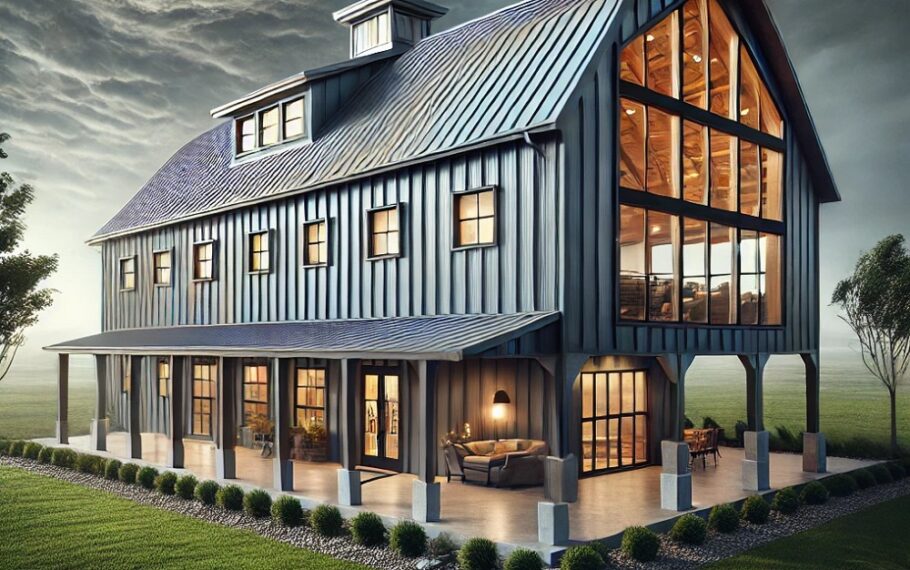
The barndominium has come a long way from its humble agricultural origins. What once served as a simple metal building for housing livestock and hay now stands as a legitimate contender in the world of custom residential architecture. But the latest frontier in barndominium design has nothing to do with interior finishes, loft layouts, or sliding barn doors. The real action is happening overhead—specifically, with roof structures that move.
Kinetic roof systems represent a paradigm shift for transformable living spaces. These aren’t your grandfather’s fixed trusses or standard-issue metal roofing panels. Think retracting glass sections that vanish at the push of a button, articulated steel panels that reconfigure themselves based on weather conditions, or entire roof quadrants that pivot open to expose the sky. For the barndominium owner who wants something genuinely extraordinary, kinetic roof engineering offers possibilities that conventional residential construction simply cannot touch.
The Core Engineering Challenge
Any roof that moves introduces complexity that static structures never have to address. The fundamental challenge lies in maintaining structural integrity while allowing for controlled motion. A traditional barndominium roof transfers loads predictably down through walls to the foundation. Change that roof into something with sliding panels or hinged sections, and suddenly the load paths become conditional rather than constant.
Engineers designing these systems must account for dead loads (the weight of the moving roof components themselves), live loads (snow, rain, maintenance workers), and environmental loads (wind uplift, seismic forces) all while ensuring that the kinetic mechanisms operate smoothly across thousands of cycles. A static roof can rely on continuous welds and fixed connections. A kinetic roof requires bearings, tracks, seals, and actuators—each one a potential point of failure if not spec’d correctly.
Wind uplift deserves particular attention. A retractable roof section that seals tight against its neighbors when closed must also resist the suction forces that high winds generate. Poorly designed systems have been known to lift or rack under wind loads, compromising the entire building envelope. The engineering solution typically involves multiple redundant locking mechanisms, often electromagnetic or hydraulic, that engage automatically when the roof reaches its closed position.
Types of Kinetic Roof Structures
Not all moving roofs work the same way. The choice of mechanism dramatically affects both the engineering approach and the final user experience.
Retractable panel systems rank as the most common kinetic roof design for barndominiums. These operate much like a drawer on a massive scale—roof sections mounted on linear bearings slide horizontally to stack at one end of the structure. The engineering focus here centers on track alignment, drive systems (rack and pinion versus cable drives versus linear actuators), and weatherproofing the gap between moving and fixed sections. A well-designed retractable system can open seventy percent or more of the roof area, turning an interior space into an exterior courtyard in seconds.
Articulating or hinged systems take a different approach. Instead of sliding, roof panels rotate upward from a pivot point, like a gull-wing door on a sports car but scaled up by a factor of fifty. These designs require careful counterbalancing—heavy roof panels need either massive actuators or sophisticated spring/counterweight systems to move safely. The advantage comes from simpler sealing details at the pivot line and the ability to open larger individual sections without the long run of track that sliding systems demand.
Folding or bi-fold configurations split the difference. Each roof section folds at its centerline, stacking in a more compact arrangement than either pure sliding or pure hinging designs. These work particularly well for barndominiums with limited roof edge space for stacking panels. The engineering tradeoff involves more complex hinge details and the need for coordinated motion between panel halves.
Louvered kinetic roofs offer a distinct alternative. Rather than moving entire roof sections, individual blades rotate in unison to open or close the roof plane. This approach provides granular control over ventilation and light—from fully closed and sealed to fully open, with every stop in between. The engineering challenge lies in the drive linkage that synchronizes blade motion and the weather seals that compress and release across thousands of cycles.
Structural Frame Considerations
A kinetic roof cannot simply bolt onto a standard barndominium frame and call it good. The supporting structure must accommodate the moving parts without twisting, racking, or deflecting under load.
Steel remains the material of choice for these applications. The structural frame—typically I-beams or heavy C-channels—needs stiffness that wood framing simply cannot provide. Any flex in the supporting structure translates directly into binding tracks, misaligned seals, and eventual mechanism failure. Engineers typically specify deflection limits of L/600 or stricter for kinetic roof support structures, compared to the L/240 standard for static residential roofs.
Portal frames with rigid corners work well for barndominiums with kinetic roofs. The continuous moment connections resist racking forces better than pinned connections, keeping the roof plane true even under asymmetrical loading. For larger installations, space frames or truss grids distribute loads across multiple support points, reducing the chances of localized deflection that could throw off track alignment.
The interface between moving and fixed structure deserves obsessive attention. Tracks must mount to precisely leveled steel, often with adjustment plates built in for fine-tuning after installation. Any welding that occurs after track placement introduces heat distortion that can throw alignment off by millimeters—enough to cause binding in a long sliding panel system.
Actuation and Control Systems
Someone has to move all this steel and glass. The choice of actuation method affects cost, reliability, operational speed, and maintenance requirements.
Hydraulic systems deliver tremendous force in a compact package. A pair of hydraulic cylinders can lift an entire roof section weighing several tons without breaking a sweat. The downsides include potential fluid leaks, the need for a power unit and reservoir, and slower operation compared to electric alternatives. Cold weather performance also requires attention—hydraulic fluid thickens as temperatures drop, slowing motion and potentially starving pumps.
Electric linear actuators offer cleaner, simpler installation. No fluid lines, no pumps, just motor-driven screws or belts. These systems work well for smaller kinetic roofs but struggle with the heaviest panel configurations. Multiple actuators can share the load, but synchronization becomes critical—if one actuator advances faster than its partner, the roof panel twists and binds in its track.
Rack and pinion drives combined with electric motors provide robust performance for sliding systems. The motor drives a pinion gear that engages a toothed rack along the moving panel’s length. This approach naturally synchronizes motion since the mechanical connection prevents independent movement. The tradeoff involves more visible hardware and the need for periodic lubrication.
Control systems range from simple switched operation to fully automated weather-responsive setups. At the basic level, the homeowner holds a button until the roof reaches the desired position. More sophisticated systems incorporate position sensors, obstacle detection, and automatic weather closure. Anemometers that trigger roof closure when wind speeds exceed a set threshold protect the structure from unexpected storms. Rain sensors can do the same, though many kinetic roof systems let precipitation through to interior drains—a design decision that dramatically changes the engineering of the space below.
Weather Sealing and Thermal Performance
A roof that moves presents endless opportunities for water infiltration. Every joint between moving sections, every track penetration, every hinge pivot creates a potential leak path that static construction never faces.
Compression seals offer the most reliable solution for kinetic roofs. When panels close, they compress bulb-type gaskets made of EPDM or silicone. The compression creates a weathertight barrier that can handle wind-driven rain and pressure differentials. The engineering challenge involves providing enough compression force to seal effectively without requiring excessive actuator power. Over-compression damages seals; under-compression leaves gaps.
Brush seals serve as secondary or transitional barriers, particularly along tracks. The dense nylon bristles block most water droplets while allowing smooth motion. No brush seal provides complete waterproofing on its own, but in combination with compression seals and proper drainage channels, the system can achieve performance comparable to fixed roofing.
Thermal breaks become critical in metal kinetic roof systems. Without them, the massive steel or aluminum panels conduct heat directly between interior and exterior. Winter condensation forms on cold interior surfaces. Summer heat radiates down from hot panels. Thermal break materials—typically reinforced polymers or insulated vinyl extrusions—interrupt this conductive path. The breaks go between the inner and outer faces of each roof panel, as well as at every connection between moving components.
Drainage planning often surprises first-time kinetic roof owners. Even the best seals leak eventually, whether from debris caught in a compression seal or simple seal aging. Responsible engineering incorporates drainage gutters beneath every seam, sloped to collect and redirect any infiltration before it reaches the interior space. These hidden drainage layers add complexity but provide the margin of safety that transforms a kinetic roof from a liability into a reliable building component.
Barndominium-Specific Applications
Why go to all this trouble for a barndominium? The answer lies in the unique way these structures blend residential living with workshop, studio, or gathering spaces.
The great room remains the most popular location for kinetic roof sections. A barndominium’s main living area often spans the full width of the building without interior load-bearing walls. This open floor plan provides the unobstructed space that sliding or folding roof panels need. With a retractable roof overhead, that same great room becomes an indoor-outdoor entertaining space for warm evenings, an open-air sleeping area for stargazing, or a naturally ventilated workshop for projects that generate fumes or dust.
Greenhouse and garden wings benefit enormously from articulated roof sections. Louvered kinetic roofs allow precise control over sunlight and air exchange, creating an environment where tropical plants can thrive year-round in climates that would otherwise kill them. Full retraction options let heat-sensitive plants get direct rain and unfiltered sun when conditions allow.
Covered outdoor living areas gain versatility from kinetic roofs that close against weather. A patio or deck space with an articulated roof overhead transforms from an unusable wet zone into a dry living area when rain moves in. The same principle applies to parking areas for vehicles, boats, or RVs—equipment stays protected without the permanent enclosure of a full garage.
Art studios, photography spaces, and any environment where natural light quality matters represent another use case. Musicians and recording engineers prize the acoustic flexibility of spaces that can transition from closed, controlled rooms to open-air environments. The ability to modulate between these extremes within a single structure eliminates the need for multiple specialized spaces.
Cost and Practical Realities
Kinetic roofs do not come cheap. A barndominium that might cost 150to250 per square foot with conventional construction jumps significantly when moving roof sections enter the picture. Track systems, actuators, controls, specialized seals, and the heavier structural framing required for support can add
50,000to200,000 or more depending on the scale and complexity.
Maintenance requirements exceed those of static roofing. Seals need inspection and replacement every five to ten years. Tracks require cleaning to prevent debris buildup. Actuators need periodic lubrication and eventual replacement. Control systems may need software updates and sensor recalibration. None of this should discourage a committed owner, but it must factor into the decision.
Permitting adds another layer of complexity. Building departments understand static construction. Kinetic roofs fall into a gray area between residential and commercial building codes. A good engineering package and a contractor with relevant experience smooth this process considerably. Expect plan review to take longer and potentially require structural peer review.
The Future of Transformable Roof Spaces
Materials science continues to push possibilities. Shape memory alloys that change geometry with temperature inputs could someday replace complex actuator systems. Photovoltaic-integrated kinetic panels that generate power whether open or closed offer efficiency gains. Lightweight composite panels reduce the structural demands and actuator power requirements, making kinetic roofs feasible for smaller barndominiums on tighter budgets.
The principles remain unchanged regardless of materials. A kinetic roof must move reliably, seal effectively, and integrate gracefully with the rest of the building envelope. When these conditions come together, the result transforms a simple barndominium into something genuinely remarkable—a space that responds to weather, mood, and need with the push of a button. The roof becomes not just shelter but a tool, equally capable of providing protection and removing it at will. That flexibility represents the true promise of kinetic architecture, and barndominiums offer the perfect canvas for bringing that promise to life.