
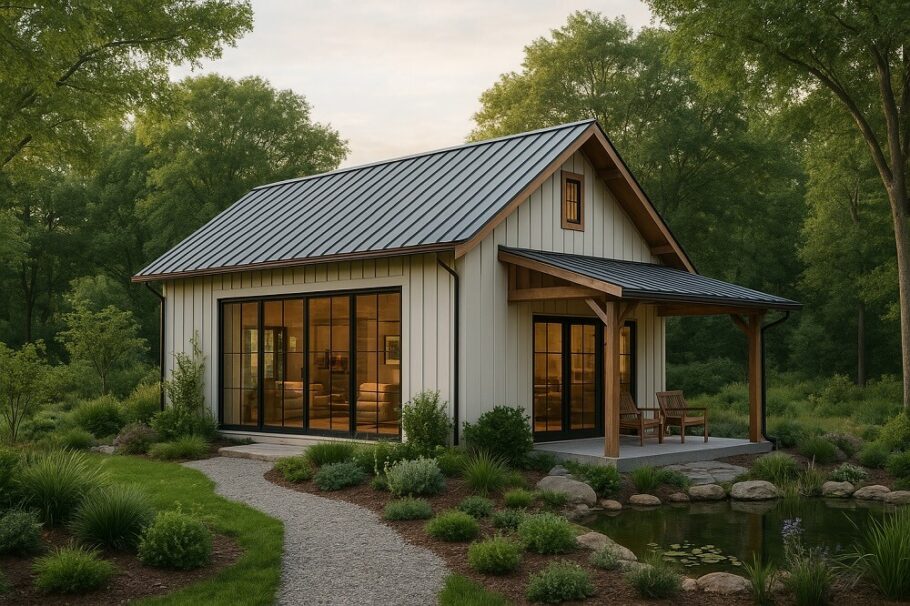
Walk into any well-built barndominium, and one of the first things that catches the eye might be the ceiling—if it’s done right. More builders and owners are moving away from conventional trusses with drywall or plywood sheathing, and turning toward a solution that pulls double duty in a way that just makes sense. Composite metal decking, used as a structural roof deck that also serves as the finished ceiling, is changing how people think about barndominium roofs. No need for temporary formwork. No need for a separate ceiling installation. Just one smart system that does the heavy lifting and looks good doing it.
What Exactly Is Composite Metal Decking?
For anyone who has spent time around commercial construction, metal decking is old news. Warehouses, parking garages, and high-rises have relied on it for decades. But the residential and barndominium world has been slower to catch on. Composite metal decking starts as a corrugated steel panel—usually galvanized or galvannealed—with a distinct wavy profile. The ribs run in one direction, and the flat parts in between create a surface that bonds mechanically and chemically with poured concrete.
The magic happens thanks to embossments or indentations pressed into the steel during manufacturing. These tiny patterns act like teeth, gripping the cured concrete so the two materials behave as one structural unit. That composite action is what makes the system so much stronger than either material alone. Steel handles tension, concrete handles compression, and together they span farther and carry heavier loads than most people expect from a roof system.
For barndominium use, the typical deck thickness ranges from 22 gauge up to 18 gauge, depending on the span and expected loads. Shallower profiles around 1.5 to 2 inches deep work well for most residential-scale roofs, though deeper profiles become necessary when spans stretch past twelve or fourteen feet.
No Formwork, No Mess, No Waste
Traditional concrete roof construction requires building forms underneath—plywood, shoring posts, beams, all that temporary framework that holds wet concrete in place until it cures. Then crews strip it all down, haul away lumber, patch holes, and start from scratch to install a ceiling. That process burns labor hours, creates material waste, and leaves plenty of room for error.
Composite metal decking eliminates the formwork entirely. Each steel panel screws or welds directly to the barndominium’s structural frame—steel purlins or wood trusses, depending on the build. Once those panels are down, they act as a permanent forms. Crews pour concrete right on top of the steel. No plywood underneath to get soaked and sag. No stripping forms a month later. The deck stays in place forever, becoming both the bottom of the concrete slab and the ceiling of the living space below.
That simplicity translates directly to faster construction schedules. A roof that might take three weeks with traditional methods can close in one week with composite decking. For barndominium owners acting as their own general contractors, that time savings matters immensely when juggling subcontractors and weather windows.
The Exposed Ceiling Aesthetic
Here is where personal taste enters the picture, and it tends to divide opinions—though in a good way. An exposed composite metal deck ceiling looks industrial, intentional, and honestly pretty tough. The corrugated steel becomes a design feature rather than something to hide behind drywall. Many barndominium owners lean hard into that look, pairing the metal ceiling with exposed beams, concrete floors, and steel-framed windows.
Paint transforms the deck dramatically. A coat of flat black or charcoal makes the ribs recede visually, creating a moody, modern loft vibe. White or light gray brightens the space and makes the ceiling feel taller. Some adventurous owners go with bold colors—deep blue, forest green, or even rusted orange for that aged industrial aesthetic. The steel accepts paint readily as long as the surface gets cleaned and primed properly.
For those who worry about acoustics, yes, a metal ceiling can get echoey. But that issue has easy fixes. Spray foam insulation applied to the top side of the deck before the concrete pour deadens sound transmission significantly. Adding batt insulation between purlins above the deck works too. And once the concrete goes on, the mass of the slab itself blocks exterior noise like rain, hail, and wind better than any shingle-and-plywood assembly ever could.
Designing the Deck for Real-World Loads
A barndominium roof does more than keep rain off the furniture. It might need to support snow loads that vary wildly by region, roof-mounted solar panels, HVAC equipment, or even a rooftop deck if the owner wants outdoor access. And because barndominiums often sit in rural areas with high wind exposure, uplift resistance cannot be an afterthought.
Proper design starts with accurate load calculations. Most residential barndominiums need decks rated for at least 40 pounds per square foot of live load, though snow country might require 70 or even 100 psf. Dead load includes the weight of the steel deck itself plus the concrete topping—typically 2.5 to 3 inches thick over the ribs. That concrete adds roughly 30 to 38 psf, so the total dead load often lands between 40 and 50 psf before any finishes or mechanicals.
Span tables provided by deck manufacturers tell the story clearly. An 18-gauge deck with a 2-inch profile might span 10 feet when supporting 40 psf of superimposed load, while a heavier 16-gauge deck pushes that span to 14 feet. Purlins or trusses get spaced accordingly. Trying to stretch a deck beyond its recommended span leads to noticeable deflection under foot traffic during construction and, worse, cracking in the finished concrete.
The concrete mix itself matters too. Structural lightweight concrete reduces dead load substantially compared to normal-weight mix, often saving ten pounds per square foot or more. For large barndominiums, that difference adds up to tons of structural savings. Fiber-reinforced concrete helps control shrinkage cracking without needing rebar or mesh, though many engineers still specify welded wire reinforcement for extra security.
Managing Condensation and Insulation
Here is the question that comes up in every barndominium forum: won’t that metal ceiling sweat? The answer depends entirely on the insulation strategy. A bare metal deck with concrete on top and no thermal break will absolutely condense moisture on the interior surface under the right conditions. Warm, humid interior air meets cold steel, and water droplets form. Then they drip. Not a good look.
The solution lies in keeping the steel warm. Spray polyurethane foam applied directly to the top of the deck before pouring concrete provides both insulation and a vapor barrier. The foam bonds to the steel, eliminates thermal bridging, and keeps the interior side of the deck at room temperature. Closed-cell foam works best because it resists moisture migration and adds structural rigidity. With two inches of closed-cell foam under the concrete, the steel deck stays warm, dry, and condensation-free.
An alternative approach uses rigid foam boards laid over the deck before the pour, though getting a flat, continuous surface with ribs underneath takes careful shimming. Some builders pour a thin lightweight insulating concrete as a base layer, then top with structural concrete. That works but adds complexity.
For the ceiling side, the exposed metal can still feel cold to the touch even without condensation—simple physics of radiative heat loss. Covering the interior face of the deck with a thin layer of acoustic insulation or even adhesive-backed foam sheeting eliminates that cold feeling without hiding the corrugated profile. A few manufacturers make pre-laminated deck panels with foam bonded to the underside specifically for exposed ceiling applications.
Attachment to the Barndominium Frame
Steel-framed barndominiums have the easiest time with composite decking. Welding or screwing the panels to steel purlins creates a rigid, reliable connection that handles uplift loads beautifully. Each panel gets fastened along every support, with edge fasteners spaced closer together than field fasteners. The concrete pour locks everything in place permanently.
But what about wood-framed barndominiums? They exist, and composite decking works there too. The key is using heavy-duty structural screws or nails specifically rated for diaphragm shear transfer. Wood purlins need to be thick enough—at least 2×6, often doubled at panel edges—to prevent splitting under fastener loads. Some manufacturers produce deck panels with pre-punched fastener patterns designed for wood framing. The concrete still bonds to the steel just fine, but the connection to the wood frame becomes the critical path for load transfer. Engineering guidance helps immensely here.
Cost Comparison Against Traditional Roofing
No one builds a barndominium to throw money away. So what does composite metal decking actually cost compared to a conventional roof-and-ceiling assembly? Up front, the steel deck plus concrete plus fasteners plus insulation typically lands higher than simple corrugated metal roofing over purlins with no ceiling. But that comparison misses the point. The relevant comparison is against a complete assembly: structural roof sheathing, roofing material (standing seam metal or shingles), insulation, vapor barrier, and a finished interior ceiling (drywall or wood planks).
When stacked against that full system, composite decking often comes out surprisingly close or even cheaper. The steel deck replaces both the roof sheathing and the ceiling structure. The concrete replaces the roofing material and provides inherent fire resistance that drywall cannot match. Labor gets halved because one crew does what used to take two or three separate trades.
Add in the long-term benefits: a concrete-topped steel deck does not rot, does not warp, does not attract termites, and does not need replacement for decades. The occasional repaint of the exposed ceiling keeps it looking fresh, but the structural components require virtually no maintenance.
Fire Resistance and Insurance Considerations
Hidden value exists in the fire performance of a concrete-filled composite deck. Most residential roofs burn readily because wood trusses and plywood sheathing provide abundant fuel. A barndominium roof with two inches of concrete over steel deck earns high marks from fire safety professionals. The concrete protects the steel from temperature spikes, and the steel, being non-combustible, does not contribute to flame spread.
Insurance companies notice these things. A barndominium with a composite deck roof often qualifies for lower premiums compared to wood-framed roofs, especially in wildfire-prone regions. Some carriers even offer discounts specifically for non-combustible roof assemblies. The savings add up over the life of the mortgage.
Getting the Pour Right
Concrete placement on a metal roof deck requires some technique. Pumping the concrete up to the roof is standard practice, but the crew needs to work methodically. Starting at the low end of the roof slope and moving uphill prevents the mix from running away faster than workers can screed it. Vibrating the concrete helps it flow into the deck ribs and eliminates air pockets that would weaken bond.
Curing matters enormously. A roof deck bakes in the sun, so moisture evaporates quickly. Spray-on curing compounds, wet burlap, or plastic sheeting all work, but something must slow that moisture loss. Concrete that dries too fast cracks, curls at the edges, and fails to develop full bond strength to the steel. Three to seven days of proper curing makes the difference between a roof that performs for fifty years and one that starts spalling within two.
The Bottom Line for Barndominium Builders
Composite metal decking is not the right choice for every barndominium. Builds in extremely hot, humid climates need careful attention to condensation control. Budgets that cannot absorb the upfront material cost might struggle. But for anyone wanting a roof that laughs at high winds, shrugs off hail, and presents a finished ceiling without hanging a single sheet of drywall, this system delivers.
The best approach involves talking to manufacturers early. Companies like ASC Steel Deck, Canam, and Metal Deck Direct all publish load tables, fastening schedules, and detail drawings specifically for barndominium applications. A good manufacturer rep will help optimize the deck gauge, profile depth, and concrete thickness for local conditions. Pair that with an engineer who understands composite construction, and the result is a roof that performs like a commercial building while looking like a thoughtfully designed home.
Barndominiums get their name from blending barn utility with condominium comfort. Composite metal decking fits that ethos perfectly—utilitarian where it counts, finished where it shows, and smart from every angle.