
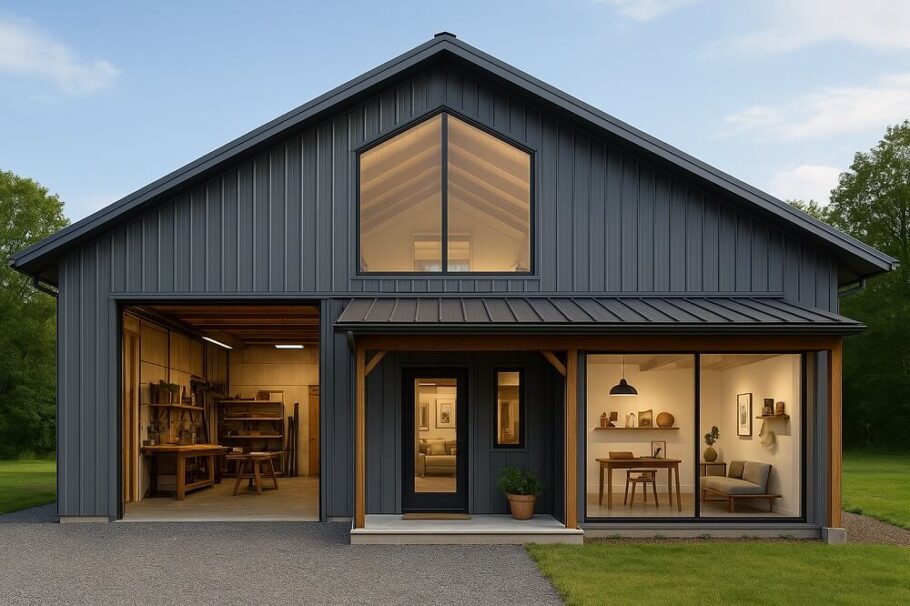
The barndominium boom has changed how people think about post-frame construction. What started as a practical solution for agricultural buildings with living quarters has evolved into a full-blown residential movement. But here is where most plans go sideways before a single nail gets driven: electrical design. Not the high-voltage stuff that keeps the refrigerator cold and the AC humming. No, the real missed opportunity lives in the low-voltage side of things—lighting controls, automated shades, occupancy sensors, and the growing web of smart systems that make a modern barndominium actually feel modern.
Running low-voltage wiring alongside standard 120V circuits inside the same structural bays creates problems. Interference creeps in. Signal degradation becomes a guessing game. And future upgrades turn into drywall surgery. The solution sits right in front of every barndominium builder: designing a completely separate, dedicated pathway for low-voltage systems within the steel or timber frame itself.
Why Standard Practice Fails the Barndominium
Most homes run low-voltage wiring however it fits. Electricians pull Cat6 through the same stud holes as Romex. Security camera cables get zip-tied to lighting circuits. Smart thermostat wire shares notches with outlet feeds. In conventional stick framing, this happens because space is tight and nobody wants to drill more holes than necessary. But barndominium construction offers something stick framing cannot: wide-open structural bays, deep columns, and the ability to create dedicated chases without fighting for every cubic inch.
The problem with mixing voltages in the same pathways comes down to electromagnetic interference. Any 120V or 240V AC line creates a magnetic field around itself. Low-voltage DC signals—whether for DALI lighting control, RS-485 shades, or standard 0-10V dimming—are remarkably sensitive to that field. Run a control wire parallel to a feeder line for three feet, and the dimmer starts flickering. Run it for fifteen feet, and the smart home hub stops seeing half the lighting nodes. This is physics, not poor equipment.
The Steel Frame as a Low-Voltage Asset
Barndominiums use red-iron steel or heavy timber posts spaced eight to twelve feet apart. Between these columns runs a matrix of girts and purlins. That grid creates natural vertical and horizontal raceways completely separate from the pathways electricians typically use for high-voltage work.
The smart approach treats the structural frame as two parallel electrical systems. High-voltage runs through one set of drilled holes or clipped along one side of each column. Low-voltage gets the opposite side or a completely different bay. In a typical post-frame building with six-inch square columns, there is enough real estate on the column face to attach two separate conduit runs or cable trays without them ever touching.
But conduit is not always necessary for low-voltage inside a barndominium frame. Plenum-rated low-voltage cable can run exposed along structural members where local codes allow. The key is physical separation. Maintaining two to three inches of air gap or any non-metallic barrier between high and low-voltage lines eliminates the vast majority of interference problems. Steel columns themselves actually help here—the metal acts as a partial shield when low-voltage runs on the opposite flange from the high-voltage lines.
Designing the Dedicated Pathway Before Concrete Gets Poured
The best time to plan this separate pathway is before the slab goes down. Low-voltage lighting systems often require home runs back to a central controller or power supply. Those cables need to come up through the floor or down from the ceiling. Running PVC conduit sleeves embedded in the concrete creates designated low-voltage chases from the slab edge to each column base.
Think about where lighting control keypads belong. In a barndominium with open floor plans, the great room might have four or five entry points. Each of those locations needs a low-voltage pathway back to the lighting panel. The same goes for motion sensors in hallways, photocells near windows, and temperature sensors in each zone. Running individual conduits from each device location to a central low-voltage enclosure gives total flexibility for future system changes.
For the ceiling plane, the barndominium roof trusses or rafters create natural horizontal raceways. Purlins running perpendicular to the trusses form a grid that can support cable trays, J-hooks, or simple bundle clips. The trick is assigning one bay per voltage type. Truss bay one holds all high-voltage lighting feeds. Truss bay two, three feet away, holds all low-voltage control wiring. That distance eliminates interference without expensive shielded cable.
Low-Voltage Lighting Demands a Different Mindset
Standard residential lighting uses line-voltage switching. A 120V wire runs to a switch, then to the light. Simple, but dumb. Low-voltage lighting separates the power path from the control path. The high-voltage side goes directly to a driver or power supply. The low-voltage side carries only control signals—usually 0-10V, DALI, DMX, or proprietary wireless protocols.
This separation actually makes the barndominium frame the perfect host. High-voltage feeds to each lighting zone can run in one conduit along the column line. Low-voltage control wires for those same zones run in a separate conduit two feet over. They meet only at the fixture location, and even there, keeping the two cables entering opposite sides of the junction box preserves the separation.
Magnetic low-voltage transformers for under-cabinet lighting or cove lights need careful placement. These devices generate heat and some magnetic field. Mounting them directly to steel columns solves the heat dissipation problem, but keeping the input and output wiring on different sides of the column prevents the secondary low-voltage loops from picking up noise from the primary high-voltage leads.
Smart Systems Beyond Lighting
Modern barndominiums pack in more than smart bulbs. Motorized blinds, automated windows, ceiling fans with proprietary controls, irrigation valves, and security sensors all rely on low-voltage pathways. Each system has its own wiring requirements, but most share a common need: clean, interference-free runs back to a network closet or automation hub.
The structural frame strategy extends to every low-voltage application. Consider motorized shades on a row of twelve-foot barndominium windows. Each shade needs power—usually 24V DC—plus control wiring for group automation. Running a single 14-gauge low-voltage power loop along the purlin line above the windows, with separate Cat6 for control, keeps the entire system clean. No high-voltage lines anywhere near the shades means no flickering, no missed commands, and no mysterious resets.
Security cameras mounted on the exterior columns present another opportunity. Low-voltage PoE (Power over Ethernet) delivers both data and power through a single Cat6 cable. Running these cables through the column’s interior flange channel protects them from weather and physical damage while keeping them completely separate from any high-voltage lines inside the building envelope.
The Centralized Low-Voltage Panel
Every barndominium needs a dedicated low-voltage enclosure. Not a subpanel—those are for high-voltage breakers. A low-voltage panel is a metal or plastic cabinet where all the control wiring terminates. Lighting controllers, network switches, automation hubs, and power supplies live here. This panel should sit near the main electrical panel for convenience but not share the same stud bay or conduit path.
From this central point, low-voltage home runs radiate out through the structural pathways to every endpoint. Lighting control keypads each get their own pair back to the panel. Motorized shade zones send their Cat6 here. Temperature and humidity sensors terminate on input modules. The beauty of the barndominium frame is that every column can serve as a vertical riser, and every purlin row can serve as a horizontal distributor. The building becomes the raceway.
Practical Implementation Without Overcomplicating
None of this requires exotic materials or special tools. Standard PVC conduit for low-voltage runs costs pennies per foot. Smurf tube (ENT) works perfectly for future-proofing—pull empty tubes from the low-voltage panel to each column, and any future system simply gets fished through. For open runs, cable trays mounted to purlins give unlimited capacity and easy access for changes.
Labeling matters more in low-voltage than high-voltage. Every home run should have a printed flag at both ends identifying its destination and purpose. The central panel should have a detailed map showing which conduit or cable tray serves which zone. Without this organization, the separate pathway becomes a mess of unidentifiable wires within two years.
Code compliance remains critical. Low-voltage wiring must still meet NEC Class 2 and Class 3 requirements. Separation distances from high-voltage are specified in Article 800. Local amendments may require conduit even where code would permit open cabling. A quick conversation with the building department before running any wire saves headaches later.
Future Proofing the Frame
The barndominium being built today will see three or four generations of smart home technology over its lifespan. Low-voltage pathways designed now determine how painful those upgrades become. Running empty conduits from the central panel to every major structural bay costs almost nothing during construction. Retrofitting them afterward costs everything.
Leave pull strings in every conduit. Use larger conduit than the current cables require—one-inch minimum for any low-voltage home run, even if only two 22-gauge wires go in today. Install junction boxes at every column intersection so new cables can turn corners without fighting existing bundles. Document everything with photographs before drywall or metal liner panels go up.
The separate low-voltage pathway transforms a barndominium from a building with lights into a building that thinks. Lighting responds without lag. Shades move in perfect sync. Sensors report accurately. And when the next smart system arrives, the pathway waits ready, completely isolated from the noise and clutter of the high-voltage world. That is the difference between a barndominium that works today and one that works for decades.