
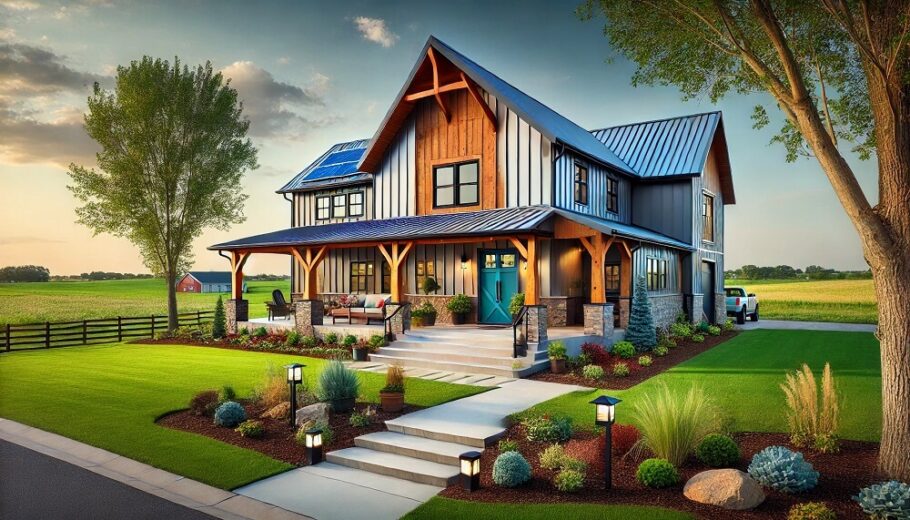
The barndominium has shed its agricultural roots and emerged as a serious contender in modern residential design. What began as a practical way to convert pole barns into living spaces has evolved into a full-fledged architectural movement, prized for wide-open floor plans, cost-effective construction, and that unmistakable blend of industrial grit and country charm. But as barndominiums spread beyond flat farmland into the hills of California, the seismic zones of the Pacific Northwest, and even earthquake-prone regions of Alaska and the South, a critical question has surfaced: how does a traditional steel barndo hold up when the ground starts shaking?
Standard barndominium construction relies on red-iron steel frames or cold-formed steel studs. Steel is strong, no doubt. But it also has a reputation for cold, echoey interiors—a far cry from the cozy, warm atmosphere that makes a house feel like home. Enter the hybrid solution, one that takes the best of both worlds: a steel primary frame for brute-force seismic performance, paired with mass timber interiors for warmth, acoustic comfort, and surprising structural benefits. This combination isn’t just a compromise. It’s a genuine upgrade.
Why Conventional Barndominiums Fall Short in Seismic Zones
Before diving into the hybrid approach, it helps to understand what a typical barndominium does well—and where it struggles. Most barndominiums use a rigid steel moment frame or braced frame design. These structures handle vertical gravity loads (the weight of the roof, snow, finishes) just fine. They also manage moderate wind loads. But seismic events introduce horizontal forces—side-to-side shaking that puts diagonal stress on every connection.
A pure steel frame has ductility, meaning it can bend and flex without fracturing. That’s good. However, conventional barndominium detailing often prioritizes cost savings over seismic optimization. Light-gauge steel studs may buckle under racking forces. Heavy red-iron frames require careful moment-resisting connections, which many prefab kits skimp on. And the typical barndo’s large, unsupported openings for garage doors and windows create soft stories—a notorious failure point in earthquakes.
Even when a steel barndo survives the shaking structurally, secondary damage tells another story. Brittle drywall cracks, shattered tile, and collapsed masonry veneers are common. And because plain steel transmits heat and cold so efficiently (not in a good way), these buildings already struggle with temperature stability. Adding seismic reinforcements without addressing thermal performance leaves homeowners with a durable but uncomfortable bunker.
Mass Timber: More Than Just a Pretty Face
Mass timber refers to engineered wood products like cross-laminated timber (CLT), glued laminated timber (glulam), and dowel-laminated timber (DLT). These aren’t your grandfather’s two-by-fours. A CLT panel consists of multiple layers of lumber stacked crosswise and bonded with structural adhesive. The result is a slab of wood that rivals steel in strength-to-weight ratio while behaving completely differently under seismic loads.
Here’s where it gets interesting: mass timber has inherent damping capacity. Wood fibers absorb vibrational energy. When an earthquake hits, a mass timber structure doesn’t just resist motion—it dissipates it, reducing the peak forces transmitted through the building. Steel is springy; it rebounds. But mass timber acts almost like a shock absorber. That’s a seismic advantage most people overlook.
Of course, mass timber alone has limitations. Tall mass timber buildings require substantial connection detailing, and wood can creep under sustained heavy loads. But combine mass timber with a steel frame, and each material cancels out the other’s weaknesses.
Designing the Steel-Mass Timber Hybrid for Earthquakes
The most effective hybrid barndominium starts with a steel primary structure—columns and beams sized to handle both gravity and lateral loads. But instead of cladding that steel frame with conventional drywall and insulation, the design integrates mass timber panels as diaphragms, shear walls, and even floor decks.
Think of it this way: the steel frame provides the building’s skeleton, while mass timber panels become the structural skin and internal bracing. In a seismic event, forces travel from the roof down through the mass timber shear walls into the steel moment frame, then into the foundation. The timber panels stiffen the steel frame against racking while adding damping. Meanwhile, the steel frame provides redundancy—if a timber panel cracks (unlikely with modern CLT, but possible in extreme overloads), the steel skeleton still holds.
Connection detailing makes or breaks this system. Steel-to-timber connections require slotted holes, oversized washers, and ductile dowel-type fasteners that allow some movement without brittle failure. This isn’t the kind of engineering a prefab barndo kit from a discount supplier can provide. But for a custom hybrid build, the seismic performance far exceeds either material alone.
Recent shake-table testing at UC San Diego and the NHERI TallWood project has demonstrated that mass timber-steel hybrids survive design-level earthquakes with minimal damage. In some tests, these buildings remained habitable after shaking that would have condemned a standard steel or concrete structure. For barndominium owners in zones like Seattle, Salt Lake City, or Memphis, that means less repair cost and no need to vacate post-quake.
Warmth Without the Wood Stove
Now for the side of the equation that drew most people to barndominiums in the first place: the feel of the space. Steel buildings have a reputation for being cold, drafty, and acoustically harsh. Walk into a bare steel workshop on a winter morning, and the echo of footsteps on concrete mixes with the chill radiating from every metal surface. That’s the opposite of a cozy home.
Mass timber transforms that experience instantly. CLT and glulam surfaces have natural thermal mass—they absorb heat during the day and release it slowly at night, smoothing out temperature swings. Wood also feels warm to the touch compared to steel or drywall. The human hand registers a ten-degree difference between a steel column and a timber beam at the same ambient temperature. That’s not just psychology; it’s thermal conductivity in action.
But the real warmth goes beyond physics. Exposed mass timber ceilings, beams, and wall panels bring organic texture, grain patterns, and a visual softness that no paint or faux finish can replicate. A barndominium with a steel frame and timber interior feels like a mountain lodge crossed with an industrial loft—raw enough to honor the building’s agricultural heritage, but inviting enough to curl up with a book on a rainy afternoon.
Acoustic performance deserves mention too. Steel buildings ring like a bell. Sound bounces off metal decking and bare studs. Mass timber absorbs sound rather than reflecting it. A CLT ceiling reduces echo from a metal roof during hailstorms. Solid timber floors above a steel mezzanine don’t transmit footsteps the way a thin steel deck would. The result is a quieter, more peaceful home.
Practical Construction Approaches
Building a hybrid steel-mass timber barndominium requires a different construction sequence than a standard barndo. A typical approach starts with a reinforced concrete foundation with embedded steel anchor bolts and embed plates for timber connections. Next, the steel primary frame goes up—columns, main beams, and lateral bracing. Unlike a traditional barndo that might use Z-purlins and girts for cladding, the hybrid design leaves room for timber infill.
Mass timber panels arrive prefabricated from a CNC mill, cut with precision openings for doors, windows, and utilities. These panels bolt directly to the steel frame using custom connections. For walls, CLT panels act as shear panels. For floors and roofs, thicker CLT spans between steel beams, eliminating the need for separate decking and underlayment. Insulation installs either as a continuous layer outside the timber (a “rain screen” assembly) or within a cavity between timber and an interior finish layer, though many owners choose to leave the timber exposed.
The envelope matters for thermal performance. A well-designed hybrid barndominium places continuous insulation on the exterior side of the steel frame to eliminate thermal bridging. Steel conducts heat rapidly; without a continuous thermal break, each steel stud becomes a pathway for heat or cold to travel from outside to inside. Wrapping the steel frame in rigid foam or mineral wool before attaching the mass timber panels solves that problem. Some builders use insulated metal panels (IMPs) for the exterior skin, leaving the timber entirely on the conditioned side of the insulation.
Cost Considerations That Make Sense
Honesty about budget matters. A steel-mass timber hybrid barndominium costs more upfront than a standard red-iron kit with fiberglass batts and drywall. Mass timber carries a premium—CLT panels can run
15to
15to30 per square foot just for the material, depending on thickness and species. Steel is relatively affordable, but the connections and engineering for a hybrid seismic design add expense.
However, that upfront cost buys genuine value. In seismic zones, a hybrid building may qualify for lower insurance premiums due to reduced expected damage. The thermal performance of mass timber plus continuous insulation cuts heating and cooling bills year-round. And the durability means less maintenance—no drywall cracks to patch, no peeling veneer, no corroded steel framing hidden inside walls.
There’s also a resale argument. A barndominium with exposed timber has a visceral appeal that plain drywall lacks. Buyers consistently pay more for authentic materials and architectural character. A steel barndo looks like a barndo. A steel-mass timber hybrid looks like a custom home that happens to have a barndominium’s floor plan.
Where This System Shines Most
Not every barndominium needs seismic engineering. In the flat, stable geology of the Midwest or the Gulf coastal plain, a standard steel kit works fine. But in regions with known seismic hazards—the Pacific coast, the Intermountain West, the New Madrid seismic zone, parts of Alaska and Hawaii—the hybrid approach delivers peace of mind that no amount of added drywall or decorative wood can match.
The warmth factor has no geographic boundaries. A barndominium in Montana faces different challenges than one in Texas, but both benefit from mass timber’s thermal and acoustic properties. Cold climates appreciate the thermal mass and reduced drafts. Hot climates benefit from wood’s slower heat transfer, keeping interiors cooler during scorching afternoons.
A Final Look at the Hybrid Path
The beauty of this combination lies in its honesty. No material has to pretend to be something else. Steel does what steel does best—provides slender, high-strength columns and beams that resist extreme loads without excessive bulk. Mass timber does what timber does best—dampens vibrations, regulates temperature, creates a space that feels alive and welcoming. Together, they solve the two biggest criticisms of the barndominium type: seismic vulnerability and a cold, industrial atmosphere.
For the growing number of owners who want the open floor plans and cost-efficient construction of a barndo without compromising safety or comfort, the steel-mass timber hybrid offers a proven path forward. It’s not the cheapest way to build. But cheap isn’t the point. The point is a home that stands firm when the earth moves and feels like a refuge every other day of the year. That’s the barndominium reimagined—not as a converted barn, but as a purpose-built hybrid that finally gives steel and wood equal billing.