
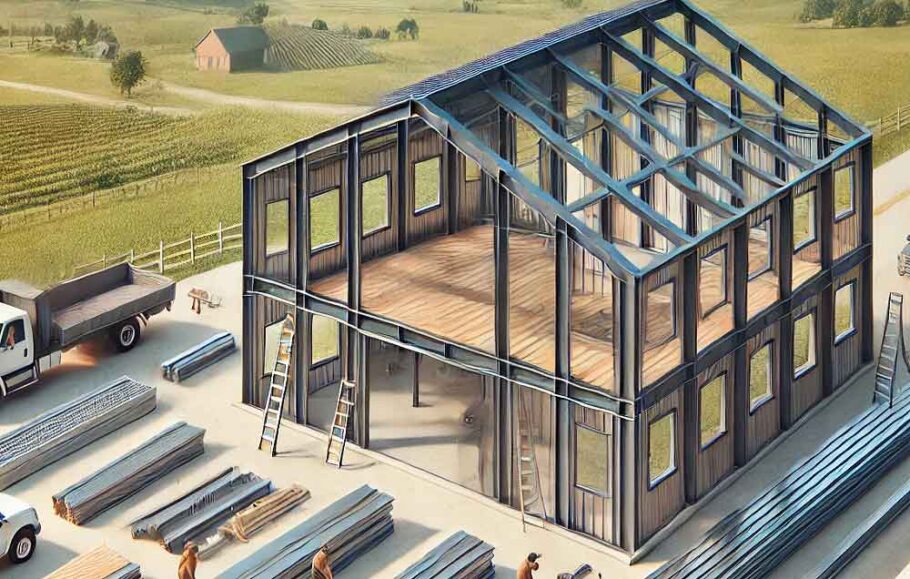
The barndominium boom isn’t slowing down. What started as a niche idea—living inside a modified metal building—has turned into a serious movement across rural America and beyond. People love the open spans, the high ceilings, and the raw industrial charm wrapped in residential comfort. But here’s what the glossy Instagram photos don’t show: the absolute nightmare of trying to route ductwork, plumbing lines, and structural beams through the same limited cavity without them colliding.
This is where Building Information Modeling, or BIM, moves from fancy construction jargon to something that actually saves marriages and bank accounts.
The Hidden Complexity Inside a Simple Box
A barndominium looks straightforward from the outside. Big metal building. Some windows. A garage door or two. But inside, it’s a different story. Unlike traditional stick-frame homes where interior walls hide all the messy stuff, barndominiums often expose their structure. Exposed beams become design features. Vaulted ceilings stay open. And somewhere up there, hidden from casual view, ductwork has to snake from HVAC equipment to living spaces while plumbing vents punch through the roof and electrical conduits find their paths.
The post-frame construction method common to barndominiums creates wide open spaces interrupted only by columns spaced eight or ten feet apart. That sounds liberating until someone realizes those deep steel beams or laminated wood columns can’t be cut, notched, or moved. They belong exactly where they are. Everything else works around them.
Where Clashes Actually Happen
Most people hear “clash detection” and think of skyscrapers or airport terminals. But the same physics applies at a smaller scale. In a barndominium, the typical collision zones include the space between the bottom chord of roof trusses and the top plate of interior walls. Ductwork needs fall there. So do plumbing vents. So do recessed light housings. Without coordination, something loses.
Plumbing stacks present another headache. A three-inch waste pipe dropping from a second-floor bathroom has to travel vertically through the main floor’s framing, then horizontally through a wall or floor cavity to reach the septic or sewer connection. Along that path, it might cross paths with a supply duct heading to the kitchen or a beam carrying the loft load. Traditional two-dimensional drawings rarely show these intersections clearly. The mechanical engineer draws plumbing on one sheet, the structural engineer shows beams on another, and the HVAC designer routes ducts on a third. Nobody puts them together until the framing is already up.
The BIM Difference for Barndominium Builders
BIM takes those separate drawings and merges them into a single three-dimensional model. Every beam, every duct, every pipe exists in digital space with real dimensions and real locations. When the HVAC duct passes through the same coordinates as a steel column, the software highlights the conflict in bright red. No interpretation needed. No arguing about who was supposed to check what.
For a barndominium specifically, BIM proves valuable in ways that might not seem obvious at first glance. Those tall, open ridge lines that make the living room so dramatic? That’s also where warm air naturally collects and where ducts have to travel to reach second-floor bedrooms. A clash between a horizontal duct run and a cross-brace beam can force a redesign that lowers ceilings or adds bulkheads—neither of which fits the barndominium aesthetic.
Working Around the Deep Beams
Deep structural members define the barndominium look. Eighteen-inch steel I-beams. Twenty-four-inch laminated veneer lumber. Glulam arches spanning forty feet. These aren’t subtle elements you can hide. They’re featured players. But they’re also immovable obstacles for every trade that follows.
BIM allows the design team to position those beams first in the digital model—not as symbols on a page, but as solid volumes with exact dimensions. Then the mechanical engineer routes ductwork around them. The plumber finds paths for drain lines between them. The electrician plans junction box locations that won’t land inside a beam’s shadow. By the time construction starts, every system knows where every beam sits and adjusts accordingly.
The alternative, which plays out on job sites every week, involves a duct installer showing up with twelve-foot sections of rectangular duct only to discover a beam blocking the intended route. Then comes the change order. Then comes the awkward conversation with the homeowner about why that beam can’t move and why the duct now has to drop down twelve inches, eating into headroom.
Plumbing Runs That Actually Make Sense
Plumbing in a barndominium faces unique challenges because of the slab foundation common to these buildings. Many barndominiums use a monolithic concrete slab with radiant floor heating tubes embedded inside. That slab gets poured early, often before all the interior partition locations are finalized. Once that concrete sets, adding or relocating a drain line means jackhammering through four inches of reinforced concrete, digging out the gravel base, reworking the pipe, and repouring—a process that costs thousands and creates dust that finds its way into everything.
BIM forces the plumbing layout to get resolved before the concrete truck arrives. The model shows exactly where every toilet drain, shower trap, and sink waste line enters the slab. It also shows where those pipes rise into wall cavities, and whether those cavities align with the beam spacing. Nothing worse than a plumbing stack that wants to occupy the same two-inch gap between a post and a window rough opening.
Ductwork in the No-Man’s Land
HVAC designers love barndominiums for their volume but hate them for their lack of attic space. Traditional homes hide ductwork in unconditioned attics or basement crawl spaces. Barndominiums often have neither. The roof deck sits directly on top of trusses or rafters, leaving a triangular cavity that tapers to zero at the eaves. Running round or rectangular duct through that tapered space requires precision that paper drawings cannot provide.
A BIM model lets the HVAC designer tilt and rotate duct sections to fit within the available depth. It shows exactly where the duct’s outer diameter contacts the roof sheathing or compresses insulation. It also reveals when a supply duct to a far bedroom has to cross over a waste vent stack from an upstairs bathroom, requiring just enough vertical separation to install both without crushing either.
The Cost Reality Nobody Talks About
Here’s the uncomfortable truth. Barndominiums get marketed as affordable alternatives to conventional homes. And in many ways, they are. The shell goes up fast. The open floor plan reduces framing labor. Metal roofing and siding last decades with little maintenance. But the savings disappear quickly when trades have to redo work because nobody coordinated the overhead space.
A single duct relocation might cost $800. A plumbing stack moved after slab pour might run $2,500. Electrical conduit that has to be rerouted because it crosses a beam hanger adds another few hundred. Multiply those corrections across a typical barndominium build, and the total easily reaches five or six thousand dollars. That’s money that could have bought nicer appliances, better flooring, or that wood stove everyone wanted.
BIM software costs money. Learning to use it takes time. But for a barndominium project, the break-even point comes fast. One major clash avoided pays for the software subscription. Two clashes make the whole thing profitable.
What Barndominium Owners Need to Know
For someone planning a barndominium, the question isn’t whether to use BIM. The question is whether the design team and builder already use it. Many residential architects still work in traditional two-dimensional CAD or, believe it or not, paper and pencil. Those methods worked fine for conventional homes with attics and basements and forgiving framing. They struggle with the tight tolerances of post-frame construction.
Look for a design-build team that mentions clash detection specifically. Ask to see a sample BIM model from a previous barndominium project. A good model shows not just the structure but the mechanical, electrical, and plumbing systems all layered together. Rotate the view, zoom into tight spots, and look for conflicts that the team resolved before construction.
Some barndominium kits now include basic BIM models as part of the package. The major post-frame manufacturers have realized that homeowners want more than just a building shell. They want a coordinated home where the heat reaches every room, the drains flow freely, and the lights turn on without any of those systems fighting each other for space.
The Bottom Line on Barndominium Coordination
Building a barndominium should feel like creating something unique, not like solving a puzzle where the pieces don’t fit. The open structure, the exposed beams, the high ceilings—those are the features that drew people to this style in the first place. BIM preserves those features by working around them rather than compromising them. A beam stays exposed because the duct found a different path. A vaulted ceiling stays high because the plumbing vent tucked into a corner chase instead of dropping straight through the ridge.
The clashes between ductwork, beams, and plumbing don’t have to become job site battles. With the right digital tools and a team that knows how to use them, those conflicts get resolved on a screen instead of under a deadline. That means fewer change orders, less frustration, and a finished barndominium that looks exactly like the vision—without any surprises hidden above the ceiling.