
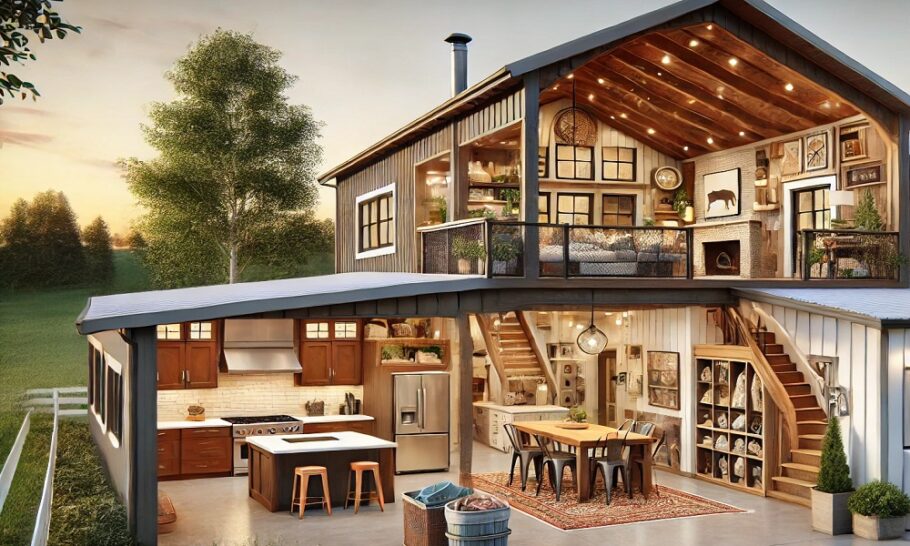
The barndominium has shed its novelty status and planted itself firmly in the mainstream of American housing. And for good reason. These steel-and-beam structures offer wide-open floor plans, industrial charm, and a cost-effective path to homeownership. But here is where many barndo owners hit a wall—literally. The same soaring ceilings and expansive layouts that feel so liberating can quickly become a lesson in wasted square footage if not handled with intention.
Walk into a poorly planned barndominium and the problems reveal themselves fast. Corners that serve no purpose. Walls that stop ten feet short of the ceiling. Loft areas that collect dust instead of serving the household. The good news? None of these issues require a second mortgage or a full renovation to fix. What they require is a shift in thinking—moving away from traditional residential storage solutions and toward strategies designed for barn-scale living.
The Vertical Opportunity Most People Ignore
Standard homes train people to think horizontally. Cabinets go on walls. Dressers go on floors. Closets fit between standard eight-foot ceilings. A barndominium throws those rules out entirely. With ceiling heights often reaching fourteen, sixteen, or even twenty feet, the air itself becomes usable real estate.
Floor-to-ceiling shelving units transform dead vertical space into a storage powerhouse. Think beyond basic bookcases. Custom-built units with varied depths accommodate everything from bulk paper goods to seasonal gear. The key lies in accessibility. Top shelves work perfectly for items used once or twice a year—holiday decorations, camping equipment, off-season wardrobes. Lower shelves handle daily needs. A rolling library ladder makes every inch reachable without turning the home into a cluttered maze.
Mezzanines deserve serious consideration during the design phase. A partial second floor built along one wall creates an entirely new room without expanding the building’s footprint. Use it as a home office, a guest sleeping area, or a dedicated craft space. The area underneath becomes prime real estate for closets, a laundry room, or a pantry. This two-for-one approach doubles function from a single structural decision.
Hidden Storage That Disappears Into the Architecture
The most effective storage in a barndominium is the kind nobody notices. Built-in solutions that blend with the building’s character preserve the open, airy feel while providing massive holding capacity.
Consider the stairway to a loft. Each step can pull open as a drawer. The space beneath the staircase—often a dark, unused void—houses pull-out cabinets or a small desk nook. Window seats with hinged tops conceal bins of toys, linens, or pet supplies. A bench along the entry wall lifts to reveal shoe storage and umbrella stands.
Interior walls in barndominiums often lack traditional stud framing, which actually works in favor of creative storage. Sliding barn doors on tracks hide shallow pantries, media centers, or home command centers. Recessed niches between structural posts create perfect spots for wall beds, folding desks, or display shelving that sits flush with the wall surface.
Furniture That Earns Its Square Footage
Multi-functional furniture separates a well-designed barndominium from one that simply looks spacious. Every piece should pull at least double duty, ideally triple.
A kitchen island on locking casters rolls to wherever the work happens. Push it against the wall for maximum floor space during a party. Pull it to the center for food prep. Add drop-leaf ends that extend the surface for big cooking projects or collapse when not needed. Build drawers into both sides. Install open shelving on the ends for cookbooks.
Dining tables with built-in leaf storage eliminate the need for a separate buffet or sideboard. Benches with hinged seats store table linens and serving pieces right where they are needed. Coffee tables that lift to dining height serve as impromptu work surfaces or game tables. Ottomans with removable tops hold blankets, remote controls, and magazines while providing extra seating.
The bedroom demands particularly clever solutions. A captain’s bed with deep drawers underneath replaces a separate dresser entirely. Headboards with built-in nightstands, reading lights, and USB ports eliminate bedside tables. Wall-mounted folding desks give a place to pay bills or write letters, then tuck away to nothing.
Zones Without Walls
Open floor plans succeed or fail based on how well they define spaces without building partitions. Barndominiums feel enormous when zones flow naturally from one to another. They feel chaotic when every area bleeds into every other area.
Furniture placement does the heavy lifting here. A tall bookshelf turned perpendicular to the wall creates a visual boundary between living room and dining area without blocking light or airflow. A sofa with its back to the kitchen defines the conversation zone. A low console table behind the sofa gives a landing spot for drinks and remotes while maintaining sightlines across the whole space.
Area carpets anchor specific zones. A large rug under the dining table signals “this is where we eat.” Another rug in the living area says “this is where we relax.” The change in floor texture underfoot reinforces the mental transition from one activity to another.
Lighting seals the deal. Pendant lights over the kitchen island cast a different quality of light than floor lamps in the seating area. Track lighting aimed at artwork changes the mood from functional to atmospheric. Dimmer switches on everything allow each zone to transform throughout the day.
The Kitchen: Where Storage Density Meets Daily Life
Barndominium kitchens often sprawl across one end of the great room. The temptation is to spread everything out—giant islands, massive refrigerators, endless counter runs. Resist it. A tightly organized kitchen actually performs better than a scattered one.
Pull-out pantry systems turn shallow wall depth into serious storage. A twelve-inch-deep cabinet with full-extension slides holds as many canned goods as a standard pantry twice its depth. Corner cabinets with rotating lazy Susans or swing-out shelves eliminate dead space. Drawers inside drawers—a shallow top tray for utensils over a deep bottom section for pots—double capacity in the same footprint.
Magnetic strips on the backsplash hold knives and metal spice tins. Pegboards on cabinet doors keep measuring cups and small tools visible and reachable. Under-cabinet racks for wine glasses free up shelf space above. The goal is to make every square inch work without requiring a search party to find the can opener.
Appliance garages with roll-up doors hide stand mixers, blenders, and coffee makers while keeping them plugged in and ready. When the counter needs to be clear for meal prep, the doors close and the visual clutter disappears.
Loft Spaces That Actually Get Used
The loft is the barndominium’s most misunderstood feature. Too many become dumping grounds for overflow junk—holiday decorations, old furniture, boxes of who-knows-what. A proper loft serves the household every single day.
Design lofts with specific purposes in mind. A narrow loft accessed by a ship’s ladder works beautifully as a library. Floor-to-ceiling bookcases line the walls. A single armchair and a good reading lamp turn it into a retreat. The space below the loft houses a desk or a small sitting area.
Wider lofts accommodate sleeping quarters for guests. A murphy bed folds against the wall when not in use, leaving floor space for yoga or a play area. Built-in drawers along the knee walls store bedding and clothing without bulky dressers taking up precious square footage.
The key to usable lofts is headroom and access. No one wants to crawl on hands and knees. Keep the finished floor at least five feet below the roof peak. Install permanent stairs instead of a ladder whenever possible—spiral stairs take surprisingly little floor space while feeling like intentional design rather than an afterthought.
Making Every Door and Drawer Count
The hardware and mechanics of storage matter just as much as the spaces themselves. Cheap drawer slides that stick halfway open discourage use. Flimsy cabinet hinges that sag turn frustration into avoidance.
Full-extension drawer slides allow access to every inch of depth. Soft-close mechanisms prevent slamming and extend the life of the hardware. Pull-out trash and recycling bins keep waste hidden while making disposal effortless. Vertical dividers inside deep drawers organize baking sheets, cutting boards, and serving platters so they don’t become a jumbled pile.
Pocket doors slide into the wall cavity instead of swinging into the room. This single choice saves several square feet in tight areas like bathrooms, pantries, and laundry rooms. Sliding barn doors on exterior tracks serve the same purpose while adding architectural interest.
The Laundry and Utility Zone
Barndominiums handle laundry differently than traditional homes. The machines often sit in a closet off the main living area or at the end of a hallway. Without careful planning, this space becomes a bottleneck of baskets, bottles, and unfolded chaos.
Stackable washer-dryer units free up floor space for a folding table or hanging rod. Cabinets above the machines store detergents and supplies within arm’s reach. A pull-out hamper cabinet hides dirty clothes until wash day. Retractable clotheslines stretch across the room for delicates that shouldn’t see the dryer’s heat.
The back of the utility closet door holds a hanging organizer for lint rollers, stain sticks, and mesh laundry bags. A small ironing board mounted on the wall folds down when needed and disappears when finished.
Seasonal Rotation as a Storage Strategy
No amount of clever design can overcome the basic math of too much stuff. The most effective space-maximizing technique costs nothing but a bit of time. Seasonal rotation.
Winter gear—heavy coats, snow boots, wool blankets—takes up three times the space of summer items. Swap them twice a year. Winter gear goes into labeled bins stored up high or in less accessible spots. Summer gear moves to prime locations. The household interacts with only the items needed for the current season.
This rotation applies to sports equipment, hobby supplies, and even kitchen appliances. The bread machine comes forward in autumn when baking season begins. The ice cream maker takes its turn when summer returns. Everything else lives in deep storage until its season arrives.
Making Peace with the Open Floor Plan
The barndominium’s greatest strength is also its greatest challenge. Open space feels luxurious but eats efficiency. The solution isn’t to fill every corner with furniture or to build walls that defeat the purpose. The solution is intentional emptiness.
Leave some walls completely bare. Keep some floor space completely open. These voids are not wasted—they are the visual breathing room that makes barndominiums special. The storage that exists should be so well-organized, so beautifully integrated, that the empty spaces feel like a choice rather than a limitation.
A successful barndominium tells a story of thoughtful living. Every shelf has a purpose. Every drawer opens to order. Every piece of furniture earns its place. The soaring ceilings and exposed beams still impress guests, but the real magic happens in the details—the pull-out pantry, the window seat with hidden storage, the loft library accessible by rolling ladder. That is maximizing space. Not cramming more in, but making every inch work so the rest can breathe.