
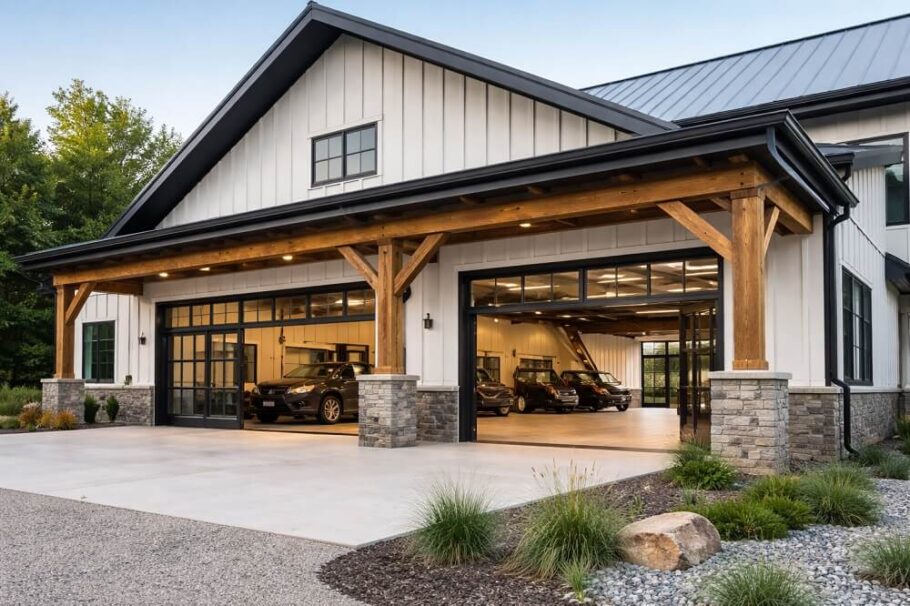
The barndominium has shed its rustic, backwoods reputation. What began as a cost-effective way to convert a metal barn into livable quarters has rapidly matured into one of the most intriguing movements in residential architecture. But the conversation has shifted from stained concrete floors and exposed fastener panels. The real question now is not whether barndominiums can look like traditional homes—they already do. The question is how these hybrid structures will evolve over the next decade through smart home ecosystems and advanced engineering.
Step onto any build site today, and the changes are visible before the first post is set. The future of barndominium design is no longer about mimicking farmhouse chic. It is about leveraging the inherent advantages of post-frame construction to create homes that are structurally superior, technologically seamless, and genuinely future-proof.
The Structural Canvas: Why Barndominiums Are Ideal for Innovation
To understand where barndominiums are headed, look first at what makes them different from stick-frame houses. The typical barndominium uses rigid steel or laminated wood columns spaced eight to twelve feet apart, with girts and purlins forming the envelope. That spacing creates something conventional framing cannot: vast, uninterrupted cavities within the walls and ceilings. Those cavities become the nervous system of the smart home.
Advanced engineering is already exploiting this hidden real estate. Instead of forcing sensors, wiring, and conduit through drilled studs or surface-mounted raceways, designers can plan entire home automation networks within the six-inch void between the exterior metal and interior finish. Conduits for low-voltage lighting, Cat8 ethernet, fiber optics, and centralized control hubs run horizontally and vertically without interference. The result is a home where smart features appear almost invisible because the structure was engineered to host them from the start.
New building techniques are also addressing the old weaknesses. Historically, barndominiums struggled with thermal bridging through steel framing. That problem has effectively been solved through continuous insulation systems and thermal break materials applied directly to the flange of every column. These aren’t retrofits or afterthoughts. They are engineered assemblies that double as mounting surfaces for smart sensors, eliminating the need to drill into the thermal envelope.
Smart Systems Designed for Large-Volume Spaces
Open floor plans are the soul of the barndominium. The absence of load-bearing interior walls creates soaring great rooms and uninterrupted living areas. But open volumes present unique challenges for climate control, lighting, and audio distribution. Standard residential smart systems often fail in spaces with ceiling heights over fourteen feet or square footage exceeding eight hundred square feet without partitions.
The next wave of barndominium-specific smart technology solves this directly. Multi-zone HVAC dampers controlled by distributed temperature sensors can now maintain consistent comfort in a two-story great room without cooking the adjacent bedrooms. These systems learn occupancy patterns and adjust air mixing rates based on real-time data from motion and CO2 sensors placed in the column cavities. No more drafts, no more hot zones near the clerestory windows.
Lighting control has also matured beyond simple dimmers. Future barndominiums will use tunable white LED strips integrated into the purlin channels, providing indirect illumination that highlights the structure’s rhythm while eliminating glare. These fixtures connect to daylight harvesting systems that measure incoming light through the building’s existing windows and adjust color temperature from cool morning tones to warm evening spectrums. The engineering challenge was always heat dissipation inside enclosed steel channels. New low-profile, high-efficacy LEDs paired with passive convection paths solved that without adding active cooling.
Engineering the Envelope for Sensor Density
A smart home is only as reliable as its network. Barndominiums, with their metal skins, have historically been brutal on wireless signals. Steel siding acts as a Faraday cage, blocking cellular, Wi-Fi, and Zigbee frequencies. Early adopters had to install external antennas or suffer dead zones in half the house. That era is ending.
Advanced engineering now treats the metal envelope not as an obstacle but as a controlled boundary. Pre-planned waveguide apertures—carefully sized gaps around windows, doors, and ridge vents—allow specific frequencies to pass while maintaining structural integrity. Inside, mesh networks no longer rely on a single router screaming through the walls. Instead, low-profile access points mount directly to the interior face of steel girts, with backhaul connections running through the sealed cavities. The metal envelope actually improves performance by blocking interference from neighboring properties, creating a private, noise-free spectrum for the home’s critical systems.
This same principle applies to security and environmental sensors. Vibration sensors attached to the primary columns can detect the difference between a wind event, a raccoon on the roof, and an attempted door breach. The steel structure becomes the sensor array itself. Strain gauges embedded in critical connections can even alert homeowners to foundation movement, snow load accumulation, or shifting soil conditions before any visible damage occurs. That is not a futuristic concept. These systems are already specified in premium barndominium packages, and costs are falling rapidly.
Energy Independence Through Structural Integration
The barndominium’s large, unbroken roof plane has always been an obvious place for solar panels. But early installations treated panels as an add-on, bolted through the standing seams with clamps that compromised the weather barrier. The next generation embeds photovoltaics directly into the engineering of the roof.
Structural standing seam roofs are now available with integrated solar laminates that replace conventional panel coatings. These systems generate power across the entire roof surface, not just in discrete rectangles. The electrical collection runs inside the purlins to a central inverter that fits flush within the wall cavity. No conduit on the surface. No boxes protruding from the ceiling. The house generates electricity as a fundamental property of its skin, not as an accessory.
Battery storage follows the same logic. Instead of parking a bulky unit in the garage or against an exterior wall, engineers are designing column bays specifically sized for modular lithium-iron-phosphate batteries. These bays include factory-installed thermal management, fire suppression ports, and quick-disconnect wiring. The batteries become invisible components of the structural grid, balanced across the building to maintain even load distribution. A barndominium with forty feet of column spacing might host four or five such bays without losing a single square foot of living space.
Climate Adaptation and Disaster Resilience
Smart features are compelling, but they mean nothing if the building fails in a storm. Barndominiums already have a reputation for wind resistance, but advanced engineering is taking that further. New connection details between the roof purlins and the rigid frames use slotted bolts with friction damping. Under high wind loads, these connections allow micro-movements that dissipate energy without yielding. The building flexes, absorbs, and returns to true. Coupled with real-time wind sensors on the ridge, the smart system can automatically pressurize the building during a tornado warning to resist blow-off, or depressurize during a wildfire to starve embers of oxygen.
Flood resistance is also being engineered into the slab and foundation interface. Traditional barndominiums often used a monolithic slab with perimeter footings. Newer designs incorporate a raised stem wall with flood vents and backflow prevention that communicates with upstream water level sensors. If a flash flood is detected ten miles away, the system closes the vents and engages a sump network powered by the building’s battery bank. The same sensors that manage water also monitor humidity inside the column cavities, triggering exhaust fans before condensation can lead to corrosion or mold.
The Human Interface: Control Without Complexity
All this technology creates a risk of overwhelming the occupant. No one wants to manage a dashboard with eighty-seven sensors and a dozen automation routines. The future of barndominium design recognizes that good engineering hides complexity. Interfaces are moving toward natural language and predictive behavior.
Instead of toggling thermostats and light scenes, future owners will interact with their homes through simple commands or, better yet, no commands at all. The building learns from daily rhythms. It knows that the east-facing workshop gets hot by 10 AM and pre-cools that zone. It knows that the metal roof will ping and contract during a temperature drop and reassures the occupant with a notification that says, “Normal thermal movement detected—no action needed.” The difference between a smart home and an anxious home is the quality of its alerts.
Voice control is being embedded into the structural finish materials themselves. Microphone arrays small enough to fit behind drywall or paneling are standard in new builds, with acoustic channels engineered into the girts to prevent echo in large rooms. Speakers are likewise invisible, using the rigid steel panels as diaphragms to produce clear, distributed sound without visible grilles or towers.
Looking Ahead: Five Years Out
The barndominium of 2030 will not look radically different from the outside. The classic gambrel roof, the vertical ribbed siding, the sliding barn doors—these aesthetic elements have proven their staying power. What will change is what lives inside the walls and beneath the slab.
Expect to see phase-change materials embedded in the insulation layers, absorbing excess heat during the day and releasing it at night, all managed by a predictive algorithm tied to weather forecasts. Expect to see self-dimming electrochromic glass in those sliding doors, triggered by the same sensors that control the LED lighting. Expect to see robotic maintenance crawlers that travel inside the purlin channels, checking for loose connections and cleaning dust from sensor lenses.
Most importantly, expect the cost of these features to follow the same curve as every other technology: steep decline followed by broad adoption. What seems like luxury engineering today will be standard in five years. The builders who understand how to integrate smart systems and advanced structural techniques now will be the ones defining the market tomorrow.
The Quiet Revolution
The barndominium never needed to apologize for its origins. The form has always been pragmatic, honest, and resilient. What the next decade adds is a layer of invisible intelligence that makes those qualities even more powerful. No more compromise between country living and modern convenience. No more choosing between a metal building and a smart building. The engineering is already solved. The sensors are already small enough. The software is already capable.
What remains is the will to build differently. To stop thinking of the barndominium as a simple barn with a bathroom and start seeing it as the ideal platform for the home of the future. The roof is large, the walls are strong, the cavities are deep, and the possibilities are finally being realized. That is not just progress. That is a revolution, and it is happening inside a steel building with a wraparound porch and a very smart nervous system.