
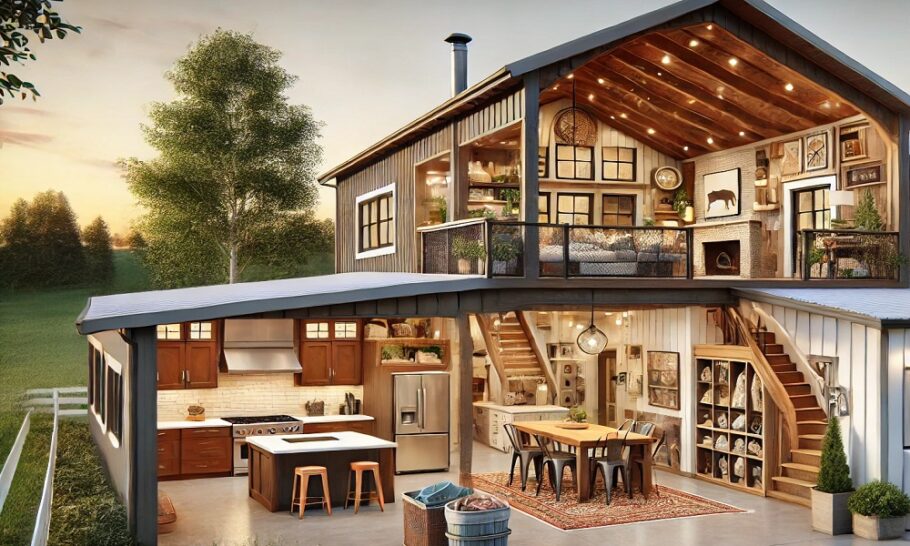
There was a time when barndominiums were strictly about practicality. Metal shells, open floor plans, maybe a concrete floor that didn’t mind muddy boots. But that era has passed. Today’s barndominium owners are asking a different question: why can’t a building that started as agricultural storage also hold a thousand bottles of vintage Bordeaux or a THX-certified screening room?
The answer, it turns out, is that barndominiums might be better suited for these luxury additions than traditional homes ever were.
The Unexpected Advantages of Post-Frame Construction
Steel framing and spray foam insulation change the conversation entirely. A standard stick-built home fights temperature swings with wood that expands and contracts, with wall cavities that leak air no matter how carefully the contractor installed the vapor barrier. Barndominiums, by contrast, offer something rare: a thermally broken envelope that actually holds steady.
For wine storage, this matters more than almost anything else. A wine cellar isn’t just a dark room with racks. It’s a climate-controlled environment that must stay between 55 and 58 degrees Fahrenheit year-round, with humidity locked at 60 to 70 percent. Most homes require extensive retrofitting to achieve this. Barndominiums, with their continuous insulation and minimal thermal bridging, start from a better place. The same metal skin that keeps summer heat out also holds winter cold at bay, meaning less work for the cooling system and fewer worries about temperature spikes during a power outage.
Home theaters benefit from a different kind of advantage. The open spans of post-frame construction mean no load-bearing walls in inconvenient places. No columns blocking the perfect spot for the center channel speaker. No ceiling joists dictating where the projector mount must go. A barndominium theater can take whatever shape works best for the acoustics, not whatever shape the floor plan forced upon it.
Designing the Wine Cellar That Matches the Barn Aesthetic
Here is where things get interesting. A traditional wine cellar in a suburban basement often tries too hard. Stone veneer. Faux torches. Something that looks like a medieval dungeon but feels like a themed restaurant. Barndominium wine cellars avoid this trap because the surrounding architecture already provides honest materials.
Corten steel wine racks. Reclaimed barn wood for the tasting table. Concrete floors are polished until they gleam like dark water. These choices don’t fight the barndominium’s character. They amplify it. The cellar becomes an extension of the same thinking that went into the main living space, just refined for a specific purpose.
Lighting deserves serious attention here. Wine hates UV radiation. Standard recessed cans or track lighting will degrade even the most carefully stored bottles over time. The solution involves LED strips tucked into the racking system itself, casting soft upward light that illuminates labels without touching the glass directly. Motion sensors keep lights off when nobody is present, because every minute of exposure adds up across decades of storage.
The door presents a common challenge. Glass looks beautiful but performs terribly. A solid wood door with weatherstripping on all four sides and a threshold seal underneath provides the necessary barrier. Some owners opt for insulated barn doors on industrial tracks, which pairs perfectly with the overall aesthetic while delivering R-values that standard hinged doors cannot match.
Climate Control Systems Worth Installing
Cheap through-wall units belong in garages, not wine cellars. A proper cellar requires a split-system cooling unit designed specifically for wine storage. These units differ from standard air conditioners in critical ways. They remove less humidity, because wine corks need moisture to stay swollen and airtight. They cycle more frequently at lower output levels, avoiding the big temperature swings that damage wine over time. And they dump heat into a separate space, not back into the same room.
Placement matters enormously. The evaporator unit goes high on one wall. The condensing unit goes outside or in a well-ventilated mechanical room. Short refrigerant lines mean better efficiency. Many barndominium owners tuck the condenser into the same utility closet as the HVAC system for the main living space, which keeps maintenance simple and noise out of the cellar itself.
Backup systems separate serious collectors from casual enthusiasts. A secondary cooling unit that kicks in only when temperatures drift beyond safe parameters costs money upfront but saves collections worth many times that investment. Remote monitoring with text alerts provides the same peace of mind. Nobody wants to discover a failed cooling system three weeks after it happened, when the cellar has been sitting at 78 degrees the entire time.
Home Theater Design Within Metal Walls
The same steel framing that makes barndominiums strong also makes them acoustically challenging. Metal reflects sound like a drumhead. Without treatment, a theater space turns into an echo chamber where dialogue becomes unintelligible and bass notes linger for seconds longer than they should.
Solving this requires layered thinking. Acoustic insulation between the interior finish and the metal skin stops sound from traveling through the walls. Double layers of drywall with green glue compound in between add mass, which blocks transmission. And then the room itself needs absorption and diffusion to control what happens inside the space.
Fabric-wrapped acoustic panels remain the standard solution, but barndominium theaters can do better. Perforated wood slats over acoustic backing provide absorption while maintaining visual warmth. Baffles hanging from the ceiling break up standing waves without requiring permanent changes to the structure. Carpet or area rugs tame floor reflections. By the time these elements come together, the metal shell stops being a problem and starts being irrelevant.
Seating arrangement follows different rules than living room furniture placement. Multiple rows require risers, which barndominium floors accommodate easily because the slab is already there. A two-row setup with the front row at floor level and the back row raised twelve to eighteen inches gives everyone a clear view. The projector goes at the back of the room, typically on a shelf mounted to the wall or ceiling. The screen goes on the front wall, sized so the viewing angle falls between 30 and 40 degrees from the furthest seat.
Integrating the Two Spaces
A wine cellar and a home theater do not naturally belong together. One wants constant temperature and absolute stillness. The other generates heat from amplifiers, projectors, and body warmth. One needs humidity. The other benefits from dry air that keeps electronics happy.
Yet barndominiums offer a solution that standard homes cannot replicate. The same mechanical room that serves the theater can also condition the wine cellar, provided the systems are separate. A small equipment closet adjacent to both spaces keeps duct runs short and maintenance centralized. The theater’s heat output, properly managed with its own dedicated cooling, never touches the cellar.
Location within the floor plan matters. The wine cellar needs a spot below grade if possible, or at least on the north side of the building. The theater wants darkness, which means no windows and ideally no exterior doors. Putting the theater in the center of the barndominium and the cellar along an exterior wall on the north side makes efficient use of the space while meeting both sets of requirements.
Budget Realities Worth Facing
Luxury costs money. There is no way around this. A proper wine cellar with commercial-grade cooling, custom racking, and professional installation runs from fifteen to thirty thousand dollars for a space holding five hundred bottles. Double that for a thousand-bottle collection with a tasting area and humidity control.
Home theaters vary more widely. A simple setup with a 4K projector, electric screen, surround sound, and basic acoustic treatment might land at ten thousand dollars. A dedicated room with stadium seating, soundproofing, room correction, and a 120-inch screen can exceed fifty thousand without much effort.
The smart approach prioritizes infrastructure first. Run conduit for speaker wires before the drywall goes up. Add dedicated electrical circuits for amplifiers and projectors. Install extra insulation in the theater walls even if the acoustic treatments come later. For the wine cellar, stub out the drain line for the cooling unit and pour the floor with a slight slope toward that drain. These moves cost little during construction but become expensive nightmares afterward.
The Final Judgment
Barndominiums started as a solution to a simple problem: affordable housing on rural land. But the form has evolved. What began as pragmatism has become a canvas for genuinely interesting design choices. A wine cellar that honors agricultural roots while protecting priceless bottles. A home theater that rivals commercial venues while sitting inside a building that looks like a barn from the outside.
These additions do not feel like contradictions. They feel like logical extensions. The same building envelope that keeps hay dry also keeps wine stable. The same open spans that once held tractors now hold theater seating. Luxury, in this context, means something different than marble countertops and gold fixtures. It means spaces that work exactly as intended, without compromise, inside a shell that never pretends to be something it is not.
For anyone building a barndominium today, the question should not be whether to include a wine cellar or home theater. The question should be which one comes first. Because the answer, for more owners every year, is both.